


Multivariate searchlight classification of structural magnetic resonance imaging in children and adolescents with autism
- PMID: 21890111
- PMCID: PMC3191298
- DOI: 10.1016/j.biopsych.2011.07.014
Multivariate searchlight classification of structural magnetic resonance imaging in children and adolescents with autism
Abstract
Background: Autism spectrum disorders (ASD) are neurodevelopmental disorders with a prevalence of nearly 1:100. Structural imaging studies point to disruptions in multiple brain areas, yet the precise neuroanatomical nature of these disruptions remains unclear. Characterization of brain structural differences in children with ASD is critical for development of biomarkers that may eventually be used to improve diagnosis and monitor response to treatment.
Methods: We use voxel-based morphometry along with a novel multivariate pattern analysis approach and searchlight algorithm to classify structural magnetic resonance imaging data acquired from 24 children and adolescents with autism and 24 age-, gender-, and IQ-matched neurotypical participants.
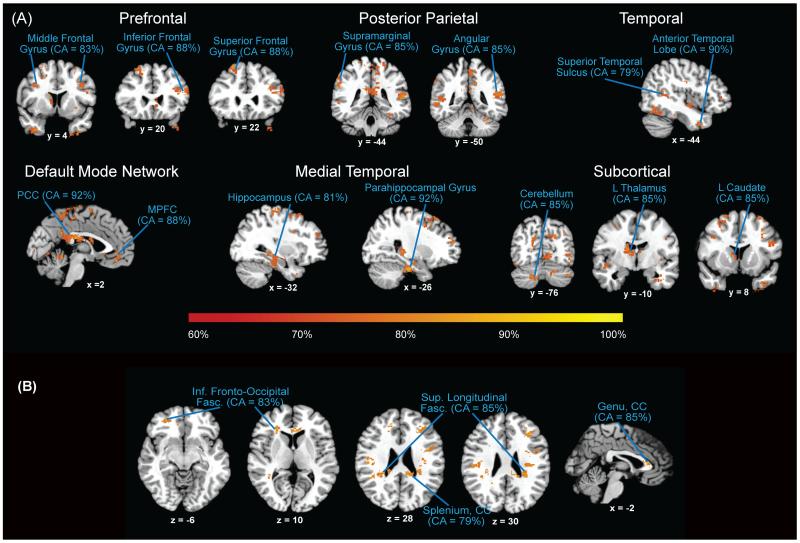
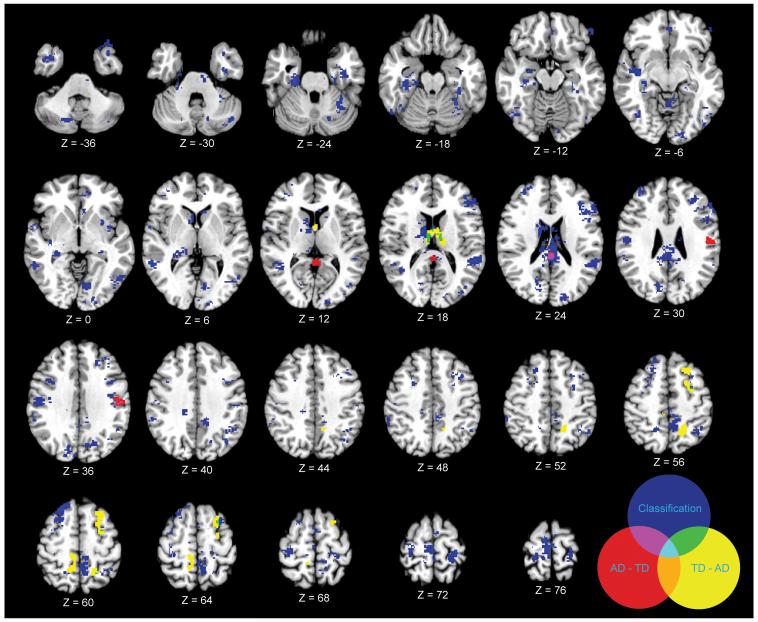
Results: Despite modest voxel-based morphometry differences, multivariate pattern analysis revealed that the groups could be distinguished with accuracies of approximately 90% based on gray matter in the posterior cingulate cortex, medial prefrontal cortex, and bilateral medial temporal lobes-regions within the default mode network. Abnormalities in the posterior cingulate cortex were associated with impaired Autism Diagnostic Interview communication scores. Gray matter in additional prefrontal, lateral temporal, and subcortical structures also discriminated between groups with accuracies between 81% and 90%. White matter in the inferior fronto-occipital and superior longitudinal fasciculi, and the genu and splenium of the corpus callosum, achieved up to 85% classification accuracy.
Conclusions: Multiple brain regions, including those belonging to the default mode network, exhibit aberrant structural organization in children with autism. Brain-based biomarkers derived from structural magnetic resonance imaging data may contribute to identification of the neuroanatomical basis of symptom heterogeneity and to the development of targeted early interventions.
Copyright © 2011 Society of Biological Psychiatry. Published by Elsevier Inc. All rights reserved.
Figures

Similar articles
-
Decreased interhemispheric functional connectivity rather than corpus callosum volume as a potential biomarker for autism spectrum disorder.Cortex. 2019 Oct;119:258-266. doi: 10.1016/j.cortex.2019.05.003. Epub 2019 May 15. Cortex. 2019. PMID: 31167156
-
Gray and white matter imbalance--typical structural abnormality underlying classic autism?Brain Dev. 2008 Jun;30(6):396-401. doi: 10.1016/j.braindev.2007.11.006. Epub 2008 Mar 24. Brain Dev. 2008. PMID: 18362056
-
Brain growth rate abnormalities visualized in adolescents with autism.Hum Brain Mapp. 2013 Feb;34(2):425-36. doi: 10.1002/hbm.21441. Epub 2011 Oct 20. Hum Brain Mapp. 2013. PMID: 22021093 Free PMC article.
-
Comparative meta-analyses of brain structural and functional abnormalities during cognitive control in attention-deficit/hyperactivity disorder and autism spectrum disorder.Psychol Med. 2020 Apr;50(6):894-919. doi: 10.1017/S0033291720000574. Epub 2020 Mar 27. Psychol Med. 2020. PMID: 32216846 Free PMC article.
-
Systematic review and meta-analysis: multimodal functional and anatomical neural alterations in autism spectrum disorder.Mol Autism. 2024 Apr 4;15(1):16. doi: 10.1186/s13229-024-00593-6. Mol Autism. 2024. PMID: 38576034 Free PMC article.
Cited by
-
Gray matter volume abnormalities in depressive patients with and without anxiety disorders.Medicine (Baltimore). 2014 Dec;93(29):e345. doi: 10.1097/MD.0000000000000345. Medicine (Baltimore). 2014. PMID: 25546687 Free PMC article.
-
Disrupted dynamic network reconfiguration of the brain functional networks of individuals with autism spectrum disorder.Brain Commun. 2022 Aug 1;4(4):fcac177. doi: 10.1093/braincomms/fcac177. eCollection 2022. Brain Commun. 2022. PMID: 35950094 Free PMC article.
-
Brain imaging-based machine learning in autism spectrum disorder: methods and applications.J Neurosci Methods. 2021 Sep 1;361:109271. doi: 10.1016/j.jneumeth.2021.109271. Epub 2021 Jun 24. J Neurosci Methods. 2021. PMID: 34174282 Free PMC article. Review.
-
Progress and roadblocks in the search for brain-based biomarkers of autism and attention-deficit/hyperactivity disorder.Transl Psychiatry. 2017 Aug 22;7(8):e1218. doi: 10.1038/tp.2017.164. Transl Psychiatry. 2017. PMID: 28892073 Free PMC article. Review.
-
Region-Specific Brain Volume Changes Emerge in Adolescence in the Valproic Acid Model of Autism and Parallel Human Findings.Dev Neurosci. 2025;47(1):68-80. doi: 10.1159/000538932. Epub 2024 Apr 26. Dev Neurosci. 2025. PMID: 38679020 Free PMC article.
References
-
- Lord C, Risi S, Lambrecht L, Cook EH, Jr., Leventhal BL, DiLavore PC, et al. The autism diagnostic observation schedule-generic: a standard measure of social and communication deficits associated with the spectrum of autism. J Autism Dev Disord. 2000;30:205–223. - PubMed
-
- Lord C, Rutter M, Le Couteur A. Autism Diagnostic Interview-Revised: a revised version of a diagnostic interview for caregivers of individuals with possible pervasive developmental disorders. J Autism Dev Disord. 1994;24:659–685. - PubMed
Publication types
MeSH terms
Grants and funding
- MH084164/MH/NIMH NIH HHS/United States
- K01MH092288/MH/NIMH NIH HHS/United States
- R01 MH084164/MH/NIMH NIH HHS/United States
- HD059205/HD/NICHD NIH HHS/United States
- DC0111095/DC/NIDCD NIH HHS/United States
- HD047520/HD/NICHD NIH HHS/United States
- K23 MH064027/MH/NIMH NIH HHS/United States
- R01 HD059205/HD/NICHD NIH HHS/United States
- R01 NS033355/NS/NINDS NIH HHS/United States
- U19 HD035469/HD/NICHD NIH HHS/United States
- R01 HD047520/HD/NICHD NIH HHS/United States
- HD055748/HD/NICHD NIH HHS/United States
- K01 MH092288/MH/NIMH NIH HHS/United States
- HD 35469/HD/NICHD NIH HHS/United States
- P01 HD035469/HD/NICHD NIH HHS/United States
- MH64027/MH/NIMH NIH HHS/United States
LinkOut - more resources
Full Text Sources
Medical
