


A valid mouse model of AGRIN-associated congenital myasthenic syndrome
- PMID: 21890498
- PMCID: PMC3209832
- DOI: 10.1093/hmg/ddr396
A valid mouse model of AGRIN-associated congenital myasthenic syndrome
Abstract
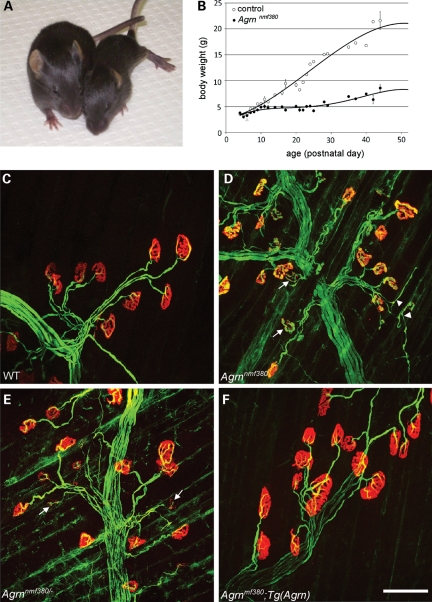
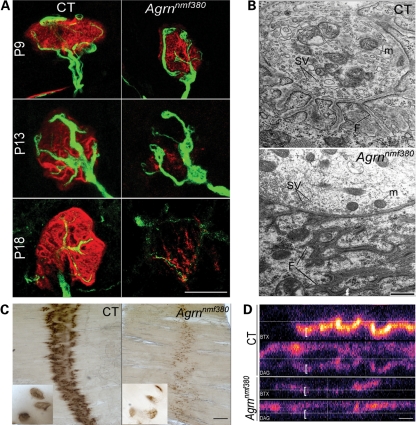
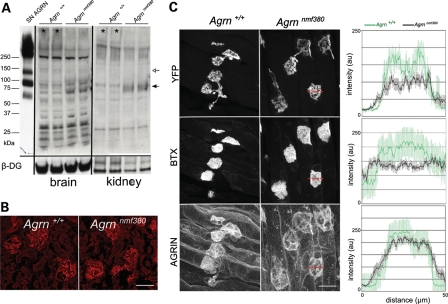
Congenital myasthenic syndromes (CMS) are inherited diseases affecting the neuromuscular junction (NMJ). Mutations in AGRIN (AGRN) and other genes in the AGRIN signaling pathway cause CMS, and gene targeting studies in mice confirm the importance of this pathway for NMJ formation. However, these mouse mutations are complete loss-of-function alleles that result in an embryonic failure of NMJ formation, and homozygous mice do not survive postpartum. Therefore, mouse models of AGRIN-related CMS that would allow preclinical testing or studies of postnatal disease progression are lacking. Using chemical mutagenesis in mice, we identified a point mutation in Agrn that results in a partial loss-of-function allele, creating a valid model of CMS. The mutation changes phenylalanine 1061 to serine in the SEA domain of AGRIN, a poorly characterized motif shared by other extracellular proteoglycans. NMJs in homozygous mice progressively degrade postnataly. Severity differs with genetic background, in different muscles, and in different regions within a muscle in a pattern matching mouse models of motor neuron disease. Mutant NMJs have decreased acetylcholine receptor density and an increased subsynaptic reticulum, evident by electron microscopy. Synapses eventually denervate and the muscles atrophy. Molecularly, several factors contribute to the partial loss of AGRIN's function. The mutant protein is found at NMJs, but is processed differently than wild-type, with decreased glycosylation, changes in sensitivity to the protease neurotrypsin and other proteolysis, and less efficient externalization and secretion. Therefore, the Agrn point mutation is a model for CMS caused by Agrn mutations and potentially other related neuromuscular diseases.
Figures




References
-
- Engel A.G., Ohno K., Sine S.M. Chapter 66: Congenital Myasthenic Syndrome. In: Engel A.G., Franzini-Armstrong C., editors. Myology. 3rd edn. Vol. 2. New York: McGraw-Hill; 2004. pp. 1801–1854.
-
- Sanes J.R., Lichtman J.W. Development of the vertebrate neuromuscular junction. Ann. Rev. Neurosci. 1999;22:389–442. doi:10.1146/annurev.neuro.22.1.389. - DOI - PubMed
-
- Burden S.J. Building the vertebrate neuromuscular synapse. J. Neurobiol. 2002;53:501–511. doi:10.1002/neu.10137. - DOI - PubMed
-
- Kummer T.T., Misgeld T., Sanes J.R. Assembly of the postsynaptic membrane at the neuromuscular junction: paradigm lost. Curr. Opin. Neurobiol. 2006;16:74–82. doi:10.1016/j.conb.2005.12.003. - DOI - PubMed
-
- Nitkin R.M., Smith M.A., Magill C., Fallon J.R., Yao Y.M., Wallace B.G., McMahan U.J. Identification of agrin, a synaptic organizing protein from Torpedo electric organ. J. Cell Biol. 1987;105:2471–2478. doi:10.1083/jcb.105.6.2471. - DOI - PMC - PubMed
Publication types
MeSH terms
Substances
Grants and funding
LinkOut - more resources
Full Text Sources
Other Literature Sources
Molecular Biology Databases
Research Materials
