Review
. 2011 Dec;68(24):4045-64.
doi: 10.1007/s00018-011-0792-5. Epub 2011 Sep 4.

Emerging roles of the SUMO pathway in development

Affiliations
Review

Emerging roles of the SUMO pathway in development

Hilda Lomelí et al. Cell Mol Life Sci. 2011 Dec.

Abstract

Sumoylation is a reversible post-translational modification that targets a variety of proteins mainly within the nucleus, but also in the plasma membrane and cytoplasm of the cell. It controls diverse cellular mechanisms such as subcellular localization, protein-protein interactions, or transcription factor activity. In recent years, the use of several developmental model systems has unraveled many critical functions for the sumoylation system in the early life of diverse species. In particular, detailed analyses of mutant organisms in both the components of the SUMO pathway and their targets have established the importance of the SUMO system in early developmental processes, such as cell division, cell lineage commitment, specification, and/or differentiation. In addition, an increasing number of developmental proteins, including transcription factors and epigenetic regulators, have been identified as sumoylation substrates. Sumoylation acts on these targets through various mechanisms. For example, this modification has been involved in converting a transcription factor from an activator to a repressor or in regulating the localization and/or stability of numerous transcription factors. This review will summarize current information on the function of sumoylation in embryonic development in different species from yeast to mammals.


Figures
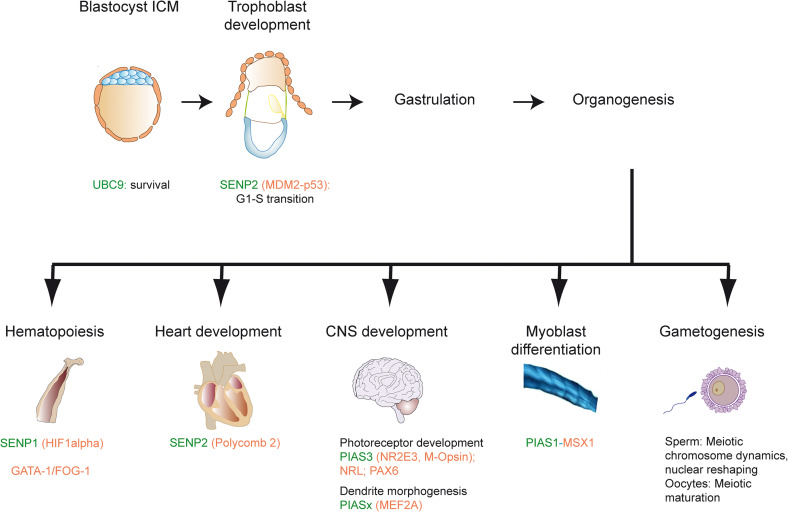
Fig. 1
Fig. 1
Components of the SUMO pathway (in green) participate at distinct steps of mouse embryonic development from pre-implantation to organogenesis and gametogenesis. In some cases, their specific targets have been identified and are indicated in parentheses (in orange). Additional developmental factors whose sumoylation seems to be involved in the indicated developmental process are listed (in orange). In some cases, PIAS proteins interact with developmental factors independently of sumoylation. For example, PIAS1-Msx1 interaction is important for in vitro myoblast differentiation, but sumoylation is not involved on their actions. SUMO1 and other sumoylation proteins have very significant expression patterns during spermatogenesis, oogenesis, and meiosis. Functional results obtained from yeast and Drosophila support the notion that SUMO-conjugation has a role in gametogenesis

References

    1. Bayer P, Arndt A, Metzger S, Mahajan R, Melchior F, Jaenicke R, Becker J. Structure determination of the small ubiquitin-related modifier SUMO-1. J Mol Biol. 1998;280(2):275–286. doi: 10.1006/jmbi.1998.1839. - DOI - PubMed
    1. Bernier-Villamor V, Sampson DA, Matunis MJ, Lima CD. Structural basis for E2-mediated SUMO conjugation revealed by a complex between ubiquitin-conjugating enzyme Ubc9 and RanGAP1. Cell. 2002;108(3):345–356. doi: 10.1016/S0092-8674(02)00630-X. - DOI - PubMed
    1. Mossessova E, Lima CD. Ulp1-SUMO crystal structure and genetic analysis reveal conserved interactions and a regulatory element essential for cell growth in yeast. Mol Cell. 2000;5(5):865–876. doi: 10.1016/S1097-2765(00)80326-3. - DOI - PubMed
    1. Desterro JM, Rodriguez MS, Kemp GD, Hay RT. Identification of the enzyme required for activation of the small ubiquitin-like protein SUMO-1. J Biol Chem. 1999;274(15):10618–10624. doi: 10.1074/jbc.274.15.10618. - DOI - PubMed
    1. Gong L, Li B, Millas S, Yeh ET. Molecular cloning and characterization of human AOS1 and UBA2, components of the sentrin-activating enzyme complex. FEBS Lett. 1999;448(1):185–189. doi: 10.1016/S0014-5793(99)00367-1. - DOI - PubMed

Publication types

MeSH terms

Substances

LinkOut - more resources
