


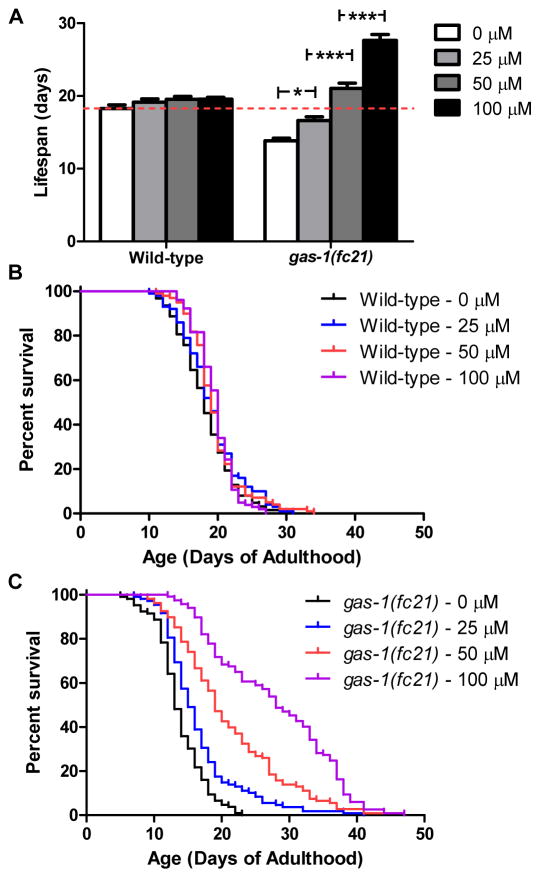
FUdR causes a twofold increase in the lifespan of the mitochondrial mutant gas-1
- PMID: 21893079
- PMCID: PMC4074524
- DOI: 10.1016/j.mad.2011.08.006
FUdR causes a twofold increase in the lifespan of the mitochondrial mutant gas-1
Abstract
The nematode worm Caenorhabditis elegans has been used to identify hundreds of genes that influence longevity and thereby demonstrate the strong influence of genetics on lifespan determination. In order to simplify lifespan studies in worms, many researchers have employed 5-fluoro-2'-deoxyuridine (FUdR) to inhibit the development of progeny. While FUdR has little impact on the lifespan of wild-type worms, we demonstrate that FUdR causes a dramatic, dose-dependent, twofold increase in the lifespan of the mitochondrial mutant gas-1. Thus, the concentration of FUdR employed in a lifespan study can determine whether a particular strain is long-lived or short-lived compared to wild-type.
Copyright © 2011 Elsevier Ireland Ltd. All rights reserved.
Figures
References
-
- Aitlhadj L, Sturzenbaum SR. The use of FUdR can cause prolonged longevity in mutant nematodes. Mechanisms of ageing and development. 2010;131:364–365. - PubMed
-
- Bluher M, Kahn BB, Kahn CR. Extended longevity in mice lacking the insulin receptor in adipose tissue. Science. 2003;299:572–574. - PubMed
-
- Fabrizio P, Pozza F, Pletcher SD, Gendron CM, Longo VD. Regulation of longevity and stress resistance by Sch9 in yeast. Science. 2001;292:288–290. - PubMed
Publication types
MeSH terms
Substances
Grants and funding
LinkOut - more resources
Full Text Sources
Miscellaneous
