Regulation of sodium transport in the proximal tubule by endothelin
- PMID: 21893989
- PMCID: PMC3987825
- DOI: 10.1159/000328684
Regulation of sodium transport in the proximal tubule by endothelin
Abstract
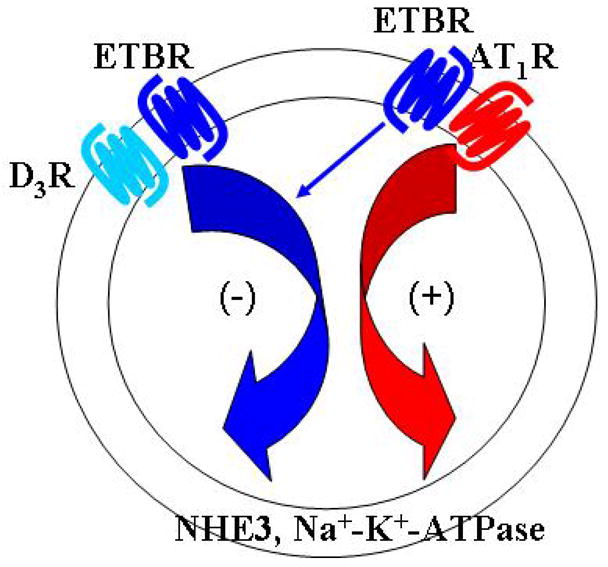
Human essential hypertension and rodent genetic hypertension are associated with increased sodium transport in the renal proximal tubule and medullary thick ascending limb of Henle. The proximal tubule, which secretes endothelin (ET), expresses the ET(B) receptor. Low (nM) concentrations of ET, via the ET(B) receptor, inhibit sodium and water transport and ATP-driven drug secretion in the proximal tubule. In contrast, very low (pM) and high nM concentrations of ET increase renal proximal sodium transport, but the receptor involved remains to be determined. The natriuretic effect of ET(B) receptor stimulation is impaired in spontaneously hypertensive rats, due in part to a defective interaction with D(3) dopamine and angiotensin II type 1 receptors. Impaired ET(B) receptor function in the renal proximal tubule may be important in the pathogenesis of genetic hypertension.
Copyright © 2011 S. Karger AG, Basel.
Figures
References
-
- Crowley SD, Coffman TM. In hypertension, the kidney rules. Curr Hypertens Rep. 2007;9:148–53. - PubMed
-
- Hall JE. The kidney, hypertension, and obesity. Hypertension. 2003;41:625–633. - PubMed
-
- Doris PA. Renal proximal tubule sodium transport and genetic mechanisms of essential hypertension. J Hypertens. 2000;18:509–19. - PubMed
-
- Yanagisawa M, Kurihara H, Kimura S, Tomobe Y, Kobayashi M, Mitsui Y, Yazaki Y, Goto K, Masaki T. A novel potent vasoconstrictor peptide produced by vascular endothelial cells. Nature. 1988;332:411–5. - PubMed
Publication types
MeSH terms
Substances
Grants and funding
LinkOut - more resources
Full Text Sources