Applying a New Model for Sharing Population Health Data to National Syndromic Influenza Surveillance: DiSTRIBuTE Project Proof of Concept, 2006 to 2009
- PMID: 21894257
- PMCID: PMC3148528
- DOI: 10.1371/currents.RRN1251
Applying a New Model for Sharing Population Health Data to National Syndromic Influenza Surveillance: DiSTRIBuTE Project Proof of Concept, 2006 to 2009
Abstract
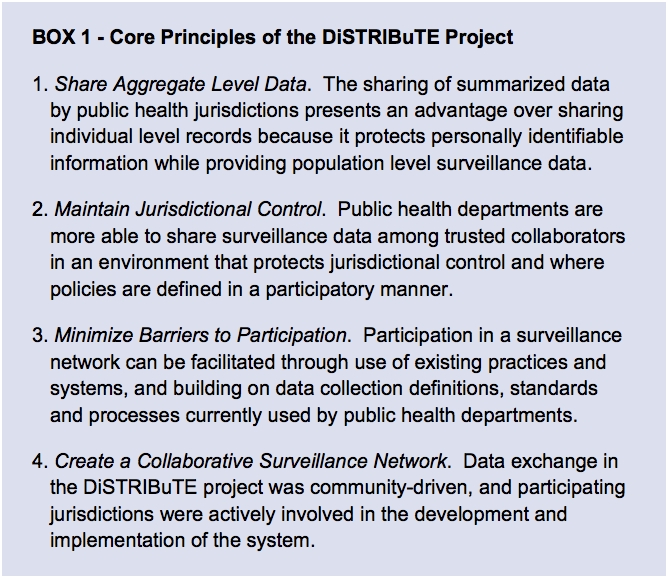
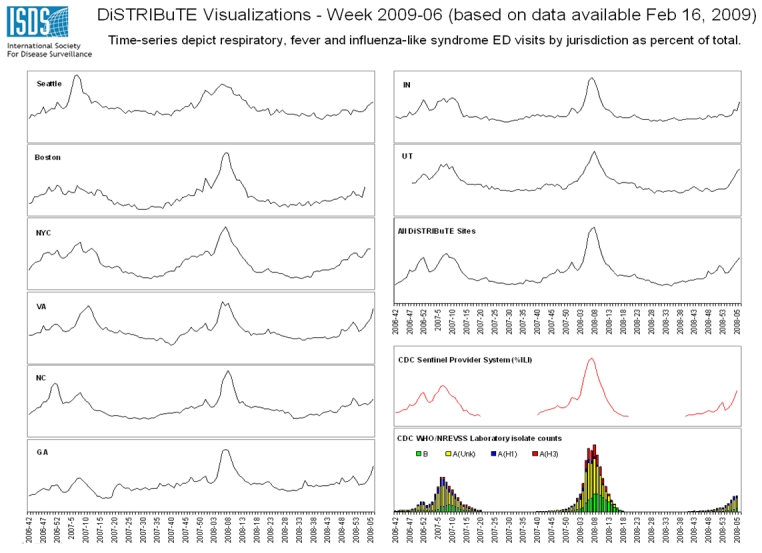
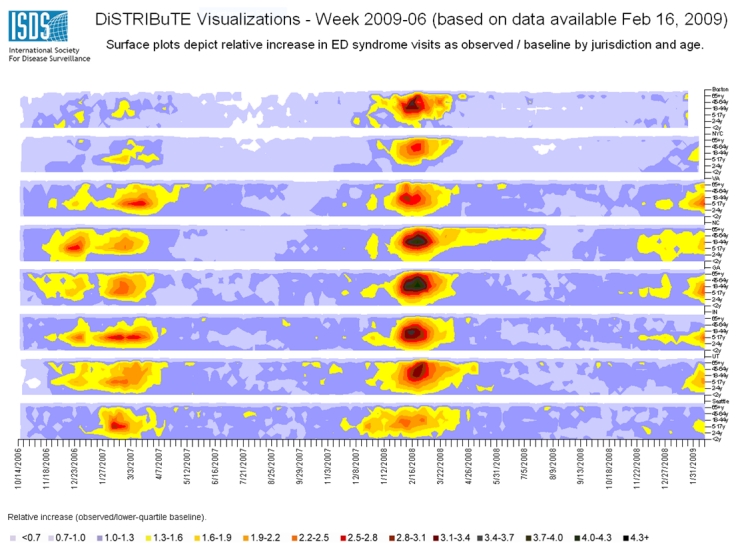
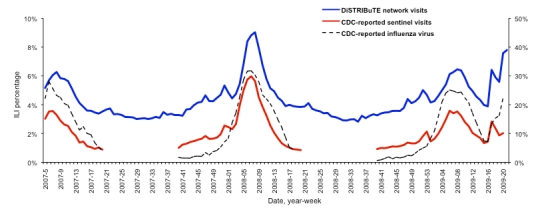
The Distributed Surveillance Taskforce for Real-time Influenza Burden Tracking and Evaluation (DiSTRIBuTE) project began as a pilot effort initiated by the International Society for Disease Surveillance (ISDS) in autumn 2006 to create a collaborative electronic emergency department (ED) syndromic influenza-like illness (ILI) surveillance network based on existing state and local systems and expertise. DiSTRIBuTE brought together health departments that were interested in: 1) sharing aggregate level data; 2) maintaining jurisdictional control; 3) minimizing barriers to participation; and 4) leveraging the flexibility of local systems to create a dynamic and collaborative surveillance network. This approach was in contrast to the prevailing paradigm for surveillance where record level information was collected, stored and analyzed centrally. The DiSTRIBuTE project was created with a distributed design, where individual level data remained local and only summarized, stratified counts were reported centrally, thus minimizing privacy risks. The project was responsive to federal mandates to improve integration of federal, state, and local biosurveillance capabilities. During the proof of concept phase, 2006 to 2009, ten jurisdictions from across North America sent ISDS on a daily to weekly basis year-round, aggregated data by day, stratified by local ILI syndrome, age-group and region. During this period, data from participating U.S. state or local health departments captured over 13% of all ED visits nationwide. The initiative focused on state and local health department trust, expertise, and control. Morbidity trends observed in DiSTRIBuTE were highly correlated with other influenza surveillance measures. With the emergence of novel A/H1N1 influenza in the spring of 2009, the project was used to support information sharing and ad hoc querying at the state and local level. In the fall of 2009, through a broadly collaborative effort, the project was expanded to enhance electronic ED surveillance nationwide.
References
-
- Diamond CC, Mostashari F, Shirky C. Collecting and sharing data for population health: a new paradigm. Health Affairs 2009;28(2):455-466.http://content.healthaffairs.org/cgi/content/full/28/2/454 - PubMed
-
- Mostashari F, Hartman J. Syndromic surveillance: a local perspective. J Urban Health 2003;80 (2 suppl 1):i1-i7.http://www.springerlink.com/content/n241663h422gn307/ - PMC - PubMed
-
- Reingold A. If syndromic surveillance is the answer, what is the question? Biosecur Bioterror 2003;1(2):77-81.http://www.liebertonline.com/doi/pdfplus/10.1089/153871303766275745 - DOI - PubMed
-
- Fearnley L. “Redesigning syndromic surveillance for biosecurity” in Biosecurity Interventions: Global Health and Security in Question, Edited by Andrew Lakoff and Stephen J. Collier, Columbia University Press, New York, NY, 2008, pp 61-88. ISBN: 978-0- 231-14606-7.http://cup.columbia.edu/book/978-0-231-14606-7/biosecurity-interventions
-
- Khan AS, Fleischauer A, Casani J, Groseclose SL. The next public health revolution: public health information fusion and social networks. Am J Public Health. 2010 Jul;100(7):1237-42.http://ajph.aphapublications.org/cgi/reprint/100/7/1237 - PMC - PubMed
LinkOut - more resources
Full Text Sources