Understanding narrative effects: the impact of breast cancer survivor stories on message processing, attitudes, and beliefs among African American women
- PMID: 21895370
- PMCID: PMC3217077
- DOI: 10.1037/a0025395
Understanding narrative effects: the impact of breast cancer survivor stories on message processing, attitudes, and beliefs among African American women
Abstract
Objective: Examine the longitudinal effects of personal narratives about mammography and breast cancer compared with a traditional informational approach.
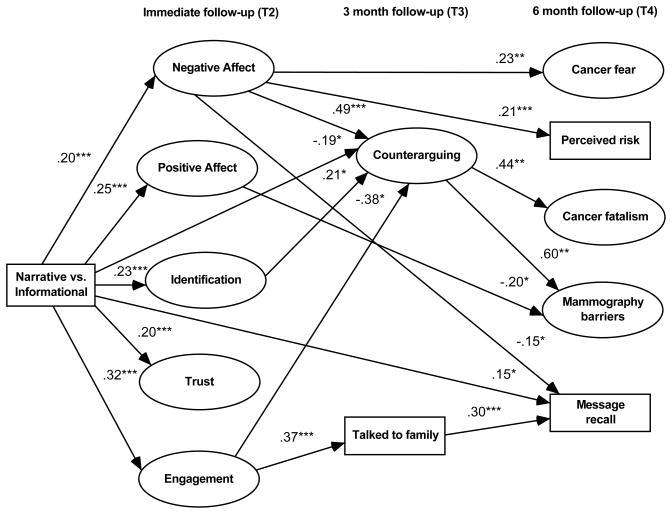
Methods: African American women (n = 489) ages 40 and older were recruited from low-income neighborhoods in St. Louis, Missouri, and randomized to watch a narrative video comprised of stories from African American breast cancer survivors or a content-equivalent informational video. Effects were measured immediately postexposure (T2) and at 3- (T3) and 6-month (T4) follow-up. T2 measures of initial reaction included positive and negative affect, trust, identification, and engagement. T3 message-processing variables included arguing against the messages (counterarguing) and talking to family members about the information (cognitive rehearsal). T4 behavioral correlates included perceived breast cancer risk, cancer fear, cancer fatalism, perceived barriers to mammography, and recall of core messages. Structural equation modeling examined interrelations among constructs.
Results: Women who watched the narrative video (n = 244) compared to the informational video (n = 245) experienced more positive and negative affect, identified more with the message source, and were more engaged with the video. Narratives, negative affect, identification, and engagement influenced counterarguing, which, in turn, influenced perceived barriers and cancer fatalism. More engaged women talked with family members more, which increased message recall. Narratives also increased risk perceptions and fear via increased negative affect.
Conclusions: Narratives produced stronger cognitive and affective responses immediately, which, in turn, influenced message processing and behavioral correlates. Narratives reduced counterarguing and increased cognitive rehearsal, which may increase acceptance and motivation to act on health information in populations most adversely affected by cancer disparities.
PsycINFO Database Record (c) 2011 APA, all rights reserved.
Figures
References
-
- Allen M. Meta-analysis comparing the persuasiveness of one-sided and two-sided messages. Western Journal of Speech Communication. 1991;55(4):390–404.
-
- Allen M, Preiss RW. Comparing the persuasiveness of narrative and statistical evidence using meta-analysis. Communication Research Reports. 1997;14:123–131.
-
- American Cancer Society. Prevention & Early Detection Facts & Figures 2010. Atlanta, GA: American Cancer Society; 2010.
-
- Ashton CM, Houston TK, Williams JH, Larkin D, Trobaugh J, Crenshaw K, et al. A stories-based interactive DVD intended to help people with hypertension achieve blood pressure control through improved communication with their doctors. Patient Education and Counseling. 2010;79:245–250. - PubMed