


Continuous monitoring of the Monro-Kellie doctrine: is it possible?
- PMID: 21895518
- PMCID: PMC3335107
- DOI: 10.1089/neu.2011.2018
Continuous monitoring of the Monro-Kellie doctrine: is it possible?
Abstract
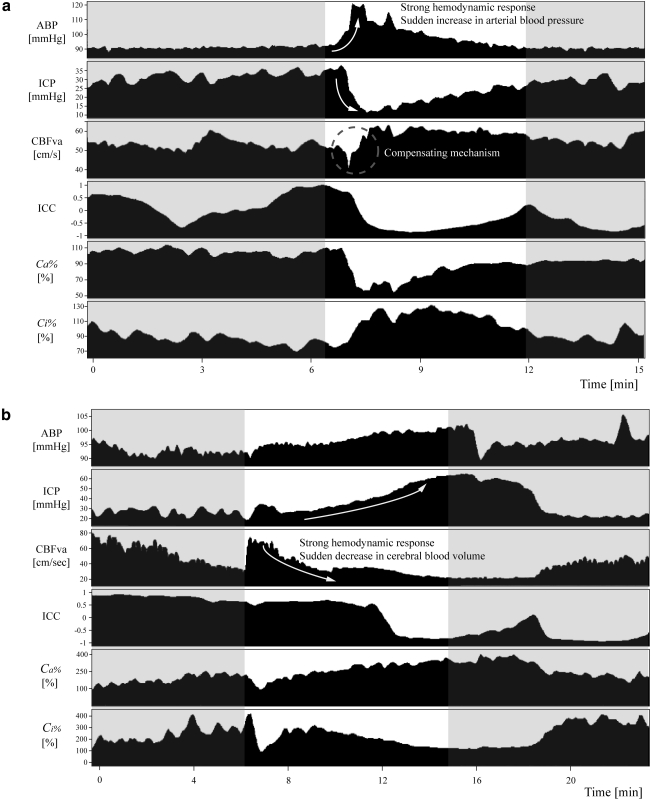
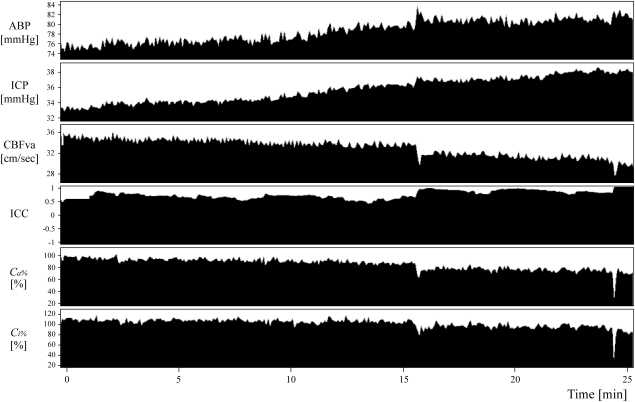
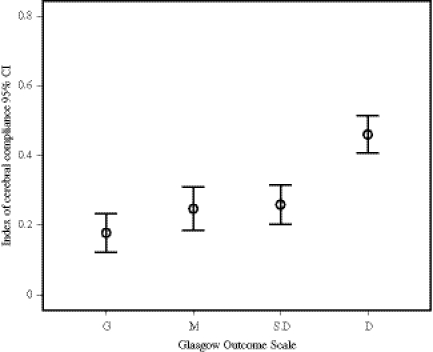
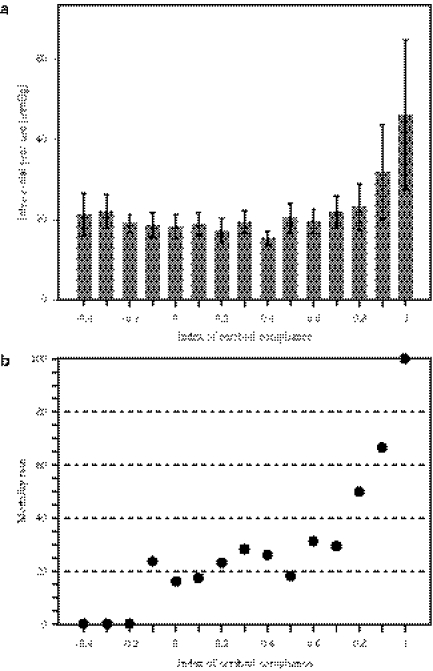
The Monro-Kellie doctrine describes the principle of homeostatic intracerebral volume regulation, which stipulates that the total volume of the parenchyma, cerebrospinal fluid, and blood remains constant. Hypothetically, a slow shift (e.g., brain edema development) in the irregular vasomotion-driven exchanges of these compartmental volumes may lead to increased intracranial hypertension. To evaluate this paradigm in a clinical setting and measure the processes involved in the regulation of systemic intracranial volume, we quantified cerebral blood flow velocity (CBFv) in the middle cerebral artery, arterial blood pressure (ABP), and intracranial pressure (ICP), in 238 brain-injured subjects. Relative changes in compartmental compliances C(a) (arterial) and C(i) (combined venous and CSF compartments) were mathematically estimated using these raw signals through time series analysis; C(a) and C(i) were used to compute an index of cerebral compliance (ICC) as a moving correlation coefficient between C(a) and C(i). Conceptually, a negative ICC would represent a functional Monro-Kellie doctrine by illustrating volumetric compensations between C(a) and C(i). Clinical observations show that Lundberg A-waves and arterial hypertension were associated with negative ICC, whereas in refractory intracranial hypertension, a positive ICC was observed. In subjects who died, ICC was significantly greater than in survivors (0.46 ± 0.027 versus 0.22 ± 0.017; p<0.01) over the first 5 days of intensive care. The mortality rate is 5% when ICC is less than 0, and 43% when above 0.7. ICC above 0.7 was associated with terminally elevated ICP (chi-square p=0.026). We propose that the Monro-Kellie doctrine can be monitored in real time to illustrate the state of intracranial volume regulation.
Figures
References
-
- Alperin N. Sivaramakrishnan A. Lichtor T. Magnetic resonance imaging-based measurements of cerebrospinal fluid and blood flow as indicators of intracranial compliance in patients with Chiari malformation. J. Neurosurg. 2005;103:46–52. - PubMed
-
- Avezaat C.J. van Eijndhoven J.H. Rotterdam, The Netherlands: Academic Hospital Rotterdam and Erasmus University; 1984. Cerebrospinal fluid pulse pressure and craniospinal dynamics.
-
- Baledent O. Gondry-Jouet C. Stoquart-Elsankari S. Bouzerar R. Le Gars D. Meyer M.E. Value of phase contrast magnetic resonance imaging for investigation of cerebral hydrodynamics. J. Neuroradiol. 2006;33:292–303. - PubMed
-
- Burton A.C. Relation of structure to function of the tissues of the wall of blood vessels. Physiol. Rev. 1954;34:619–642. - PubMed
Publication types
MeSH terms
Grants and funding
LinkOut - more resources
Full Text Sources
