


Mitochondrial injury after mechanical stretch of cortical neurons in vitro: biomarkers of apoptosis and selective peroxidation of anionic phospholipids
- PMID: 21895519
- PMCID: PMC3303096
- DOI: 10.1089/neu.2010.1602
Mitochondrial injury after mechanical stretch of cortical neurons in vitro: biomarkers of apoptosis and selective peroxidation of anionic phospholipids
Abstract
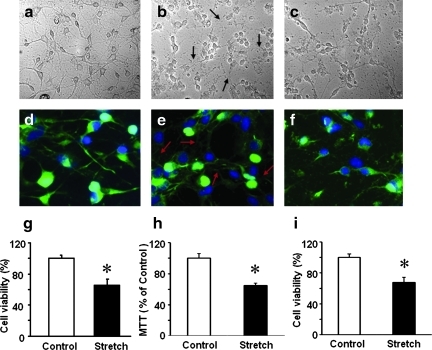
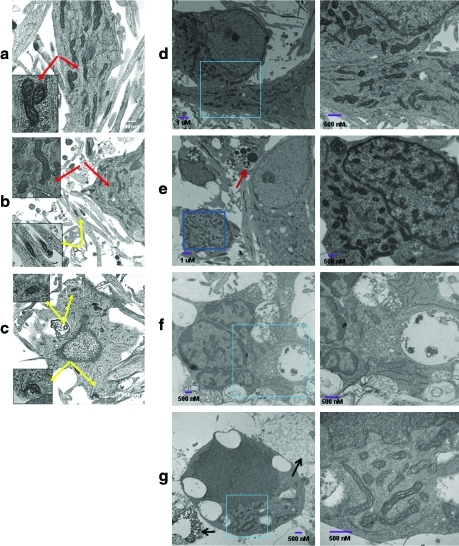
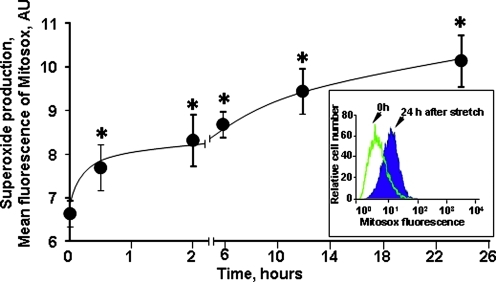
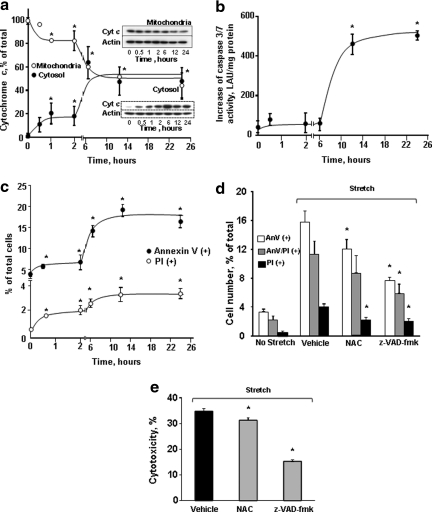
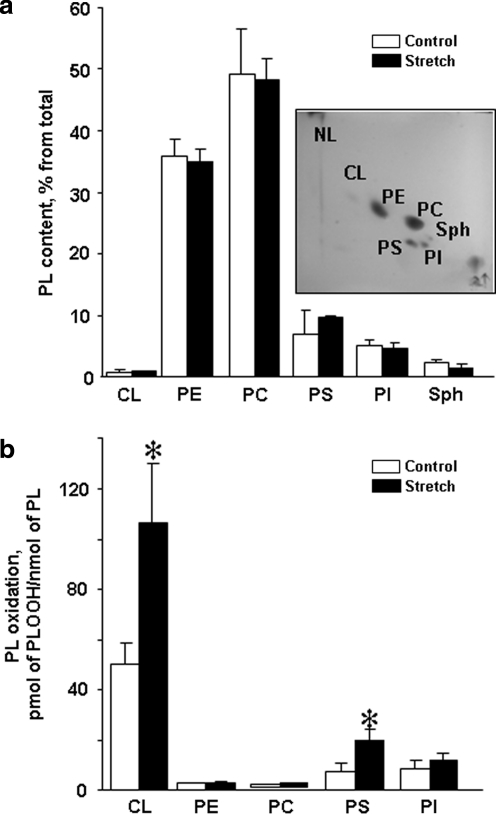
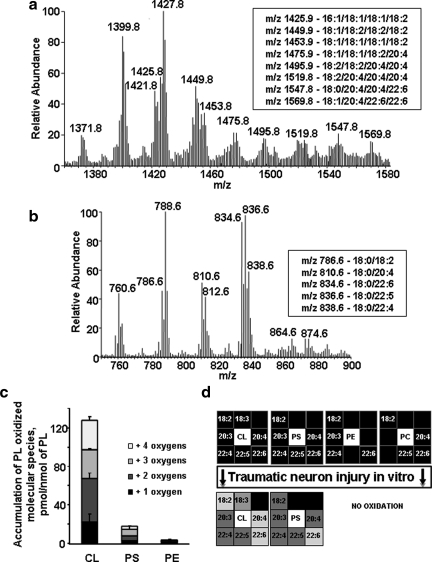
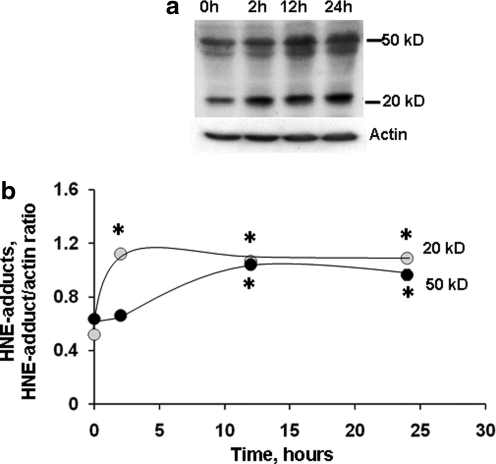
Mechanical injury of neurites accompanied by rupture of mitochondrial membranes may lead to immediate nonspecific release and spreading of pro-apoptotic factors and activation of proteases, that is, execution of apoptotic program. In the current work, we studied the time course of the major biomarkers of apoptosis as they are induced by exposure of rat cortical neurons to mechanical stretch. By using transmission electron microscopy, we found that mitochondria in the neurites were damaged early (1 h) after mechanical stretch injury whereas somal mitochondria were significantly more resistant and demonstrated structural damage and degenerative mitochondrial changes at a later time point after stretch (12 h). We also report that the stretch injury caused immediate activation of reactive oxygen species production followed by selective oxidation of a mitochondria-specific phospholipid, cardiolipin, whose individual peroxidized molecular species have been identified and quantified by electrospray ionization mass spectrometry analysis. Most abundant neuronal phospholipids - phosphatidylcholine, phophatidylethanolamine - did not undergo oxidative modification. Simultaneously, a small-scale release of cytochrome c was observed. Notably, caspase activation and phosphatidylserine externalization - two irreversible apoptotic events designating a point of no return - are substantially delayed and do not occur until 6-12 h after the initial impact. The early onset of reactive oxygen species production and cytochrome c release may be relevant to direct stretch-induced damage to mitochondria. The delayed emergence of apoptotic neuronal death after the immediate mechanical damage to mitochondria suggests a possible window of opportunity for targeted therapies.
Figures
References
-
- Ainslie K.M. Tao S.L. Popat K.C. Desai T.A. In vitro immunogenicity of silicon-based micro- and nanostructured surfaces. ACS Nano. 2008;2:1076–1084. - PubMed
-
- Barbee K.A. Macarak E.J. Thibault L.E. Strain measurements in cultured vascular smooth muscle cells subjected to mechanical deformation. Ann. Biomed. Eng. 1994;22:14–22. - PubMed
-
- Bayir H. Kapralov A.A. Jiang J. Huang Z. Tyurina Y.Y. Tyurin V.A. Zhao Q. Belikova N.A. Vlasova II. Maeda A. Zhu J. Na H.M. Mastroberardino P.G. Sparvero L.J. Amoscato A.A. Chu C.T. Greenamyre J.T. Kagan V.E. Peroxidase mechanism of lipid-dependent cross-linking of synuclein with cytochrome C: protection against apoptosis versus delayed oxidative stress in Parkinson disease. J. Biol. Chem. 2009;284:15,951–15,969. - PMC - PubMed
-
- Bayir H. Tyurin V.A. Tyurina Y.Y. Viner R. Ritov V. Amoscato A.A. Zhao Q. Zhang X.J. Janesko–Feldman K.L. Alexander H. Basova L.V. Clark R.S. Kochanek P.M. Kagan V.E. Selective early cardiolipin peroxidation after traumatic brain injury: an oxidative lipidomics analysis. Ann. Neurol. 2007;62:154–169. - PubMed
Publication types
MeSH terms
Substances
Grants and funding
LinkOut - more resources
Full Text Sources
