


How do social fears in adolescence develop? Fear conditioning shapes attention orienting to social threat cues
- PMID: 21895575
- PMCID: PMC3488275
- DOI: 10.1080/02699931.2010.524193
How do social fears in adolescence develop? Fear conditioning shapes attention orienting to social threat cues
Abstract
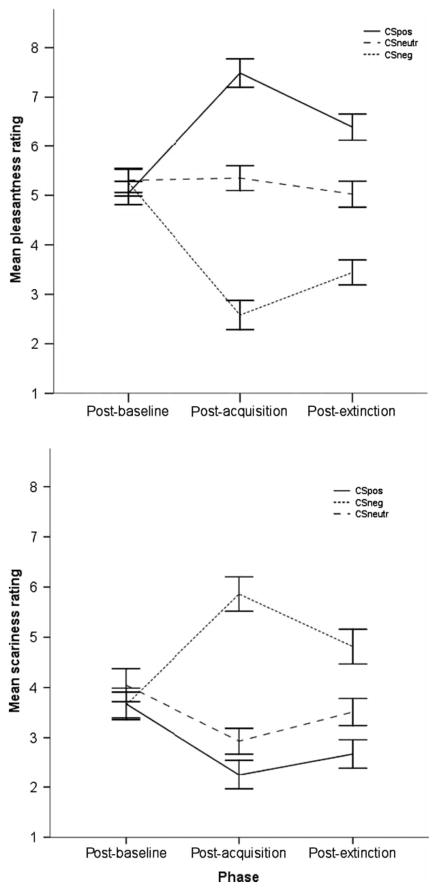
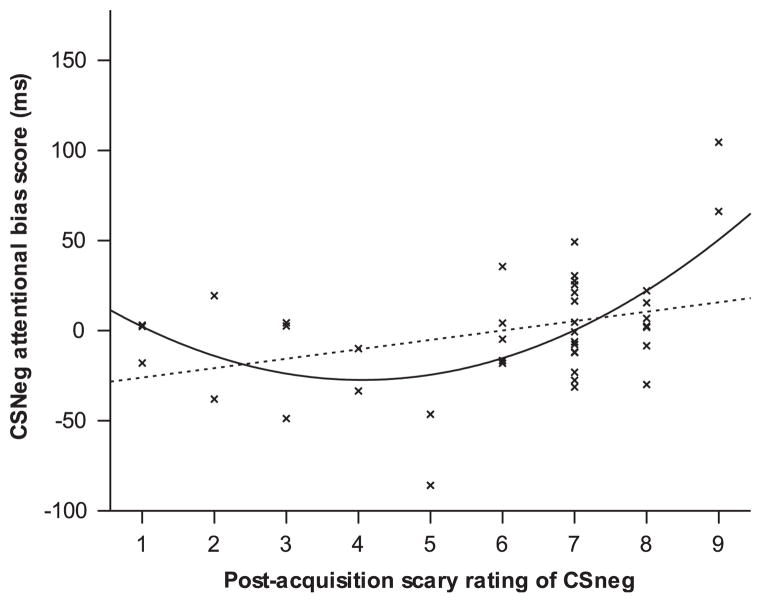
Social fears emerging in adolescence can have negative effects on emotional well-being. Yet the mechanisms by which these risks occur are unknown. One possibility is that associative learning results in fears to previously neutral social stimuli. Such conditioned responses may alter subsequent processing of social stimuli. We used a novel conditioning task to examine how associative processes influence social fear and attention orienting in adolescents. Neutral photographs were paired with socially rewarding or aversive stimuli during conditioning; a dot-probe task then assessed biases in attention orienting. The social conditioning task modified subjective ratings of the neutral stimuli. Moreover, for the neutral stimulus that was paired with the aversive stimulus, the strength of conditioning showed a relationship with subsequent attentional vigilance. The findings elucidate mechanisms by which negative peer experiences during adolescence may affect emotional processing.
Figures
References
-
- Birmaher B, Brent DA, Chiappetta L, Bridge J, Monga S, Baugher M. Psychometric properties of the Screen for Child Anxiety Related Emotional Disorders (SCARED): A replication study. Journal of the American Academy of Child and Adolescent Psychiatry. 1999;38:1230–1236. - PubMed
-
- Davey GC. UCS revaluation and conditioning models of acquired fears. Behaviour Research and Therapy. 1989;27:521–528. - PubMed
-
- Esteves F, Parra C, Dimberg U, Öhman A. Nonconscious associative learning: Pavlo-vian conditioning of skin conductance responses to masked fear-relevant facial stimuli. Psychophysiology. 1994;31:375–385. - PubMed
-
- Hawker DS, Boulton MJ. Twenty years’ research on peer victimization and psychosocial maladjustment: A meta-analytic review of cross-sectional studies. Journal of Child Psychology and Psychiatry and Allied Disciplines. 2000;41:441–455. - PubMed
Publication types
MeSH terms
Grants and funding
LinkOut - more resources
Full Text Sources
Medical
