Comment
doi: 10.1101/gad.17593511.
Shared and unique properties of ubiquitin and SUMO interaction networks in DNA repair
Affiliations
- PMID: 21896653
- PMCID: PMC3175713
- DOI: 10.1101/gad.17593511
Item in Clipboard
Comment
Shared and unique properties of ubiquitin and SUMO interaction networks in DNA repair
Genes Dev.
.
Abstract
In this issue of Genes & Development, Yang and colleagues (pp. 1847-1858) identify new components of a small ubiquitin-like modifier (SUMO)-like interaction network that orchestrates and fine-tunes the Fanconi anemia (FA) pathway and replication-coupled repair. This new pathway emphasizes the intricate interplay of ubiquitin (Ub) and SUMO networks in the DNA damage response.
Figures
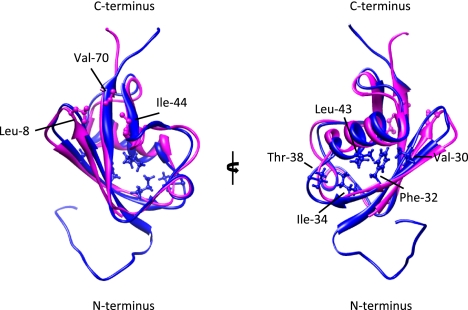
UBD and SIM interaction surfaces on Ub and SUMO are not conserved. Structural alignment of a molecular ribbon representation of Ub (magenta; Protein Data Bank [PDB]: 1aar) and SUMO-3 (cyan; PDB: 2rpq). On Ub, the canonical Leu 8, Ile 44, and Val 70 residues that contact UBDs are indicated (see Dikic et al. 2009). Val 30, Phe 32, Ile 34, Thr 38, and Leu 43 on SUMO3 have been shown to contact a canonical SIM in MCAF1 (the MBD1 [methyl-CpG-binding domain protein 1]-containing chromatin-associated factor 1) (Sekiyama et al. 2008). A similar surface in SUMO1 or SUMO2/3 has also been shown to be involved in binding to the hydrophobic SIM region of PIAS family members (Hecker et al. 2006). Remarkably, positively charged residues in SUMO paralogs, including Lys 33 of SUMO2, which is conserved in the SLD2 of UAF1, contribute to SIM binding. Note that opposite surfaces on SUMO and Ub serve as interaction platforms for the respective binding modules. The image was generated using University of California at San Francisco Chimera (release date May 24, 2011; http://www.cgl.ucsf.edu/chimera ).
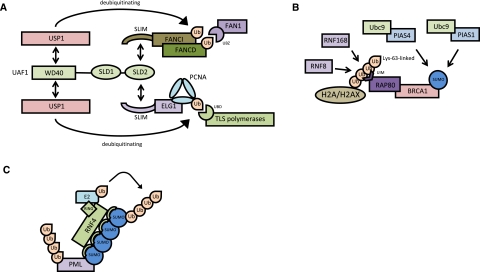
Interplay of Ub and SUMO networks in DNA repair pathways. Three different scenarios underscoring the relevance of selective Ub–UBD and SUMO–SIM interactions in DNA repair pathways. (A) The SLD–SLIM-mediated deubiquitination of PCNA-Ub and FANCD2-Ub coordinates HR and TLS. (B) A ubiquitin-SUMO cross-talk mediates the assembly of DNA damage foci. (C) Polymeric chains of SUMO2/3 can trigger substrate ubiquitination by recruiting STUbLs such as RNF4 that contain repetitive SIMs. At the moment, it remains unclear whether RNF4 creates SUMO/Ub mixed chains or modifies substrates with SUMO and Ub on two separate lysine residues. See the text for more detailed descriptions.
Comment on
-
Regulation of the Fanconi anemia pathway by a SUMO-like delivery network.Genes Dev. 2011 Sep 1;25(17):1847-58. doi: 10.1101/gad.17020911. Genes Dev. 2011. PMID: 21896657 Free PMC article.
References
-
- Baba D, Maita N, Jee JG, Uchimura Y, Saitoh H, Sugasawa K, Hanaoka F, Tochio H, Hiroaki H, Shirakawa M 2005. Crystal structure of thymine DNA glycosylase conjugated to SUMO-1. Nature 435: 979–982 - PubMed
-
- Bergink S, Jentsch S 2009. Principles of ubiquitin and SUMO modifications in DNA repair. Nature 458: 461–467 - PubMed
-
- Bienko M, Green CM, Crosetto N, Rudolf F, Zapart G, Coull B, Kannouche P, Wider G, Peter M, Lehmann AR, et al. 2005. Ubiquitin-binding domains in Y-family polymerases regulate translesion synthesis. Science 310: 1821–1824 - PubMed
-
- Cohn MA, Kowal P, Yang K, Haas W, Huang TT, Gygi SP, D'Andrea AD 2007. A UAF1-containing multisubunit protein complex regulates the Fanconi anemia pathway. Mol Cell 28: 786–797 - PubMed
-
- Dantuma NP, Heinen C, Hoogstraten D 2009. The ubiquitin receptor Rad23: at the crossroads of nucleotide excision repair and proteasomal degradation. DNA Repair (Amst) 8: 449–460 - PubMed
Publication types
MeSH terms
Substances
LinkOut - more resources
Full Text Sources
Miscellaneous