. 2011 Nov;31(21):4319-34.
doi: 10.1128/MCB.05033-11. Epub 2011 Sep 6.

Induction of the alternative NF-κB pathway by lymphotoxin αβ (LTαβ) relies on internalization of LTβ receptor

Affiliations

Induction of the alternative NF-κB pathway by lymphotoxin αβ (LTαβ) relies on internalization of LTβ receptor

Corinne Ganeff et al. Mol Cell Biol. 2011 Nov.

Abstract

Several tumor necrosis factor receptor (TNFR) family members activate both the classical and the alternative NF-κB pathways. However, how a single receptor engages these two distinct pathways is still poorly understood. Using lymphotoxin β receptor (LTβR) as a prototype, we showed that activation of the alternative, but not the classical, NF-κB pathway relied on internalization of the receptor. Further molecular analyses revealed a specific cytosolic region of LTβR essential for its internalization, TRAF3 recruitment, and p100 processing. Interestingly, we found that dynamin-dependent, but clathrin-independent, internalization of LTβR appeared to be required for the activation of the alternative, but not the classical, NF-κB pathway. In vivo, ligand-induced internalization of LTβR in mesenteric lymph node stromal cells correlated with induction of alternative NF-κB target genes. Thus, our data shed light on LTβR cellular trafficking as a process required for specific biological functions of NF-κB.


Figures
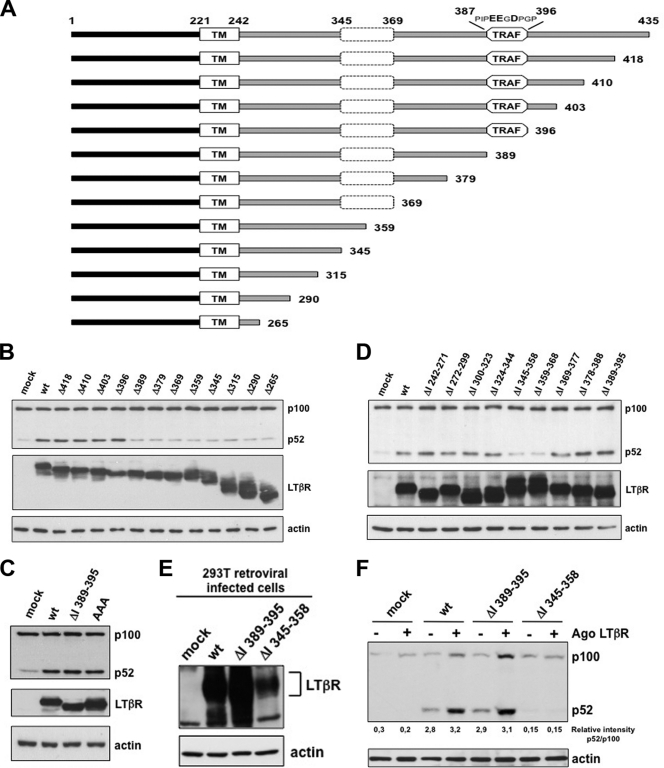
Fig. 1.
Fig. 1.
Identification of the cytoplasmic domain involved in LTβR-mediated p100 processing. (A) Schematic representation of human full-length and deletion mutant LTβR. The black bar, the gray bar, and TM represent the extracellular domain (amino acids 1 to 121), the cytosolic tail (amino acids 242 to 425), and the transmembrane domain (amino acids 222 to 241), respectively. (B to D) HEK 293 cells were transiently transfected with different sets of LTβR deletion mutants of the cytosolic tail and with the triple D390D391E393/AAA mutant. (E) 293T cells were stably infected with retrovirus encoding the indicated Myc-tagged LTβR, and expression was analyzed with anti-Myc immunoblotting. (F) Stable clones were stimulated for 6 h with an agonistic (Ago) anti-LTβR antibody prior to analysis by Western blotting of the processing of p100 into p52.
Fig. 2.
Fig. 2.
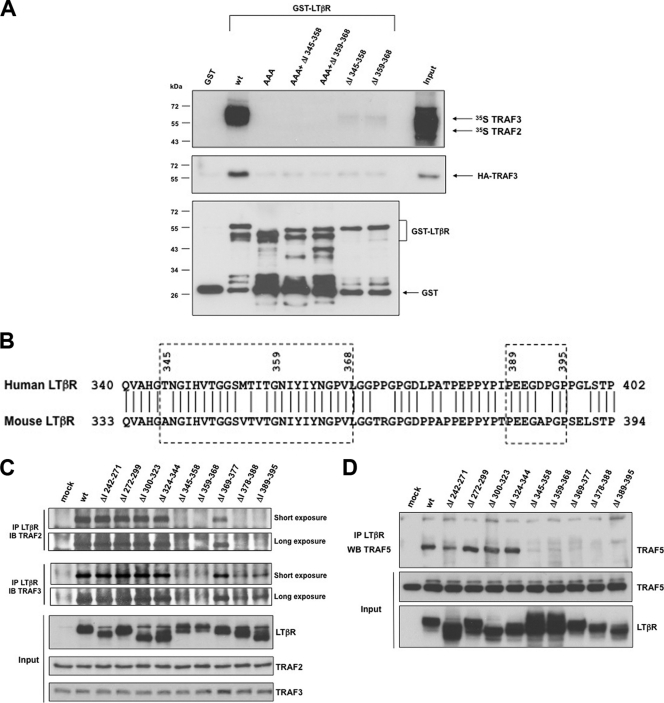
Conformation of LTβR dictates the mechanism of TRAF recruitment through an unconventional bipartite site. (A) GST pulldown of either in vitro-translated TRAF2 and TRAF3 or 293 cell extracts containing HA-TRAF3 with GST-LTβR and the indicated mutants. (B) Alignment of human and mouse LTβR. The two TRAF binding sites are boxed with dashed lines. (C and D) HEK 293T cells were transfected with internal deletion mutant LTβR, and immunoprecipitated LTβR was analyzed by Western blotting for the recruitment of TRAF2 and TRAF3 (C) or ectopic Flag-TRAF5 (D).
Fig. 3.
Fig. 3.
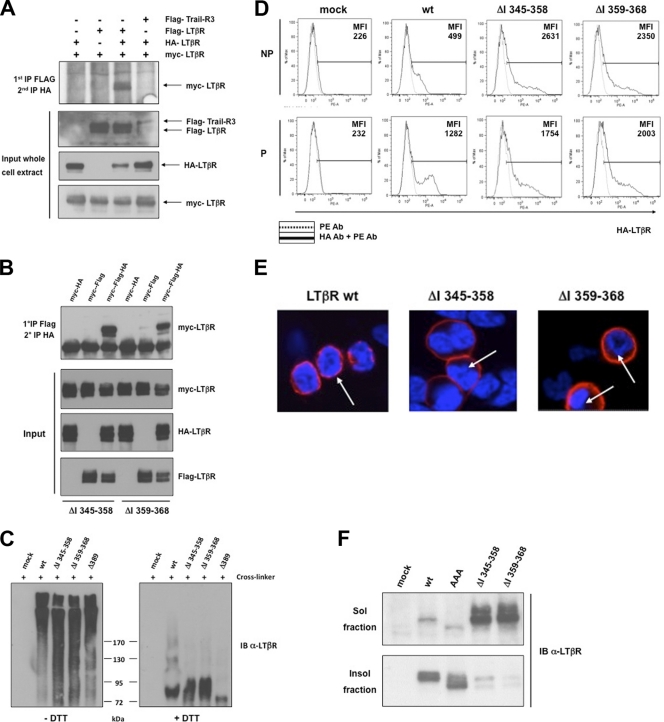
LTβR defective for p100 processing is sequestered into the plasma membrane. (A) HEK 293T cells were transfected with three differently tagged LTβRs (HA, Flag, and Myc tagged), and double immunoprecipitations were performed to analyze the trimerization of wt LTβR (see the supplemental material for details). (B) The same procedure as in panel A was applied for internal deletion mutants ΔI 345–358 and ΔI 359–368. (C) HEK 293T cells were transfected with wt LTβR, ΔI 345–358, ΔI 359–368, and Δ389. The cross-linker DSP was used prior to immunoprecipitation and immunoblotting of LTβR under nonreduced (−DTT) and reduced (+DTT) conditions. (D) Flow cytometry analysis of HEK 293 cells mock transfected or transfected with expression vector for wt LTβR, LTβR ΔI 345–358, or LTβR ΔI 359–368 and stained for cell surface LTβR (nonpermeabilized [NP]) or cell surface and intracellular LTβR (permeabilized [P]). MFI (mean fluorescence intensity) represents the value of one measurement out of three independent experiments. (E) Localization of wt LTβR, LTβR ΔI 345–358, and LTβR ΔI 359–368 in HEK 293 cells. Arrows indicate the perinuclear compartment. (F) Cell fractionation of LTβR into Triton X-100-soluble and -insoluble fractions from HEK 293 cells transfected with the indicated LTβR constructs.
Fig. 4.
Fig. 4.
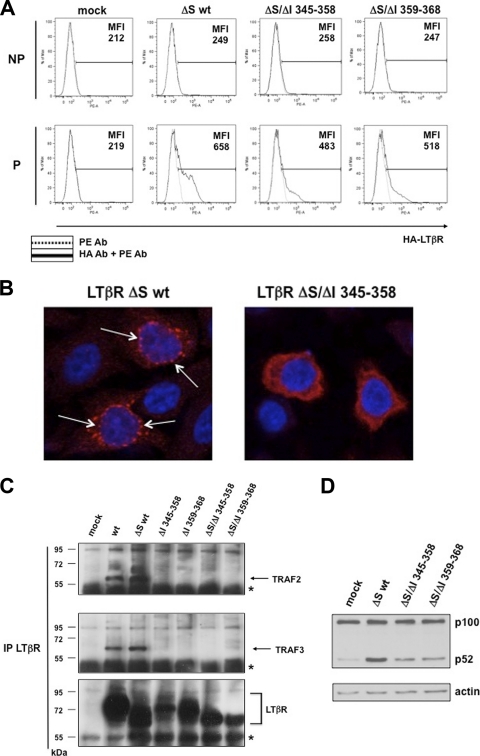
Perinuclear location of LTβR is a prerequisite for the recruitment of endogenous TRAF proteins and induction of p100 processing. (A) Flow cytometry analysis of HEK 293 cells mock transfected or transfected with expression vector for LTβR ΔS wt, LTβR ΔS/ΔI 345–358, or LTβR ΔS/ΔI 359–368 and stained for cell surface LTβR (nonpermeabilized) or cell surface and intracellular LTβR (permeabilized). MFI (mean fluorescence intensity) represents the value of one measurement out of three independent experiments. (B) HeLa cells transiently transfected with the indicated HA-tagged construct were stained for LTβR (in red) and nuclei (DAPI). Arrows indicate the punctate perinuclear staining of LTβR. (C) HEK 293 cells were mock transfected or transfected with LTβR expression vectors encoding either wt, ΔI 345–358, ΔI 359–368, or their signal sequence (ΔS)-defective counterpart. Immunoprecipitated LTβR was analyzed by Western blotting for the recruitment of endogenous TRAF2 and TRAF3. The asterisks represent the cross-reactivity with Ig heavy chains. (D) Extracts from cells transfected with signal sequence (ΔS)-defective mutants were used to analyze the processing of p100 by Western blotting.
Fig. 5.
Fig. 5.
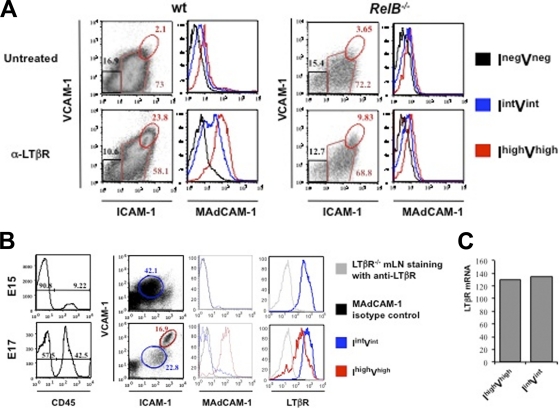
Internalization of stromal LTβR correlates with induction of MAdCAM-1. (A) RelB is necessary for a sustained induction of MAdCAM-1 expression in E14 mLN organ culture treated with an agonistic antibody to LTβR. Flow cytometry analysis of single cell suspensions of wt (left panel) and RelB−/− (right panel) E14 mLNs in organ cultures for 3 days. Percentages shown in histograms correspond to CD45 stromal cells. Three different stromal cell populations were gated: ICAM-1neg VCAM-1neg (Ineg Vneg), Iint Vint, and Ihigh Vhigh. Expression levels of MAdCAM-1 for each cell population are shown in histograms. (B) Emergence of the Ihigh Vhigh stromal organizer cells in mLNs. Flow cytometry analysis of single cell suspensions of mLNs at E15 and E17 showing the recruitment of CD45+ hematopoietic cells and the concomitant phenotypic changes in the CD45 stromal cells. Percentages shown in the histogram correspond to CD45 stromal cells and CD45+ hematopoietic cells. At E15, the stromal cell population expressed low levels of ICAM-1 and VCAM-1 (Iint Vint cell population). These cells expressed LTβR but were MAdCAM-1 negative. At E17, the stromal cells have matured and some cells express high levels of ICAM-1 and VCAM-1 (Ihigh Vhigh cell population, in red) and MAdCAM-1 but downregulated LTβR cell surface expression. (C) The Iint Vint and Ihigh Vhigh cell populations expressed the same levels of LTβR mRNA. Iint Vint and Ihigh Vhigh stromal cell populations of mLNs at E18 were sorted and analyzed for LTβR mRNA expression by real-time PCR. Ratios of the gene of interest to the β-actin gene are shown. Results are representative of at least 3 independent experiments.
Fig. 6.
Fig. 6.
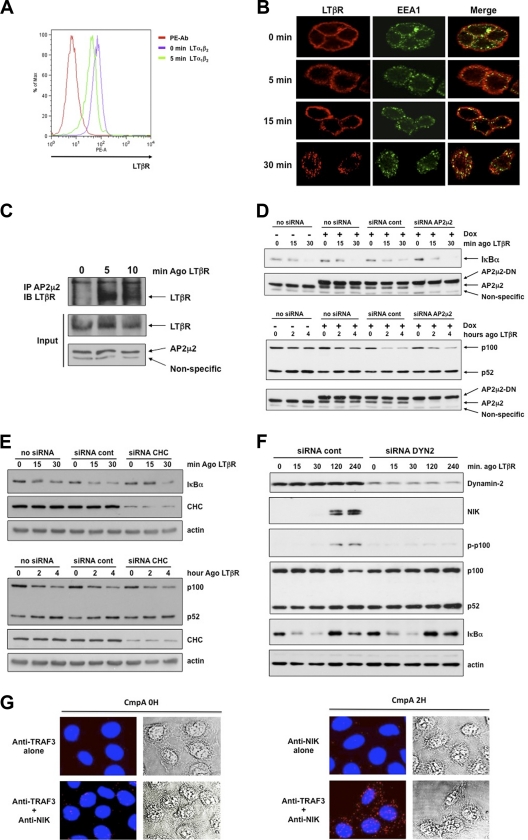
Dynamin-dependent internalization of LTβR is required for the activation of the alternative but not the classical NF-κB pathway. (A) Flow cytometry analysis of cell surface LTβR expression in untreated and LTα1β2-treated HT29 cells. (B) Colocalization of LTβR and EEA1 to early endosomes. HT29 cells were stimulated with an agonistic antibody to LTβR for the indicated time prior to immunostaining. (C) Recruitment of endogenous AP2μ2 subunit to immunoprecipitated LTβR. (D) Inducible (+ Dox [doxycycline]) rat dominant negative (DN) AP2μ2-expressing HeLa cells transfected with control or siRNA AP2μ2 and stimulated with an agonistic anti-LTβR antibody. (E) HeLa cells transfected with siRNA clathrin heavy chain (CHC) and treated as indicated for the assessment of IκBα degradation and p100 processing. (F) The same cells were transfected with siRNA dynamin-2 and treated as in panel E for the analysis of classical and alternative NF-κB pathways. (G) HeLa cells were treated with the Smac mimetic CmpA prior to staining with the Duolink technology and the indicated antibodies. The endogenous NIK/TRAF3 complex appears in red, and nuclei appear in blue (DAPI).
Fig. 7.
Fig. 7.
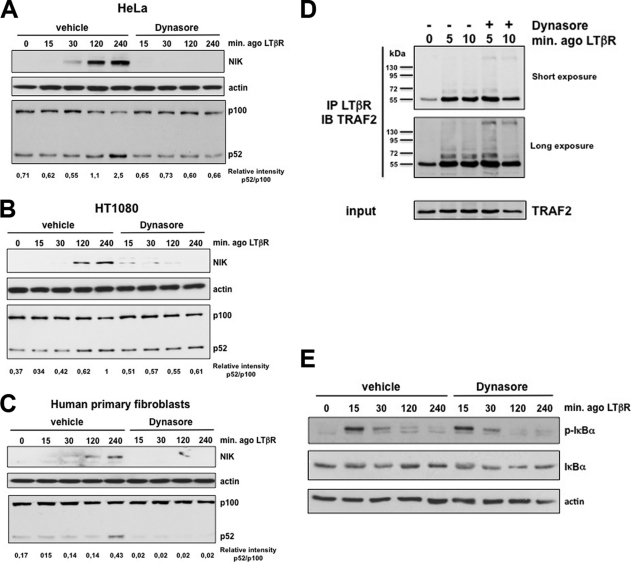
The GTPase activity of dynamin-2 is involved in the induction of the processing of p100 in response to activated LTβR. (A) HeLa cells were incubated with DMSO (vehicle) or Dynasore (80 μM) 1 h before stimulation with the agonist (ago) to LTβR for the indicated time period. Total cell extracts were analyzed by immunoblotting for the indicated proteins. (B and C) Experiments were conducted as for panel A with HT1080 and human primary fibroblasts, respectively. (D) HeLa cells were pretreated or not with Dynasore for 1 h followed by a brief stimulation with the ago to LTβR. Cell extracts were immunoprecipitated with an anti-LTβR antibody prior to immunoblotting with anti-TRAF2. (E) The same extracts as in panel A were analyzed for the phosphorylation and degradation of IκBα.
Fig. 8.
Fig. 8.
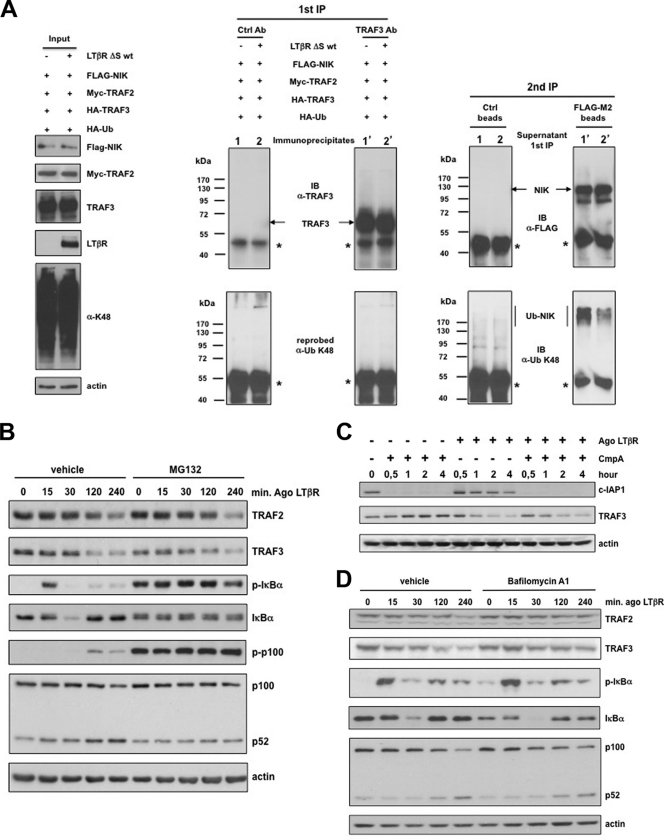
Intracellular LTβR activates the alternative NF-κB pathway independently of TRAF degradation. (A) HEK 293 cells were transiently transfected (+) or not (−) with the indicated expression vectors. Cells were lysed in 1% SDS and diluted up to 0.1% prior to the first round of immunoprecipitation (1st IP) with a control antibody (Ctrl Ab) or an anti-TRAF3 antibody. The immunoprecipitated material was analyzed by immunoblotting for TRAF3 and K48-linked TRAF3. The supernatants from the 1st IP were incubated with control beads or anti-Flag-coated beads. The immunoprecipitated materials were analyzed by immunoblotting for NIK and K48-linked ubiquitinated NIK. The asterisks represent the cross-reactivity with Ig heavy chains. (B) HeLa cells were stimulated with the agonist (Ago) to LTβR in the presence of DMSO (vehicle) or the proteasome inhibitor MG132, and cell extracts were analyzed by immunoblotting for the indicated proteins. (C) HeLa cells were treated with compound A (CmpA) or the Ago to LTβR alone or in combination as indicated, and the indicated proteins were analyzed by immunoblotting. (D) HeLa cells were stimulated as indicated with the Ago to LTβR in the absence (vehicle) or presence of bafilomycin A1. Total cell extracts were analyzed by Western blotting for the indicated proteins.
Fig. 9.
Fig. 9.
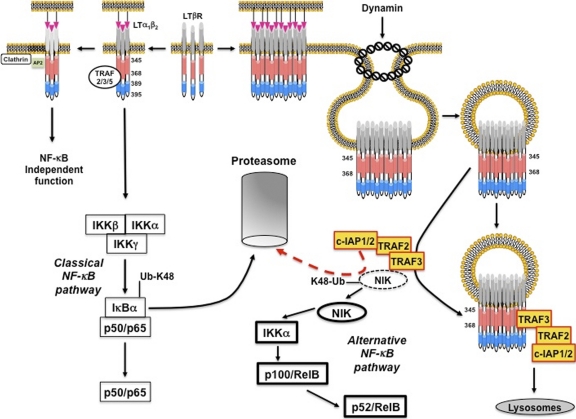
Model of LTβR trafficking and NF-κB activation. The binding of LTα1β2 to LTβR leads to its trimerization. This event allows a fast recruitment of TRAF proteins through the bipartite TRAF binding site (amino acids 389 to 395 in blue and 345 to 368 in red). This process then connects the receptor to the induction of IκBα degradation by the proteasome (classical NF-κB pathway). In the meantime, the complex AP2 in association with clathrin regulates an NF-κB-independent function of LTβR. While LTα1β2 accumulates at the cell surface of inducer cells, LTβR trimers form clusters on targeted cells. This process likely triggers the internalization of LTβR, which relies on the cytosolic region 345 to 368 and the presence of dynamin-2. Endocytic vesicles released from the plasma membrane expose the tail of LTβR toward the cytosol. This event allows LTβR to compete with intracellular NIK for the binding of its inhibitory complex TRAF3/TRAF2/c-IAP1/2. As a consequence, the constitutive proteasomal degradation of NIK (dashed line) is alleviated. Thus, NIK accumulates (solid line) and activates IKKα, and both events trigger the processing of p100 and the generation of p52/RelB. TRAF3/TRAF2/c-IAP1/2 complex is then degraded into lysosomes.

References

    1. Annunziata C. M., et al. 2007. Frequent engagement of the classical and alternative NF-kappaB pathways by diverse genetic abnormalities in multiple myeloma. Cancer Cell 12:115–130 - PMC - PubMed
    1. Batten M., et al. 2004. TNF deficiency fails to protect BAFF transgenic mice against autoimmunity and reveals a predisposition to B cell lymphoma. J. Immunol. 172:812–822 - PubMed
    1. Benezech C., et al. 2010. Ontogeny of stromal organizer cells during lymph node development. J. Immunol. 184:4521–4530 - PMC - PubMed
    1. Bista P., et al. 2010. TRAF3 controls activation of the canonical and alternative NFkappaB by the lymphotoxin beta receptor. J. Biol. Chem. 285:12971–12978 - PMC - PubMed
    1. Cheung T. C., et al. 2009. Unconventional ligand activation of herpesvirus entry mediator signals cell survival. Proc. Natl. Acad. Sci. U. S. A. 106:6244–6249 - PMC - PubMed

Publication types

MeSH terms