. 2011 Aug 23:5:79.
doi: 10.3389/fnhum.2011.00079. eCollection 2011.

Corticomotor Excitability during Observation and Imagination of a Work of Art

Affiliations

Corticomotor Excitability during Observation and Imagination of a Work of Art

Fortunato Battaglia et al. Front Hum Neurosci. .

Abstract

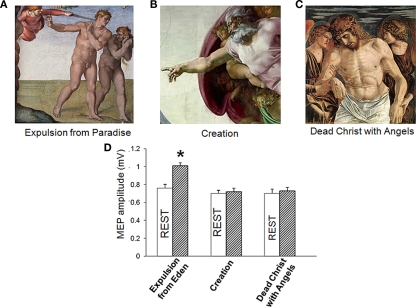
We examine the effects of the artistic representation - here exemplified by Michelangelo's Expulsion from Paradise - of an action on the motor system. Using single and paired- pulse transcranial magnetic stimulation we analyze corticomotor excitability during observation of an action in the painting, during imagery of the painting, and during observation of a photograph of the same pose. We also analyze the effects of observation of two further paintings, one showing the same muscles at rest, and in the other in a more overtly emotional context. Both observation of the Expulsion and of imagery of the painting increased cortical excitability. Neither the relaxed pose of Michelangelo's Creation nor the flexed posture in the highly emotional context of Bellini's Dead Christ increased cortical excitability. Observation of a photograph of the same extended pose did not increase cortical excitability either. Moreover, intracortical inhibition was reduced during imagery of the painting. Our results offer clear motor correlates of the relationship between the esthetic quality of a work and the perception of implied movement within it.

Keywords: art; mental imagery; mirror neurons; motor cortex; transcranial magnetic stimulation.


Figures
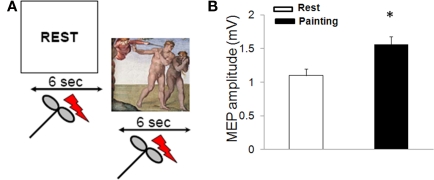
Figure 1
Figure 1
MEP amplitude during observation of Expulsion from Paradise. (A) Experimental paradigm used to assess corticomotor excitability during observation of a painting. Two digitized video sequences were presented. In one sequence (REST), the participants were instructed to relax. In a second video, subjects were instructed to observe Adam's gesture in Michelangelo's Expulsion from Paradise. Each video was presented for 6 s and transcranial magnetic stimuli were delivered after 3 s. Each condition was presented 10 times. (B) Painting observation increased motor evoked potentials (MEP) size (mean ± SE)* = p < 0.05.
Figure 2
Figure 2
(A–C) Corticomotor facilitation during observation of emotionally charged paintings depicting a right hand in different postures. (D) Only observation of Adam’ gesture in Michelangelo's Expulsion from Paradise increased motor evoked potentials (MEP) size. (Mean ± SE) * = p < 0.01.
Figure 3
Figure 3
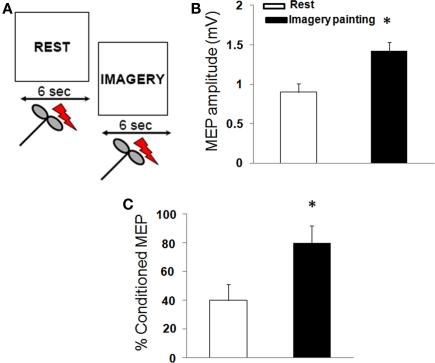
Corticomotor excitability during imagery of a painting. (A) In one sequence (REST), the participants were instructed to relax. In a second video (IMAGERY), participants were asked to imagine the painting. (B) Painting observation increased motor evoked potentials (MEP) size and (C) reduced the amount of short-interval intracortical inhibition. (Mean ± SE) * = p < 0.01.
Figure 4
Figure 4
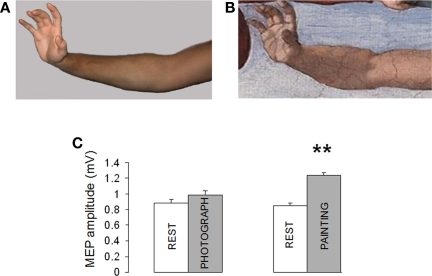
(A,B) Corticomotor facilitation during observation of Adam’ arm in Expulsion from Paradise and a photograph of the same pose. (C) Motor evoked potentials (MEP) increased during observation of Adam’ arm while observation of a photograph of the same pose did not induce significant changes in MEP size. (Mean ± SE) ** = p < 0.01.

References

    1. Abbruzzese G., Assini A., Buccolieri A., Marchese R., Trompetto C. (1999). Changes of intracortical inhibition during motor imagery in human subjects. Neurosci. Lett. 263, 113–116 10.1016/S0304-3940(99)00120-2 - DOI - PubMed
    1. Allison T., Puce A., McCarthy G. (2000). Social perception from visual cues: role of the STS region. Trends Cogn. Sci. (Regul. Ed.) 4, 267–278 10.1016/S1364-6613(00)01501-1 - DOI - PubMed
    1. Baldissera F., Cavallari P., Craighero L., Fadiga L. (2001). Modulation of spinal excitability during observation of hand actions in humans. Eur. J. Neurosci. 13, 190–194 10.1046/j.0953-816x.2000.01368.x - DOI - PubMed
    1. Battaglia F., Quartarone A., Ghilardi M. F., Dattola R., Bagnato S., Rizzo V., Morgante L., Girlanda P. (2006). Unilateral cerebellar stroke disrupts movement preparation and motor imagery. Clin. Neurophysiol. 117, 1009–1016 10.1016/j.clinph.2006.01.008 - DOI - PubMed
    1. Baumgartner T., Willi M., Jancke L. (2007). Modulation of corticospinal activity by strong emotions evoked by pictures and classical music: a transcranial magnetic stimulation study. Neuroreport 18, 261–265 10.1097/WNR.0b013e328012272e - DOI - PubMed

LinkOut - more resources