Review
. 2012 Jan-Feb;3(1):1-12.
doi: 10.1002/wrna.100. Epub 2011 Sep 2.

Evolution of SR protein and hnRNP splicing regulatory factors

Affiliations
Review

Evolution of SR protein and hnRNP splicing regulatory factors

Anke Busch et al. Wiley Interdiscip Rev RNA. 2012 Jan-Feb.

Abstract

The splicing of pre-mRNAs is an essential step of gene expression in eukaryotes. Introns are removed from split genes through the activities of the spliceosome, a large ribonuclear machine that is conserved throughout the eukaryotic lineage. While unicellular eukaryotes are characterized by less complex splicing, pre-mRNA splicing of multicellular organisms is often associated with extensive alternative splicing that significantly enriches their proteome. The alternative selection of splice sites and exons permits multicellular organisms to modulate gene expression patterns in a cell type-specific fashion, thus contributing to their functional diversification. Alternative splicing is a regulated process that is mainly influenced by the activities of splicing regulators, such as SR proteins or hnRNPs. These modular factors have evolved from a common ancestor through gene duplication events to a diverse group of splicing regulators that mediate exon recognition through their sequence-specific binding to pre-mRNAs. Given the strong correlations between intron expansion, the complexity of pre-mRNA splicing, and the emergence of splicing regulators, it is argued that the increased presence of SR and hnRNP proteins promoted the evolution of alternative splicing through relaxation of the sequence requirements of splice junctions.


Figures

Figure 1
Figure 1
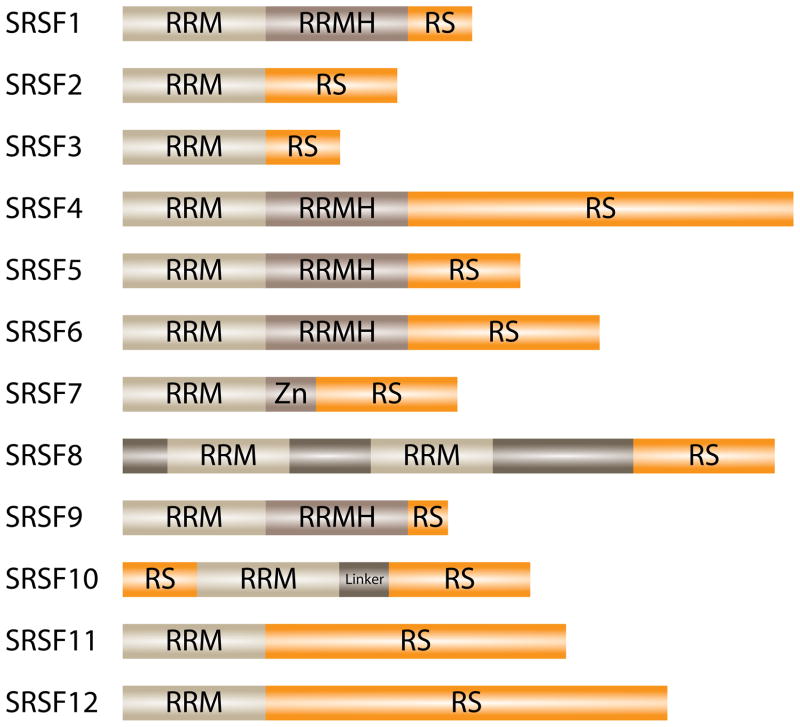
Domain configuration of human SR proteins. SRSF1–12 are members of the canonical SR protein splicing family that is defined by N-terminal RRMs followed by a downstream RS domain . The RRM is responsible for RNA binding, while the RS domain mediates protein/protein interactions.
Figure 2
Figure 2
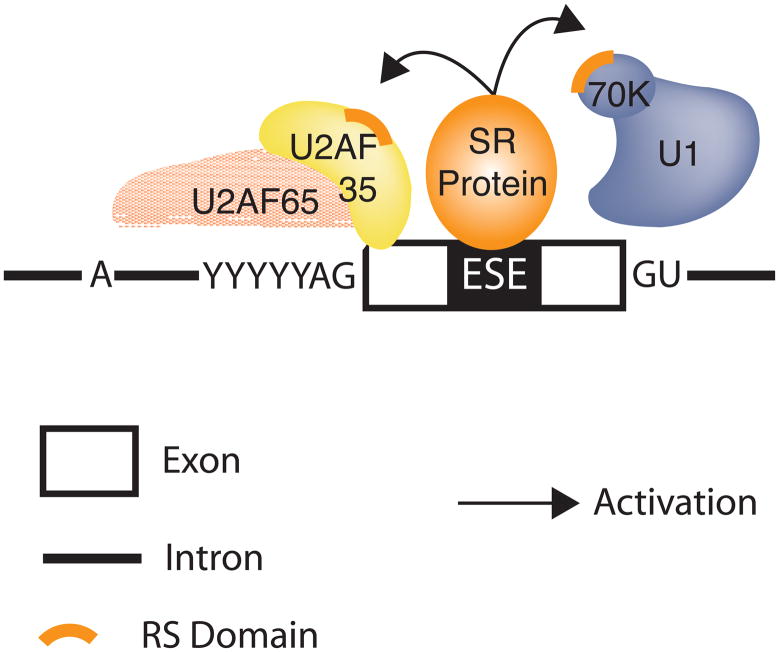
Exon dependent splicing activation by SR proteins. Exon-bound SR proteins interact with components of the general splicing machinery via RS/RS domain interactions. SR protein interactions with U2AF35 (yellow) and U1 snRNP (blue) are indicated to facilitate 3′ splice site (U2AF) or 5′ splice site (U1 snRNP) recognition. The splice junctions are indicated by AG and GU.
Figure 3
Figure 3
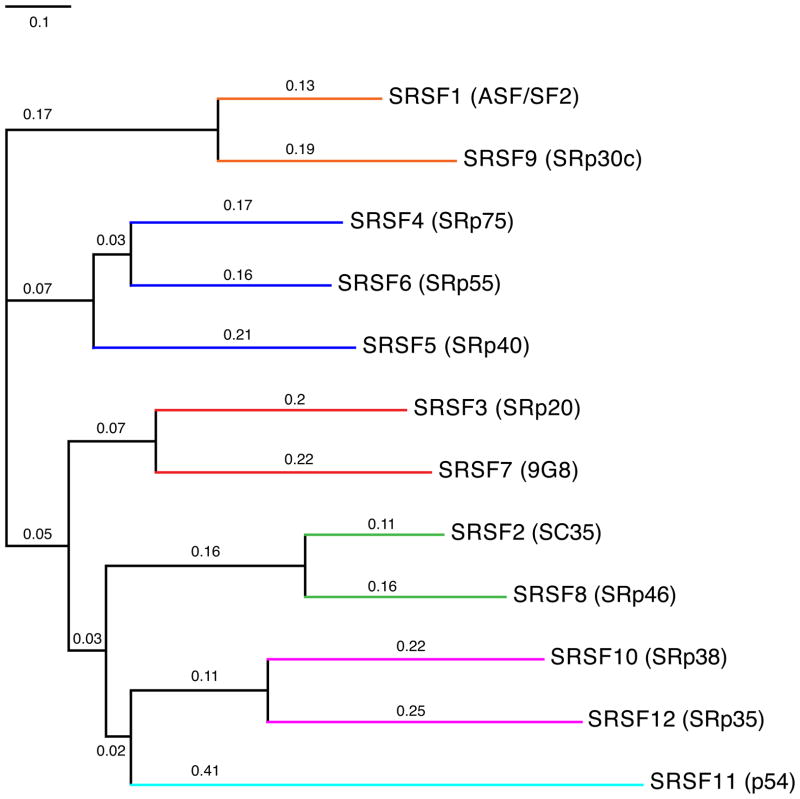
Evolutionary relationship between human SR proteins. The phylogenetic tree is based on the alignment of all human SR proteins (Table 1). The number above each bar indicates the degree of similarity. The colored lines indicate different clusters, also referred to as SR protein families. The old names of SR proteins are given in parentheses. ClustalW was used to align protein sequences and to perform phylogenetic analysis. Phylogenetic trees were drawn by CTree using the ClustalW output.
Figure 4
Figure 4
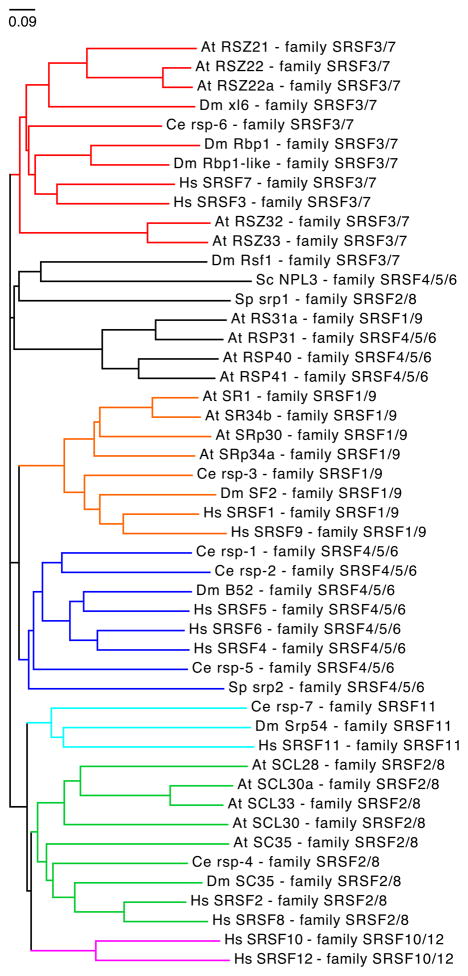
Evolutionary relationship between eukaryotic SR proteins. The phylogenetic tree is based on the alignment of Homo sapiens (Hs), Drosophila melanogaster (Dm), Caenorhabditis elegans (Ce), Arabidopsis thaliana (At), and Schizosaccharomyces pombe (Sp) SR protein sequences (Table 1). The sequence for Npl3, a SR-like protein from Schizosaccharomyces cerevisiae (Sc) was also included in the analysis. Homologues of the six human SR protein families are highlighted in color. Tree analysis was performed as described in Figure 3.
Figure 5
Figure 5
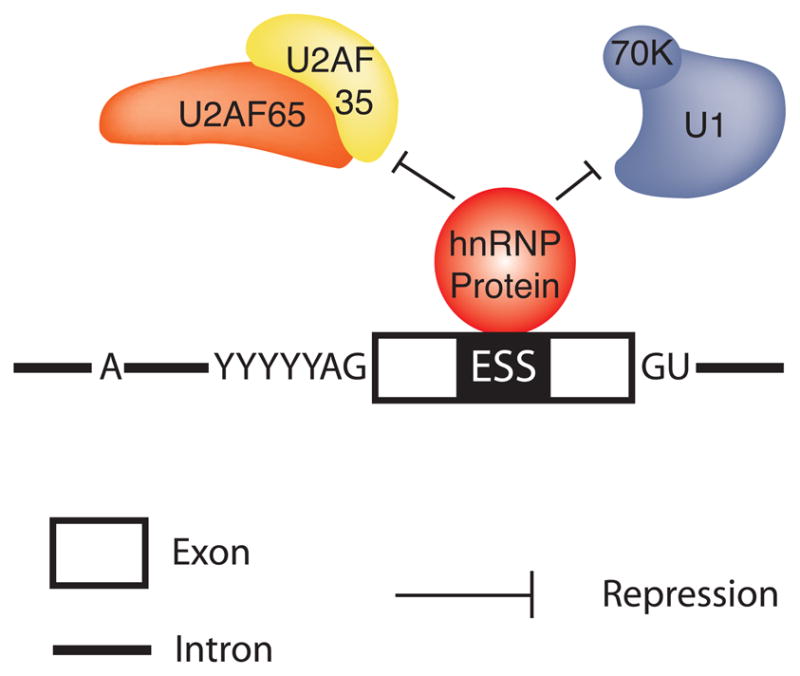
Exon dependent splicing repression by hnRNP proteins. Exon-bound hnRNP proteins interfere with the association of the general splicing machinery with the pre-mRNA. AG and GU indicate the splice junctions.
Figure 6
Figure 6
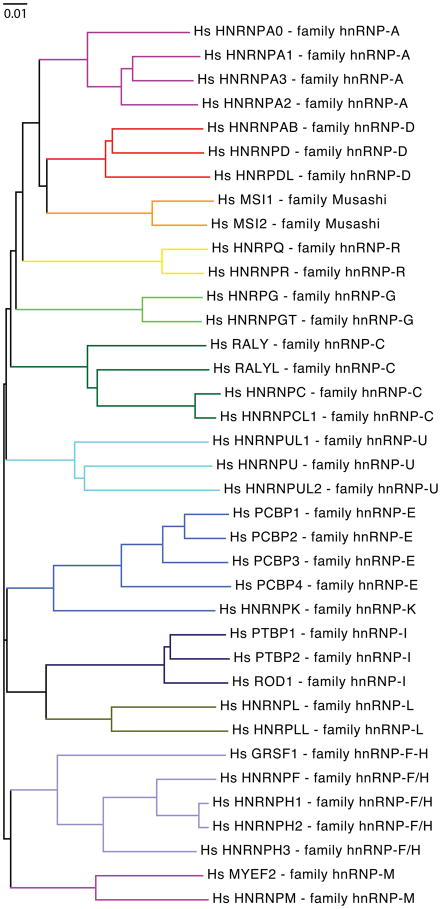
Evolutionary relationship between human hnRNP proteins. The phylogenetic tree is based on the alignment of all human hnRNP proteins (Table 3). The colored lines indicate different hnRNP families. Tree analysis was performed as described in Figure 3.
Figure 7
Figure 7
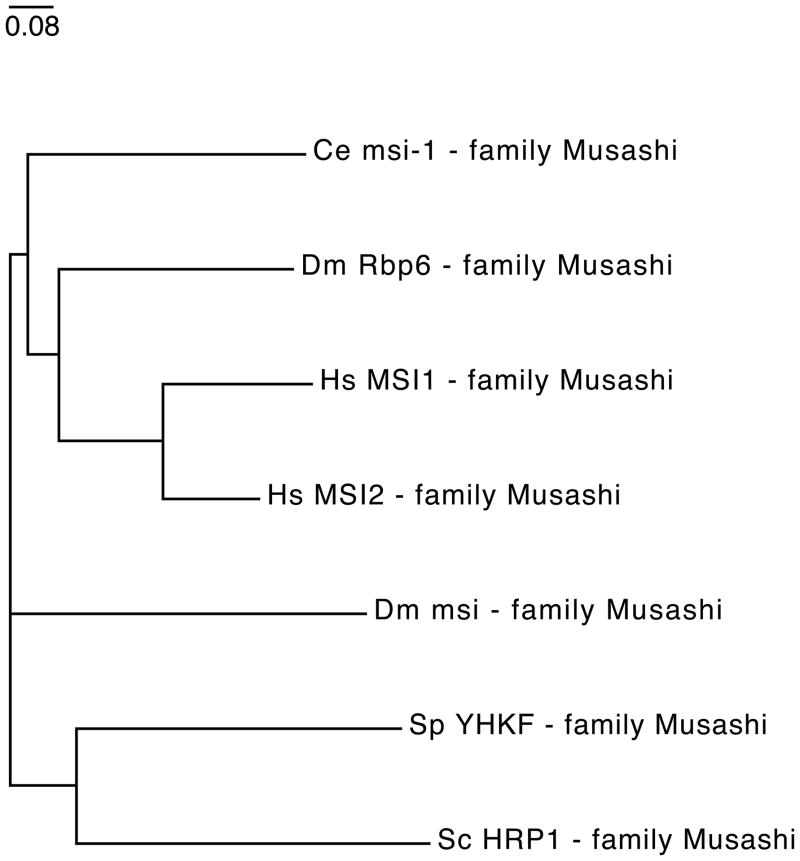
Evolutionary relationship between eukaryotic hnRNP proteins. The phylogenetic tree is based on the alignment of Homo sapiens (Hs), Drosophila melanogaster (Dm), Caenorhabditis elegans (Ce), and Schizosaccharomyces pombe (Sp) Musashi protein sequences (Table 3). The sequence for Hrp1, an hnRNP-like protein from Schizosaccharomyces cerevisiae (Sc) was also included in the analysis. Tree analysis was performed as described in Figure 3.

References

    1. Wahl MC, Will CL, Lührmann R. The spliceosome: design principles of a dynamic RNP machine. Cell. 2009;136:701–718. - PubMed
    1. Krawczak M, Reiss J, Cooper DN. The mutational spectrum of single base-pair substitutions in mRNA splice junctions of human genes: causes and consequences. Hum Genet. 1992;90:41–54. - PubMed
    1. Wang GS, Cooper TA. Splicing in disease: disruption of the splicing code and the decoding machinery. Nat Rev Genet. 2007;8:749–761. - PubMed
    1. Cooper TA, Wan L, Dreyfuss G. RNA and disease. Cell. 2009;136:777–793. - PMC - PubMed
    1. Xu Q, Lee C. Discovery of novel splice forms and functional analysis of cancer-specific alternative splicing in human expressed sequences. Nucleic Acids Res. 2003;31:5635–5643. - PMC - PubMed

Publication types