. 2011 Oct 5;133(39):15316-9.
doi: 10.1021/ja2066913. Epub 2011 Sep 13.

Copper-free Sonogashira cross-coupling for functionalization of alkyne-encoded proteins in aqueous medium and in bacterial cells

Affiliations

Copper-free Sonogashira cross-coupling for functionalization of alkyne-encoded proteins in aqueous medium and in bacterial cells

Nan Li et al. J Am Chem Soc. .

Abstract

Bioorthogonal reactions suitable for functionalization of genetically or metabolically encoded alkynes, for example, copper-catalyzed azide-alkyne cycloaddition reaction ("click chemistry"), have provided chemical tools to study biomolecular dynamics and function in living systems. Despite its prominence in organic synthesis, copper-free Sonogashira cross-coupling reaction suitable for biological applications has not been reported. In this work, we report the discovery of a robust aminopyrimidine-palladium(II) complex for copper-free Sonogashira cross-coupling that enables selective functionalization of a homopropargylglycine (HPG)-encoded ubiquitin protein in aqueous medium. A wide range of aromatic groups including fluorophores and fluorinated aromatic compounds can be readily introduced into the HPG-containing ubiquitin under mild conditions with good to excellent yields. The suitability of this reaction for functionalization of HPG-encoded ubiquitin in Escherichia coli was also demonstrated. The high efficiency of this new catalytic system should greatly enhance the utility of Sonogashira cross-coupling in bioorthogonal chemistry.


Figures
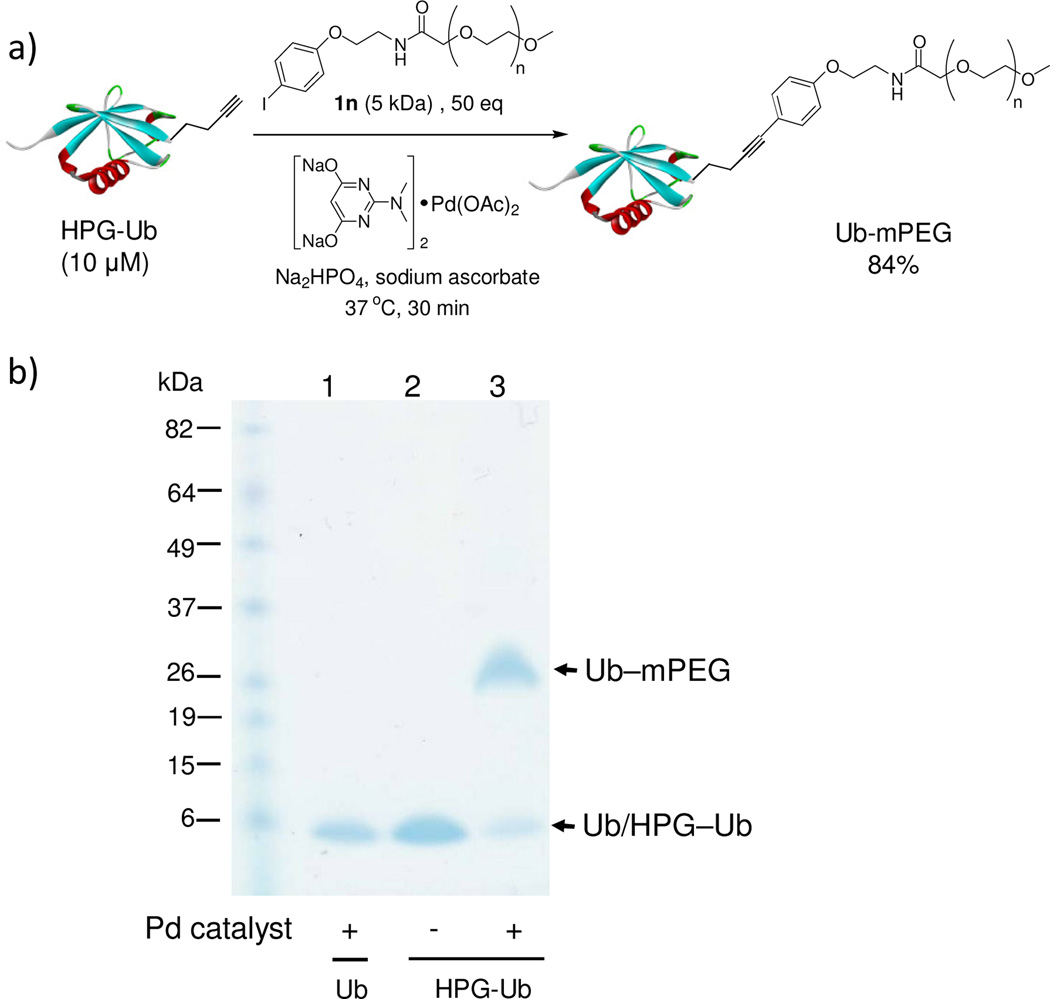
Figure 1
Figure 1
Selective PEGylation of HPG-Ub with an mPEG-linked phenyl iodide 1n via copper-free Sonogashira cross-coupling. (a) Reaction scheme. (b) Coomassie blue staining of SDS-PAGE gel showing selective formation of the PEGylated Ub (Ub-mPEG): lane 1, control reaction with wild-type ubiquitin; lane 2: control reaction with HPG-Ub in the presence of 50 equiv of 1n but absence of palladium complex; lane 3: reaction with HPG-Ub in the presence of 50 equiv of 1n and palladium catalyst.
Figure 2
Figure 2
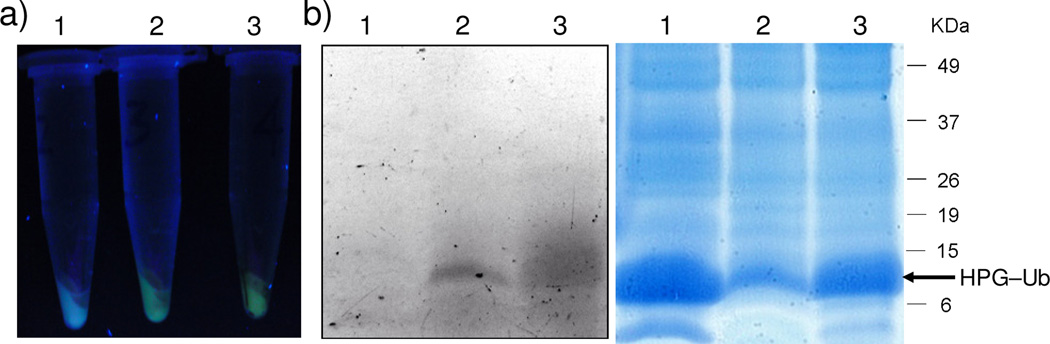
Fluorescent labeling of HPG–Ub by fluorescein iodide 1a in E. coli cells via copper-free Sonogashira cross-coupling. (a) Fluorescence image of the cell pellets upon excitation at 365 nm. Pellet 1, cells collected after treatment with 100 µM of fluorescein iodide 1a but not palladium complex; Pellet 2, cells collected after treatment with 100 µM 1a, 1 mM palladium complex, 5 mM sodium ascorbate in Na2HPO4 buffer at 37 °C for 4 h; Pellet 3, cells collected after treatment of the pre-activated mixture of palladium complex (1 mM) and 1a (100 µM). See Supporting Information for the treatment details. (b) In-gel fluorescence (left panel) and Coomassie blue staining (right panel) of SDS-PAGE analysis of the proteins captured by Ni-NTA-agarose beads from the lysates of the three cell pellets.

References

    1. Dieterich DC, Hodas JJ, Gouzer G, Shadrin IY, Ngo JT, Triller A, Tirrell DA, Schuman EM. Nat. Neurosci. 2010;13:897–905. - PMC - PubMed
    2. Laughlin ST, Baskin JM, Amacher SL, Bertozzi CR. Science. 2008;320:664–667. - PMC - PubMed
    1. Sletten EM, Bertozzi CR. Angew. Chem. Int. Ed. 2009;48:6974–6998. - PMC - PubMed
    2. Lim RK, Lin Q. Chem. Commun. 2010;46:1589–1600. - PMC - PubMed
    3. Chalker JM, Bernardes GJL, Davis BG. Acc. Chem. Res. ASAP; 2011. DOI: 10.1021/ar200056q. - PubMed
    1. Carrico IS, Carlson BL, Bertozzi CR. Nat. Chem. Biol. 2007;3:321–322. - PubMed
    2. Zeng Y, Ramya TN, Dirksen A, Dawson PE, Paulson JC. Nat. Methods. 2009;6:207–209. - PMC - PubMed
    1. Rostovtsev VV, Green LG, Fokin VV, Sharpless KB. Angew. Chem. Int. Ed. 2002;41:2596–2599. - PubMed
    2. Tornoe CW, Christensen C, Meldal M. J. Org. Chem. 2002;67:3057–3064. - PubMed
    3. Wang Q, Chan TR, Hilgraf R, Fokin VV, Sharpless KB, Finn MG. J. Am. Chem. Soc. 2003;125:3192–3193. - PubMed
    1. Agard NJ, Prescher JA, Bertozzi CR. J. Am. Chem. Soc. 2004;126:15046–15047. - PubMed
    2. Baskin JM, Prescher JA, Laughlin ST, Agard NJ, Chang PV, Miller IA, Lo A, Codelli JA, Bertozzi CR. Proc. Natl. Acad. Sci. USA. 2007;104:16793–16797. - PMC - PubMed
    3. Ning X, Guo J, Wolfert MA, Boons G-J. Angew. Chem. Int. Ed. 2008;47:2253–2255. - PMC - PubMed
    4. Dieterich DC, Link AJ, Graumann J, Tirrell DA, Schuman EM. Proc. Natl. Acad. Sci. USA. 2006;103:9482–9487. - PMC - PubMed
    5. Blackman ML, Royzen M, Fox JM. J. Am. Chem. Soc. 2008;130:13518–13519. - PMC - PubMed

Publication types