


Persistence of type-specific human papillomavirus infection and increased long-term risk of cervical cancer
- PMID: 21900119
- PMCID: PMC3176778
- DOI: 10.1093/jnci/djr283
Persistence of type-specific human papillomavirus infection and increased long-term risk of cervical cancer
Abstract
Background: Human papillomavirus (HPV) persistence is the pivotal event in cervical carcinogenesis. We followed a large-scale community-based cohort for 16 years to investigate the role of genotype-specific HPV persistence in predicting cervical cancer including invasive and in situ carcinoma.
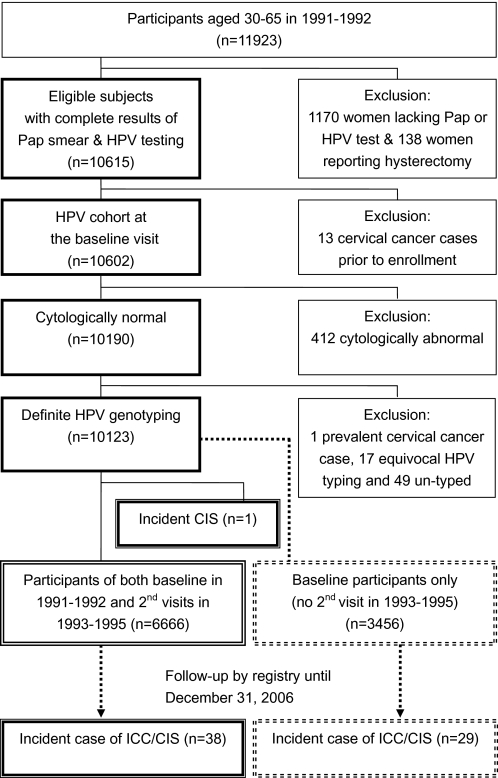
Methods: At the baseline examination in 1991-1992, 11,923 participants (aged 30-65 years) consented to HPV testing and cytology; 6923 participants were reexamined in 1993-1995. For HPV testing, we used a polymerase chain reaction-based assay that detected 39 HPV types. Women who developed cervical cancer were identified from cancer and death registries. Cumulative risks for developing cervical cancer among infected and persistently infected women were calculated by the Kaplan-Meier method.
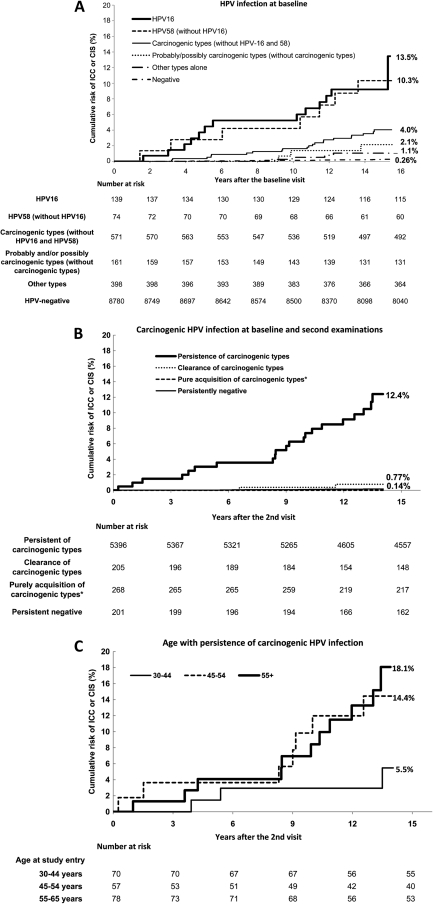
Results: Of 10,123 women who were initially cytologically normal, 68 developed cervical cancer. The 16-year cumulative risks of subsequent cervical cancer for women with HPV16, HPV58 (without HPV16), or other carcinogenic HPV types (without HPV16 or HPV58) were 13.5%, 10.3%, and 4.0%, respectively, compared with 0.26% for HPV-negative women. Women with type-specific persistence of any carcinogenic HPV had greatly increased risk compared with women who were HPV-negative at both visits (hazard ratio = 75.4, 95% confidence interval = 31.8 to 178.9). The cumulative cervical cancer risks following persistent carcinogenic HPV infections increased with age: The risks were 5.5%, 14.4%, and 18.1% for women aged 30-44 years, 45-54 years, and 55 years and older, respectively. However, newly acquired infections were associated with a low risk of cervical cancer regardless of age.
Conclusions: HPV negativity was associated with a very low long-term risk of cervical cancer. Persistent detection of HPV among cytologically normal women greatly increased risk. Thus, it is useful to perform repeated HPV testing following an initial positive test.
Figures
Comment in
-
Cervical cancer prevention: better tests, better tools, and more equitable outcomes.J Natl Cancer Inst. 2011 Sep 21;103(18):1352-3. doi: 10.1093/jnci/djr330. Epub 2011 Sep 6. J Natl Cancer Inst. 2011. PMID: 21900118 No abstract available.
References
-
- Bosch FX, Manos MM, Munoz N, et al. Prevalence of human papillomavirus in cervical cancer: a worldwide perspective. International biological study on cervical cancer (IBSCC) Study Group. J Natl Cancer Inst. 1995;87(11):796–802. - PubMed
-
- Walboomers JM, Jacobs MV, Manos MM, et al. Human papillomavirus is a necessary cause of invasive cervical cancer worldwide. J Pathol. 1999;189(1):12–19. - PubMed
-
- Chen HC, You SL, Hsieh CY, et al. Prevalence of genotype-specific human papillomavirus infection and cervical neoplasia in Taiwan: a community-based survey of 10602 women. Int J Cancer. 2011;128(5):1192–1203. - PubMed
-
- Moscicki AB, Shiboski S, Broering J, et al. The natural history of human papillomavirus infection as measured by repeated DNA testing in adolescent and young women. J Pediatr. 1998;132(2):277–284. - PubMed
-
- Schiffman M, Khan MJ, Solomon D, et al. A study of the impact of adding HPV types to cervical cancer screening and triage tests. J Natl Cancer Inst. 2005;97(2):147–150. - PubMed
