. 2011 Dec;92(Pt 12):2821-2829.
doi: 10.1099/vir.0.031641-0. Epub 2011 Sep 7.

Flavivirus-induced antibody cross-reactivity

Affiliations

Flavivirus-induced antibody cross-reactivity

Karen L Mansfield et al. J Gen Virol. 2011 Dec.

Abstract

Dengue viruses (DENV) cause countless human deaths each year, whilst West Nile virus (WNV) has re-emerged as an important human pathogen. There are currently no WNV or DENV vaccines licensed for human use, yet vaccines exist against other flaviviruses. To investigate flavivirus cross-reactivity, sera from a human cohort with a history of vaccination against tick-borne encephalitis virus (TBEV), Japanese encephalitis virus (JEV) and yellow fever virus (YFV) were tested for antibodies by plaque reduction neutralization test. Neutralization of louping ill virus (LIV) occurred, but no significant neutralization of Murray Valley encephalitis virus was observed. Sera from some individuals vaccinated against TBEV and JEV neutralized WNV, which was enhanced by YFV vaccination in some recipients. Similarly, some individuals neutralized DENV-2, but this was not significantly influenced by YFV vaccination. Antigenic cartography techniques were used to generate a geometric illustration of the neutralization titres of selected sera against WNV, TBEV, JEV, LIV, YFV and DENV-2. This demonstrated the individual variation in antibody responses. Most sera had detectable titres against LIV and some had titres against WNV and DENV-2. Generally, LIV titres were similar to titres against TBEV, confirming the close antigenic relationship between TBEV and LIV. JEV was also antigenically closer to TBEV than WNV, using these sera. The use of sera from individuals vaccinated against multiple pathogens is unique relative to previous applications of antigenic cartography techniques. It is evident from these data that notable differences exist between amino acid sequence identity and mapped antigenic relationships within the family Flaviviridae.


Figures
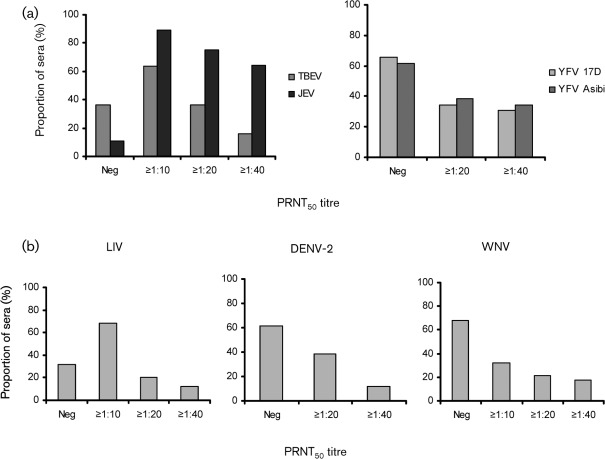
Fig. 1.
Fig. 1.
(a) Seroconversion following vaccination against TBEV (n = 25) and JEV (n = 28) (left panel), and YFV (n = 26) (right panel; strain 17D and strain Asibi). Proportion of sera (% sera) achieving a neutralizing antibody titre of ≥1 : 10, ≥1 : 20 or ≥1 : 40, or no neutralization (Neg), as determined by PRNT50. (b) Cross-neutralization of LIV (n = 25), WNV (n = 28) and DENV-2 (n = 26) (left, centre and right panels, respectively). Proportion of sera (% sera) achieving a neutralizing antibody titre of ≥1 : 10, ≥1 : 20 and ≥1 : 40, or no neutralization, as determined by PRNT50.
Fig. 2.
Fig. 2.
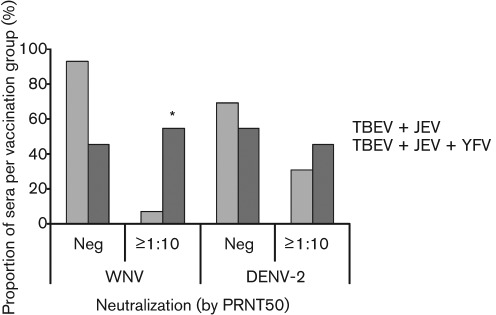
Effect of vaccination against YFV on WNV and DENV-2 PRNT50 titre: percentage of samples per vaccination group (TBEV+JEV vaccination n = 14; TBEV+JEV+YFV vaccination n = 11) achieving either a neutralizing antibody titre of at least 1 : 10 by PRNT50, or no neutralization (Neg), against WNV or DENV-2. Samples with uncertain YFV were excluded from the analysis. Statistical significance between the two vaccination groups was calculated by Kruskall–Wallis test (P = 0.002), and is denoted by *.
Fig. 3.
Fig. 3.
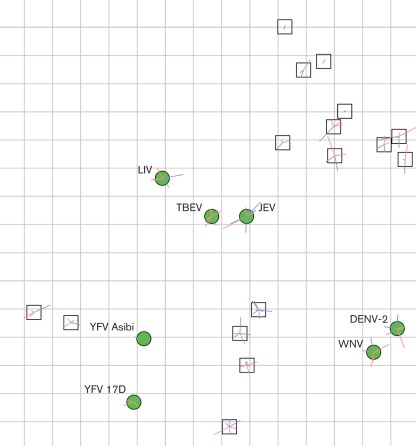
Geometric illustration of selected serum neutralization titres against TBEV, LIV, JEV, WNV, YFV (two strains) and DENV-2 made using antigenic cartography techniques. Sera are represented by white squares, and viruses are represented by green circles. Coloured error lines are shown for each virus and serum. The length of the error line is proportional to the difference between distance on the figure and the target distance; the colour indicates the direction of the difference (blue = positive difference, i.e. the distance on the figure is more than the target distance; red = negative).

References

    1. Arroyo J., Miller C., Catalan J., Myers G. A., Ratterree M. S., Trent D. W., Monath T. P. (2004). ChimeriVax-West Nile virus live-attenuated vaccine: preclinical evaluation of safety, immunogenicity, and efficacy. J Virol 78, 12497–12507 10.1128/JVI.78.22.12497-12507.2004 - DOI - PMC - PubMed
    1. Autorino G. L., Battisti A., Deubel V., Ferrari G., Forletta R., Giovannini A., Lelli R., Murri S., Scicluna M. T. (2002). West Nile virus epidemic in horses, Tuscany region, Italy. Emerg Infect Dis 8, 1372–1378 - PMC - PubMed
    1. Bakonyi T., Ivanics É., Erdélyi K., Ursu K., Ferenczi E., Weissenböck H., Nowotny N. (2006). Lineage 1 and 2 strains of encephalitic West Nile virus, central Europe. Emerg Infect Dis 12, 618–623 - PMC - PubMed
    1. Beasley D. W. C., Barrett A. D. T. (2002). Identification of neutralizing epitopes within structural domain III of the West Nile virus envelope protein. J Virol 76, 13097–13100 10.1128/JVI.76.24.13097-13100.2002 - DOI - PMC - PubMed
    1. Bosco-Lauth A., Mason G., Bowen R. (2011). Pathogenesis of Japanese encephalitis virus infection in a golden hamster model and evaluation of flavivirus cross-protective immunity. Am J Trop Med Hyg 84, 727–732 10.4269/ajtmh.2011.11-0012 - DOI - PMC - PubMed

Publication types

MeSH terms

LinkOut - more resources