


Contextual novelty modulates the neural dynamics of reward anticipation
- PMID: 21900560
- PMCID: PMC3192314
- DOI: 10.1523/JNEUROSCI.0461-11.2011
Contextual novelty modulates the neural dynamics of reward anticipation
Abstract
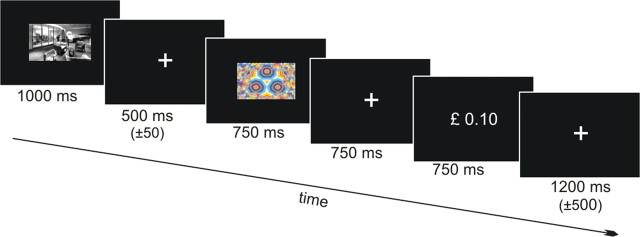
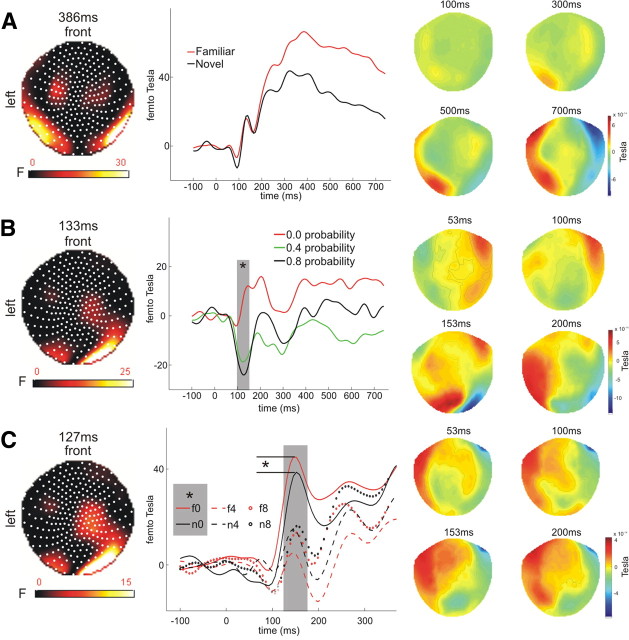
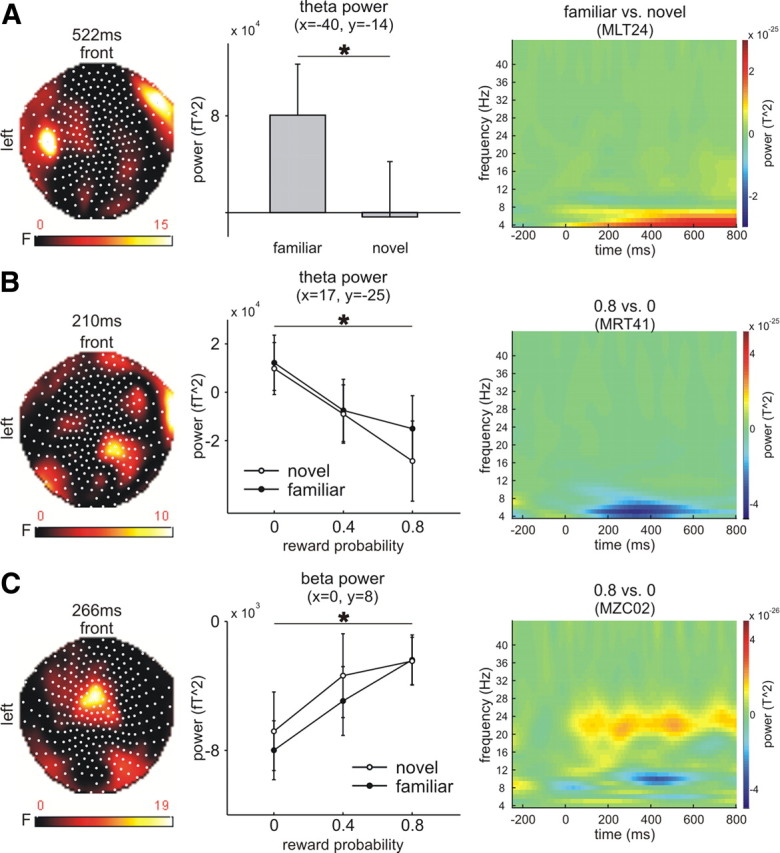
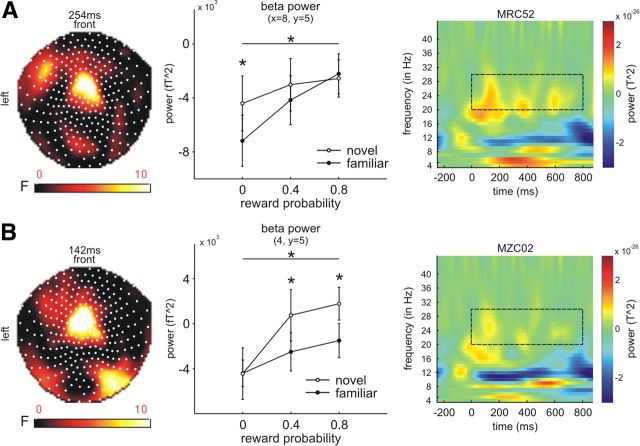
We investigated how rapidly the reward-predicting properties of visual cues are signaled in the human brain and the extent these reward prediction signals are contextually modifiable. In a magnetoencephalography study, we presented participants with fractal visual cues that predicted monetary rewards with different probabilities. These cues were presented in the temporal context of a preceding novel or familiar image of a natural scene. Starting at ∼100 ms after cue onset, reward probability was signaled in the event-related fields (ERFs) over temporo-occipital sensors and in the power of theta (5-8 Hz) and beta (20-30 Hz) band oscillations over frontal sensors. While theta decreased with reward probability beta power showed the opposite effect. Thus, in humans anticipatory reward responses are generated rapidly, within 100 ms after the onset of reward-predicting cues, which is similar to the timing established in non-human primates. Contextual novelty enhanced the reward anticipation responses in both ERFs and in beta oscillations starting at ∼100 ms after cue onset. This very early context effect is compatible with a physiological model that invokes the mediation of a hippocampal-VTA loop according to which novelty modulates neural response properties within the reward circuitry. We conclude that the neural processing of cues that predict future rewards is temporally highly efficient and contextually modifiable.
Figures
References
-
- Aberg C, Nilsson LG. Facilitation of source discrimination in the novelty effect. Scand J Psychol. 2001;42:349–357. - PubMed
-
- Axmacher N, Mormann F, Fernández G, Elger CE, Fell J. Memory formation by neuronal synchronization. Brain Res Rev. 2006;52:170–182. - PubMed
-
- Bilder RM, Volavka J, Lachman HM, Grace AA. The catechol-O-methyltransferase polymorphism: relations to the tonic-phasic dopamine hypothesis and neuropsychiatric phenotypes. Neuropsychopharmacology. 2004;29:1943–1961. - PubMed
-
- Bunzeck N, Düzel E. Absolute coding of stimulus novelty in the human substantia nigra/VTA. Neuron. 2006;51:369–379. - PubMed
-
- Bunzeck N, Schutze H, Stallforth S, Kaufmann J, Düzel S, Heinze HJ, Düzel E. Mesolimbic novelty processing in older adults. Cereb Cortex. 2007;17:2940–2948. - PubMed
Publication types
MeSH terms
Grants and funding
LinkOut - more resources
Full Text Sources
