


doi: 10.1523/JNEUROSCI.0580-11.2011.
Attentional modulation of fMRI responses in human V1 is consistent with distinct spatial maps for chromatically defined orientation and contrast
Affiliations
- PMID: 21900568
- PMCID: PMC3292779
- DOI: 10.1523/JNEUROSCI.0580-11.2011
Item in Clipboard
Attentional modulation of fMRI responses in human V1 is consistent with distinct spatial maps for chromatically defined orientation and contrast
J Neurosci.
.
Abstract
Attending to different stimulus features such as contrast or orientation can change the pattern of neural responses in human V1 measured with fMRI. We show that these pattern changes are much more distinct for colored stimuli than for achromatic stimuli. This is evidence for a classic model of V1 functional architecture in which chromatic contrast and orientation are coded in spatially distinct neural domains, while achromatic contrast and orientation are not.
Figures

a, Achromatic gratings were presented in a 1 s on, 1 s off design for 16 s followed by 10 s with only a fixation point visible. The red fixation point cued the subject to attend to orientation changes (indicated by “O”) and ignore contrast changes (“C”). b, Isoluminant chromatic gratings were used. The blue fixation point cued subjects to attend to contrast decrements. Orientation and contrast changes are exaggerated for illustrative purposes.
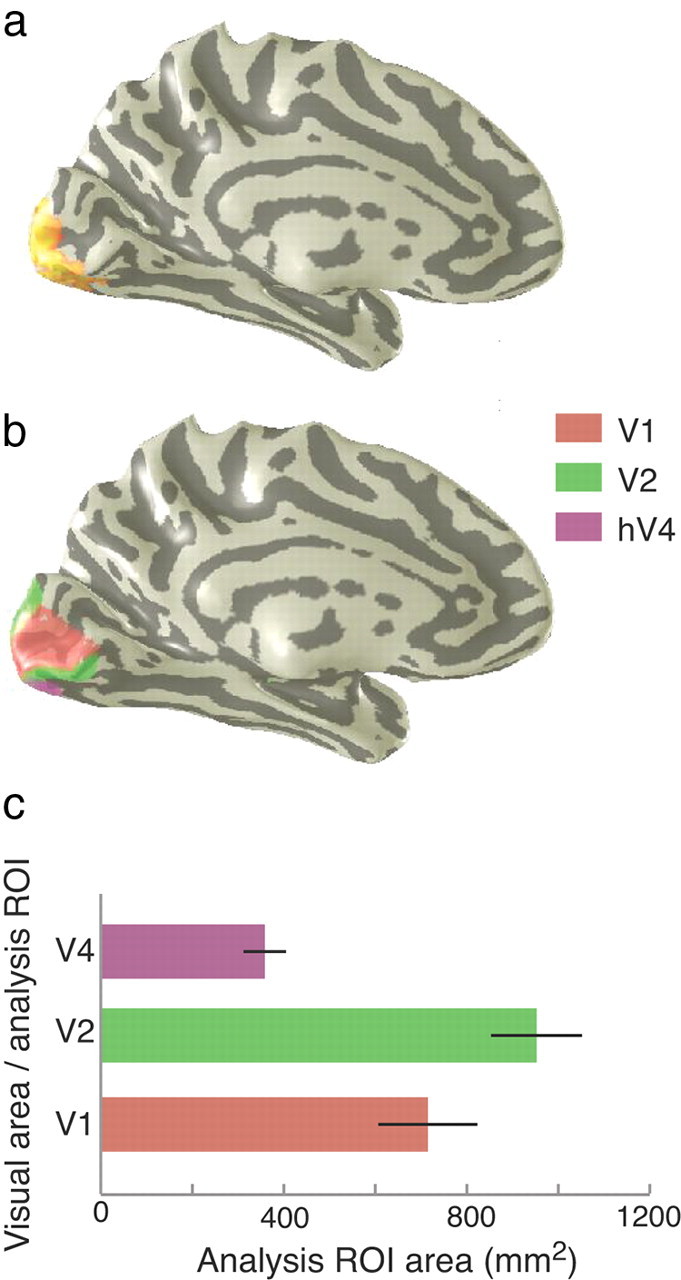
a, Region activated by the annular stimulus rendered on an inflated cortex. b, V1, V2, and hV4 defined from separate retinotopic mapping experiments shown on a single subject's left hemisphere. c, Average sizes of analysis ROIs. ROIs were defined by intersecting visual area ROIs shown in b with localizers shown in a. Visual area sizes were measured on the 3D mesh. Error bars are 1 SEM.
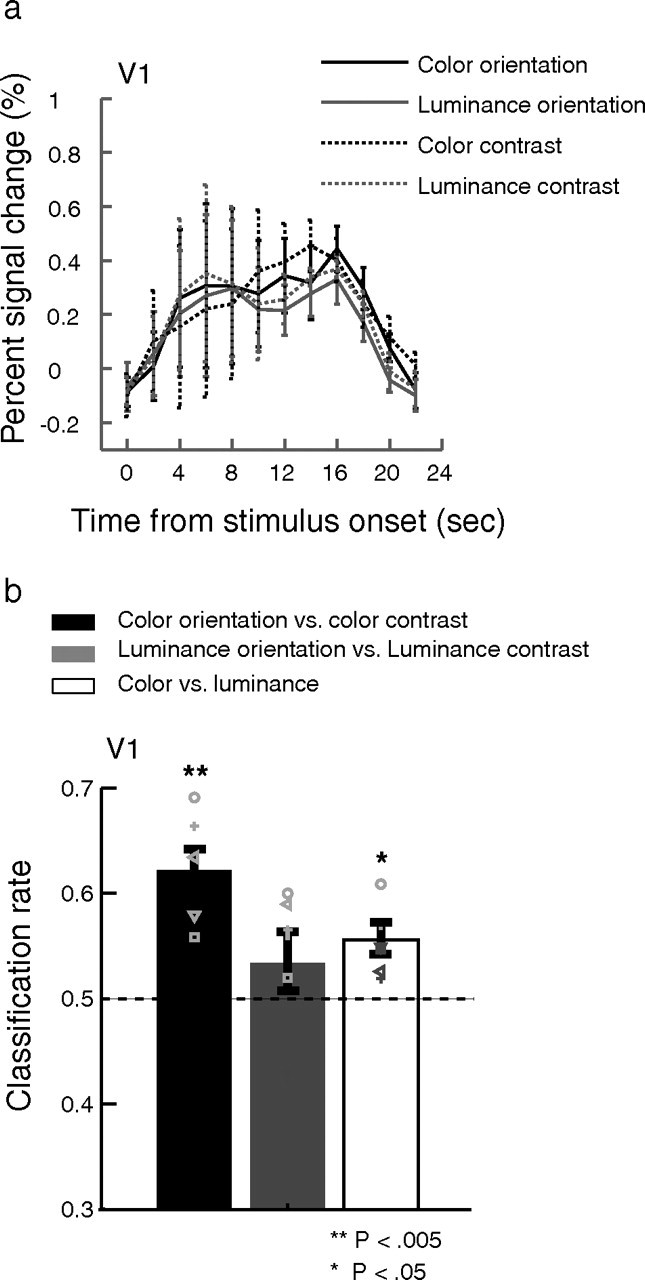
a, Mean responses to different stimulus conditions and attentional tasks. We found no significant univariate differences between conditions. b, Classification performance for AO versus AC using chromatic and achromatic gratings. Performance was highly significant for the chromatic condition but nonsignificant for the achromatic gratings. Overall performance for classifying chromatic versus achromatic gratings in V1 is also well above chance. Error bars are 1 SEM. Symbols are individual subject data.
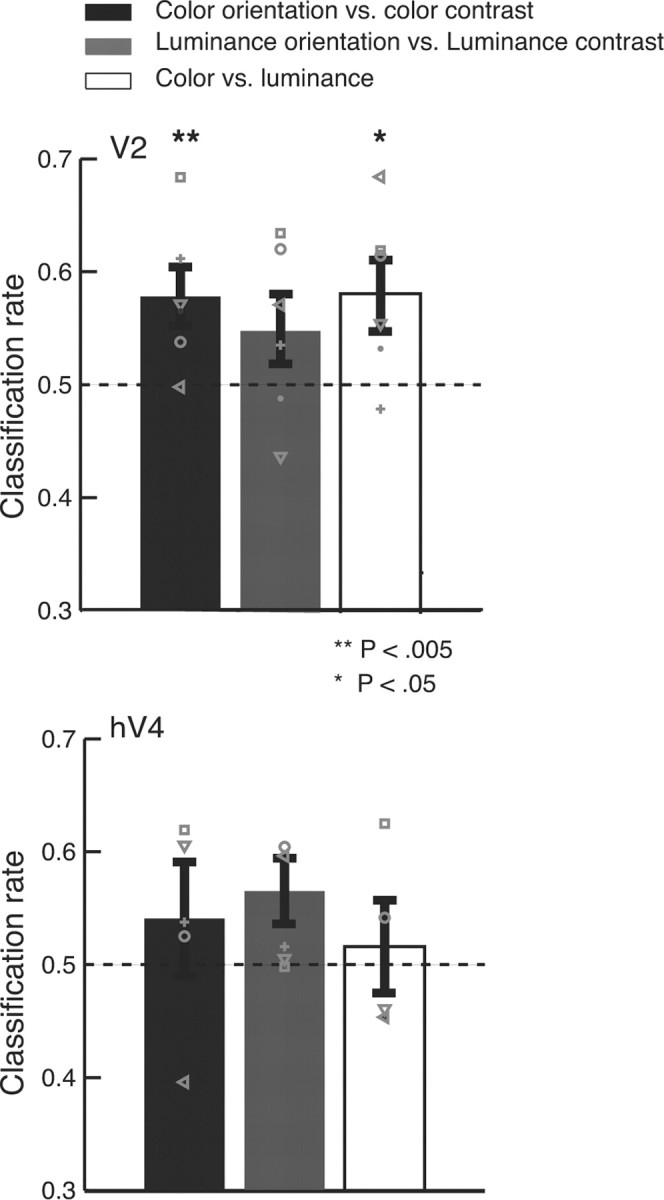
Classification for AO/AC using chromatic and achromatic gratings in V2 and hV4. Conventions are the same as in Figure 3a.
References
-
- Anstis SM, Cavanagh P. A minimum motion technique for judging equiluminance. In: Mollon JD, Sharpe LT, editors. Colour vision: physiology and psychophysics. London: Academic; 1983. pp. 156–166.
-
- Brainard DH. Calibration of a computer controlled color monitor. Color Res Appl. 1989;14:23–34.
-
- Brainard DH. The psychophysics toolbox. Spat Vis. 1997;10:433–436. - PubMed
-
- Brewer AA, Liu J, Wade AR, Wandell BA. Visual field maps and stimulus selectivity in human ventral occipital cortex. Nat Neurosci. 2005;8:1102–1109. - PubMed
Publication types
MeSH terms
Grants and funding
LinkOut - more resources
Full Text Sources
