


Interventions to reduce emigration of health care professionals from low- and middle-income countries
- PMID: 21901709
- PMCID: PMC10823415
- DOI: 10.1002/14651858.CD007673.pub2
Interventions to reduce emigration of health care professionals from low- and middle-income countries
Abstract
Background: The emigration of skilled professionals from low- and middle-income countries (LMICs) to high-income countries (HICs) is a general phenomenon but poses particular challenges in health care, where it contributes to human resource shortages in the health systems of poorer countries. However, little is known about the effects of strategies to help regulate this movement.
Objectives: To assess the effects of policy interventions to regulate emigration of health professionals from LMICs.
Search strategy: We searched the Cochrane Effective Practice and Organisation of Care (EPOC) Group Specialised Register (searched 15 March 2011), the Cochrane Register of Controlled Trials (CENTRAL) (searched 2 March 2011), MEDLINE (searched 5 March 2011), EMBASE (searched 2 March 2011), CINAHL (searched 5 March 2011), LILACS (searched 7 March 2011), WHOLIS (searched 20 March 2011), SocINDEX (searched 11 March 2011), EconLit (searched 8 March 2011), Science and Social Science Citation Index (searched 8 March 2011), NLM Gateway (searched 31 March 2011) and ERIC (searched March 3 2011). We reviewed reference lists of included studies and selected reviews on the topic, contacted authors of included studies and experts on the field, and reviewed relevant websites.
Selection criteria: Randomised controlled trials (RCT), non-randomised controlled trials (NRCT), controlled before-and-after studies (CBA) and interrupted time series (ITS) studies assessing any intervention in the source, the recipient or both countries that could have an impact on the number of professionals that emigrate from a LMIC. Health professionals, such as physicians, dentists, nurses or midwives, should be nationals of a LMIC whose graduate training was in a LMIC.
Data collection and analysis: One review author extracted data onto a standard form and a second review author checked data. Two review authors assessed risk of bias.
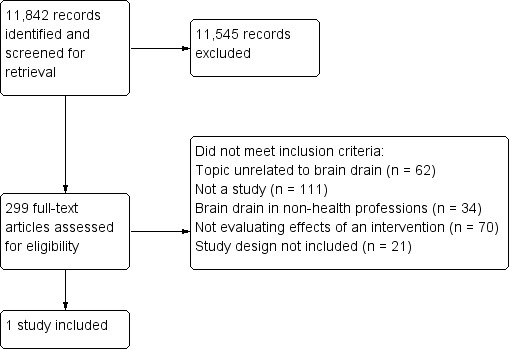
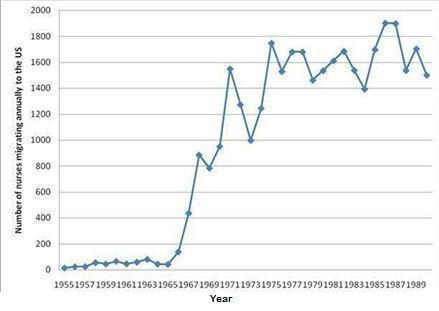
Main results: Only one study was included. This time series study assessed the migration of Philippine nurses to the United States of America (USA) from 1954 to 1990. We re-analysed it as an interrupted time series study. The intervention was a modification of migratory law in the US, called the 'Act of October 1965', which decreased the restrictions on Eastern hemisphere immigrants to the USA. The analysis showed a significant immediate increase of 807.6 (95% confidence interval (CI) 480.9 to 1134.3) in the number of nurses migrating to the USA annually after the intervention. This represents a relative increase of 5000% over the underlying pre-intervention trend. There were no significant differences in the slopes of the underlying trends for the number of nurses migrating between the pre- and postintervention periods.
Authors' conclusions: There is an important gap in knowledge about the effectiveness of policy interventions in either HICs or LMICs that could regulate positively the movement of health professionals from LMICs. The only evidence found was from an intervention in a HIC that increased the movement of health professionals from a LMIC.New initiatives to improve records on the migration of health professionals from LMICs should be implemented, as a prerequisite to conducting more rigorous research in the field. This research should focus on whether the range of interventions outlined in the literature could be effective in retaining health professionals in LMICs. Such interventions include financial rewards, career development and continuing education, improving hospital infrastructure, resource availability, better hospital management and improved recognition of health professionals.
Conflict of interest statement
The authors of the review do not have any conflicts of interest to declare.
Figures
Update of
References
References to studies included in this review
Muncada 1995 {published and unpublished data}
-
- Muncada FL. The labor migration of Philippine nurses to the United States. The labor migration of Philippine nurses to the United States. Catholic University of America, 1995.
References to studies excluded from this review
Bach 2007 {published data only}
-
- Bach S. Going global? The regulation of nurse migration in the UK. British Journal of Industrial Relations 2007;45(2):383‐403.
Barnighausen 2009 {published data only}
-
- Barnighausen T, Bloom DE. "Conditional scholarships" for HIV/AIDS health workers: educating and retaining the workforce to provide antiretroviral treatment in sub‐Saharan Africa. Social Science & Medicine 2009;68(3):544‐51. - PubMed
Bhagwati 1976 {published data only}
-
- Bhagwati J. The brain drain. International Social Science Journal 1976;28(4):691.
Bourgain 2010 {published data only}
-
- Bourgain A, Pieretti P, Zou B. The migration of medical workers in Sub‐Saharan Africa and substitution policy [Migration des professionnels de sante de pays d'Afrique subsaharienne et politique de substitution]. Revue Economique 2010;61(6):1011‐22.
Buchan 2002 {published data only}
-
- Buchan J. International recruitment of nurses: United Kingdom case study. London, Royal College of Nursing; World Health Organization; International Council of Nurses 2002.
Buchan 2004a {published data only}
-
- Buchan J, Dovlo D. International Recruitment of Health Workers to the UK: A Report for DFID. DFID Health Systems Resource Centre (www.healthsystemsrc.org) 2004.
Herfs 2007 {published data only}
-
- Herfs PG, Kater L, Haalboom JR. Non‐EEA doctors in EEA countries: doctors or cleaners?. Medical Teacher 2007;29(4):383‐9. - PubMed
Kaushik 2008 {published data only}
Kugler 2003 {published data only}
-
- Kugler A, Sauer RM. Doctors without Borders: The Returns to an Occupational License for Soviet Immigrant Physicians in Israel. RePEc Project 2003.
Lorenzo 2005 {published data only}
-
- Lorenzo F. Migration of health workers: country case study Philippines. Institute of Health Policy and Development Studies, Geneva, International Labour Office 2005.
Manning 2007 {published data only}
-
- Manning C, Sidorenko A. The regulation of professional migration: insights from the health and IT sectors in ASEAN. World Economy 2007;30(7):1084‐113.
Martineau 2006 {published data only}
-
- Martineau T, Willetts A. The health workforce: managing the crisis ethical international recruitment of health professionals: will codes of practice protect developing country health systems?. Health Policy 2006;75(3):358‐67. - PubMed
Masango 2008 {published data only}
-
- Masango S, Gathu K, Sibandze S. Retention strategies for Swaziland's health sector workforce: assessing the impact of non‐financial incentives. Harare, Ministry of Health Swaziland, EQUINET, ECSA‐HC. EQUINET. Discussion Paper Series N° 68. 2008.
Masselink 2009 {published data only}
-
- Masselink L, Lee SY. Title: Nurses, Inc.: Philippine nursing schools as migrant institutions. Conference Papers ‐ American Sociological Association. 2009.
Masselink 2010 {published data only}
-
- Masselink L, Lee SY. Nurses, Inc.: expansion and commercialization of nursing education in the Philippines. Social Science & Medicine 2010;71(1):166‐72. - PubMed
Mejía 2004 {published data only}
Moullan 2009 {published data only}
-
- Moullan Y. Can Foreign Health Assistance Reduce the Medical Brain Drain?. IRES ‐ Institut de Recherches Economiques et Sociales 2009.
Mufunda 2007 {published data only}
-
- Mufunda J, Chatora R, Ndambakuwa Y, Samkange C, Sigola L, Vengesa P. Challenges in training the ideal doctor for Africa: lessons learned from Zimbabwe. Medical Teacher 2007;29(9):878‐81. - PubMed
Rao 2003 {published data only}
-
- Rao NR. Recent trends in psychiatry residency workforce with special reference to international medical graduates. Academic Psychiatry 2003;27(4):269‐76. - PubMed
Wiwanitkit 2011 {published data only}
-
- Wiwanitkit V. Mandatory rural service for health care workers in Thailand. Rural Remote Health 2011;11(1):1583. - PubMed
Xu 2005 {published data only}
-
- Xu Y, Zhang J. One size doesn't fit all: ethics of international nurse recruitment from the conceptual framework of stakeholder interests. Nursing Ethics 2005;12(6):571‐81. - PubMed
Additional references
Bach 2003
-
- Bach S. International migration of health workers: labor and social issues (Working paper #209). Sectoral Activities Programme, International Labour Office 2003.
Buchan 2003
-
- Buchan J, Parkin T, Sochalski J. International nurse mobility: trends and policy implications. http://www.who/EIP/OSD/2003.3 (accessed July 2007).
Buchan 2004b
Chikanda 2005
-
- Chikanda A. Nurse migration from Zimbabwe: analysis of recent trends and impact. Nursing Inquiry 2005;12(3):162‐74. - PubMed
Chimbari 2008
-
- Chimbari MJ, Madhina D, Nyamangara F, Mtandwa H, Damba V. An assessment of the Zimbabwe government strategy for retention of health professionals. EQUINET Discussion Paper. Series 65.
Clemens 2006
-
- Clemens M, Petterson G. A New Database of Health Professional Emigration from Africa (Working Paper 95). Centre for Global Development(http://www.cgdev.org) August 2006. [http://www.queensu.ca/samp/migrationresources/Documents/DB_HealthProfess...
Cochrane Handbook
-
- Higgins JPT, Green S (editors). Cochrane Handbook for Systematic Reviews of Interventions Version 5.0.1 [September 2008]. The Cochrane Collaboration 2008. Available from www.cochrane‐handbook.org.
Connell 2007
-
- Connell J, Zurn P, Stilwell B, Awases M, Braichet JM. Sub‐Saharan Africa: Beyond the health worker migration crisis?. Social Science & Medicine 2007;64:1876‐91. - PubMed
Dal Poz 2006
-
- Dal Poz MR, Kinfu Y, Drager S, Kunyumen T, Diallo K. Counting health workers: definitions, data, methods and global results. Background paper for The World Health Report 2006. http://www.who.int/hrh/documents/en (accessed January 2008).
Diallo 2004
Dovlo 2003
-
- Dovlo D. The brain drain and retention of health professionals in Africa. A case study prepared for a regional training conference. Improving tertiary education in Sub‐Saharan Africa: things that work! 2003.
Dovlo 2004
-
- Dovlo D, Martineau T. A Joint Learning Initiative: Human Resources for Health and Development. A Review of the Migration of Africa's Health Professionals.. JLI Working Paper 4‐4 2004.
Dovlo 2007
Global Forum 2007
-
- Global forum on migration and development. http://www.gfmd.com (accessed October 2007).
Gobler 2009
Handbook 2006
-
- Handbook on establishing effective labour migration policies in countries of origin and destination. www.gfmd‐fmmd.org/en/document‐library‐en/42 (accessed December 2007).
Hawkes 2009
Martineau 2004
-
- Martineau T, Decker K, Bundred P. "Brain drain" of health professionals: from rhetoric to responsible action. Health Policy 2004;70(1):1‐10. - PubMed
OECD/WHO
-
- OECD/WHO. Policy Brief. International Migration of Health Workers. Improving International Cooperation to Address the Global Health Workforce Crisis. OECD Observer February 2010 (available in: http://www.oecd.org/document/47/0,3343,en_2649_33929_36506543_1_1_1_3740...) (accessed April 2010).
Starfield 2007
Stilwell 2003
Stilwell 2004
United Nations 2006
-
- United Nations. International migration 2006, wall chart. www.un.org/esa/population/publications/2006migration_chart/migration2006... (accessed October 2007).
WHO 2006
-
- Working together for health. World Health Report. World Health Organization 2006.
WHO 2010
-
- WHO's Global Policy Recommendations: increasing access to health workers in remote and rural areas through improved retention. World Health Organization 2010. - PubMed
Willets 2004
-
- Willets A, Martineau T. Ethical international recruitment of health professionals: will codes of practice protect developing country health systems?. http://www.liv.ac.uk/lstm/research/documents/codeofpracticereport.pdf (accessed October 2007). - PubMed
Willis‐Shattuck 2008
World Bank
-
- The World Bank. Country Classification. http://data.worldbank.org/about/country‐classifications (accessed January 2008).
Publication types
MeSH terms
LinkOut - more resources
Full Text Sources
Miscellaneous
