. 2011 Sep 30;333(6051):1888-91.
doi: 10.1126/science.1208592. Epub 2011 Sep 8.

An expanded palette of genetically encoded Ca²⁺ indicators

Affiliations

An expanded palette of genetically encoded Ca²⁺ indicators

Yongxin Zhao et al. Science. .

Abstract

Engineered fluorescent protein (FP) chimeras that modulate their fluorescence in response to changes in calcium ion (Ca(2+)) concentration are powerful tools for visualizing intracellular signaling activity. However, despite a decade of availability, the palette of single FP-based Ca(2+) indicators has remained limited to a single green hue. We have expanded this palette by developing blue, improved green, and red intensiometric indicators, as well as an emission ratiometric indicator with an 11,000% ratio change. This series enables improved single-color Ca(2+) imaging in neurons and transgenic Caenorhabditis elegans. In HeLa cells, Ca(2+) was imaged in three subcellular compartments, and, in conjunction with a cyan FP-yellow FP-based indicator, Ca(2+) and adenosine 5'-triphosphate were simultaneously imaged. This palette of indicators paints the way to a colorful new era of Ca(2+) imaging.


Figures
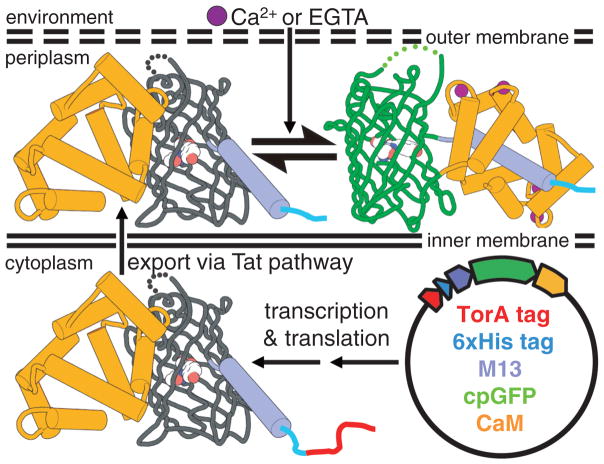
Fig. 1
Fig. 1
Schematic of the system for image-based screening of E. coli colonies. The GCaMP variant, as represented by GCaMP2 (PDB ID 3EVU and 3EVR) (6), has a TorA periplasmic export tag (17).
Fig. 2
Fig. 2
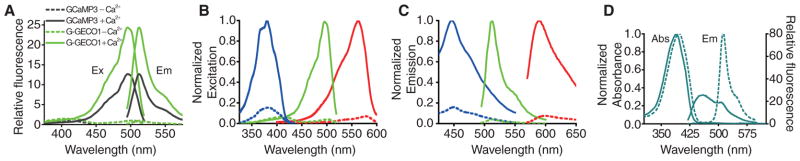
Spectral profiles of GECOs. (A) Fluorescence excitation (Ex) and emission spectra (Em) normalized to the Ca2+-free state. (B) Normalized excitation spectra of Ca2+-free (dashed line) and Ca2+-bound (solid line) B-GECO1 (blue), G-GECO1 (green), and R-GECO1 (red). (C) Emission spectra represented as in (B). (D) Absorbance (Abs) and emission spectra for Ca2+-free (dashed line) and Ca2+-bound (solid line) GEM-GECO1.
Fig. 3
Fig. 3
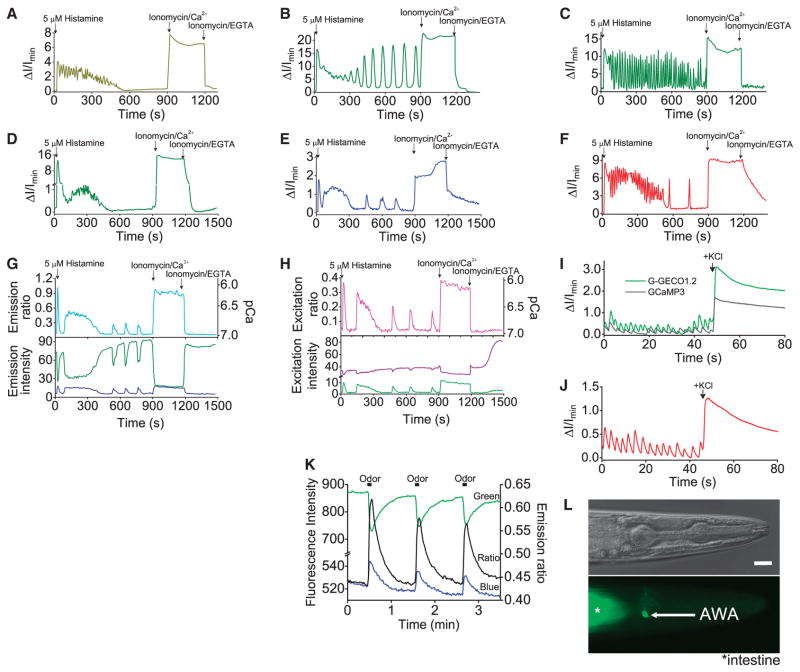
Single-color imaging with GECOs. (A to H) Intensity versus time traces for transfected HeLa cells. (A) GCaMP3, (B) G-GECO1, (C) G-GECO1.1, (D) G-GECO1.2, (E) B-GECO1, (F) R-GECO1, (G) GEM-GECO1, and (H) GEX-GECO1. Ionomycin/Ca2+, ionomycin/EGTA, and the initial histamine-induced spike are generally consistent for a given variant (table S4), but the histamine-induced oscillations are highly variable between cells. Accordingly, lower-amplitude oscillations [e.g., (A) and (D)] do not necessarily indicate poorer indicator performance. (I) Imaging of spontaneous Ca2+ oscillations in neurons. (J) R-GECO1 imaged under conditions similar to those in (I). (K) Ratiometric imaging of C. elegans with GEM-GECO1 expressed in the AWA neuron. (L) Bright-field and fluorescence images of the worm imaged in (K). Scale bar, 10 μm. Filter specifications are in table S5.
Fig. 4
Fig. 4
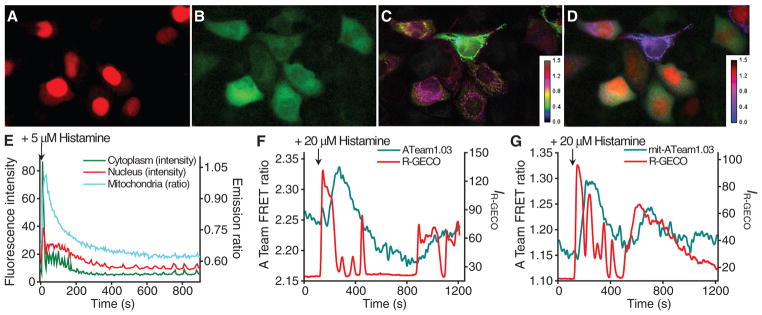
Multicolor imaging with GECOs. (A to C) HeLa cells transfected with nucleus-localized R-GECO1, cytoplasmic G-GECO1, and mitochondria-localized GEM-GECO1. (A) Red fluorescence. (B) Green fluorescence with cyan (~470 nm) excitation. (C) Pseudocolored ratio of blue to green fluorescence with UV (~380-nm) excitation (C). (D) Merge of images (A) to (C), with GEM-GECO1 ratio in magenta. Images are from movie S1. (E) Intensity or ratio versus time traces for each channel represented in (A) to (C). Filter specifications are in table S5. (F) Imaging of cytoplasmic Ca2+ and ATP. (G) Imaging of cytoplasmic Ca2+ and mitochondrial ATP.

References

    1. Tsien RY. In: Calcium as a Cellular Regulator. Carafoli E, Klee CB, editors. Oxford Univ. Press; Oxford: 1999. pp. 28–54.
    1. Miyawaki A, et al. Nature. 1997;388:882. - PubMed
    1. Nakai J, Ohkura M, Imoto K. Nat Biotechnol. 2001;19:137. - PubMed
    1. Nagai T, Sawano A, Park ES, Miyawaki A. Proc Natl Acad Sci USA. 2001;98:3197. - PMC - PubMed
    1. Single-letter abbreviations for amino acid residues are: Ala A, Cys C, Asp D, Glu E, Phe F, Gly G, His H, Ile I, Lys K, Leu L, Met M, Asn N, Pro P, Gln Q, Arg R, Ser S, Thr T, Val V, Trp W, Tyr Y.

Publication types

MeSH terms