


Respiratory muscle training improves hemodynamics, autonomic function, baroreceptor sensitivity, and respiratory mechanics in rats with heart failure
- PMID: 21903877
- PMCID: PMC5504417
- DOI: 10.1152/japplphysiol.01245.2010
Respiratory muscle training improves hemodynamics, autonomic function, baroreceptor sensitivity, and respiratory mechanics in rats with heart failure
Abstract
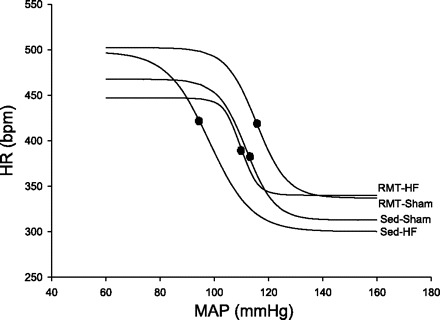
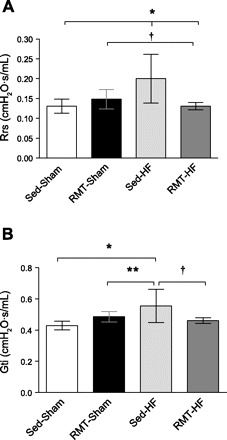
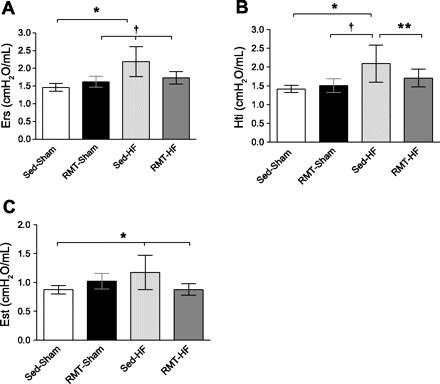
Respiratory muscle training (RMT) improves functional capacity in chronic heart-failure (HF) patients, but the basis for this improvement remains unclear. We evaluate the effects of RMT on the hemodynamic and autonomic function, arterial baroreflex sensitivity (BRS), and respiratory mechanics in rats with HF. Rats were assigned to one of four groups: sedentary sham (n = 8), trained sham (n = 8), sedentary HF (n = 8), or trained HF (n = 8). Trained animals underwent a RMT protocol (30 min/day, 5 day/wk, 6 wk of breathing through a resistor), whereas sedentary animals did not. In HF rats, RMT had significant effects on several parameters. It reduced left ventricular (LV) end-diastolic pressure (P < 0.01), increased LV systolic pressure (P < 0.01), and reduced right ventricular hypertrophy (P < 0.01) and pulmonary (P < 0.001) and hepatic (P < 0.001) congestion. It also decreased resting heart rate (HR; P < 0.05), indicating a decrease in the sympathetic and an increase in the vagal modulation of HR. There was also an increase in baroreflex gain (P < 0.05). The respiratory system resistance was reduced (P < 0.001), which was associated with the reduction in tissue resistance after RMT (P < 0.01). The respiratory system and tissue elastance (Est) were also reduced by RMT (P < 0.01 and P < 0.05, respectively). Additionally, the quasistatic Est was reduced after RMT (P < 0.01). These findings show that a 6-wk RMT protocol in HF rats promotes an improvement in hemodynamic function, sympathetic and vagal heart modulation, arterial BRS, and respiratory mechanics, all of which are benefits associated with improvements in cardiopulmonary interaction.
Figures
References
-
- Antunes-Correa LM, Melo RC, Nobre TS, Ueno LM, Franco FGM, Braga AMW, Rondon MUPB, Brum PC, Barretto ACP, Middlekauff HR, Negrao CE. Impact of gender on benefits of exercise training on sympathetic nerve activity and muscle blood flow in heart failure. Eur J Heart Fail 12: 58–65, 2010. - PMC - PubMed
-
- Bernardi L, Porta C, Gabutti A, Spicuzza L, Sleight P. Modulatory effects of respiration. Auton Neurosci 90: 47–56, 2001. - PubMed
-
- Bernardi L, Porta C, Spicuzza L, Bellwon J, Spadacini G, Frey AW, Yeung LY, Sanderson JE, Pedretti R, Tramarin R. Slow breathing increases arterial baroreflex sensitivity in patients with chronic heart failure. Circulation 105: 143–145, 2002. - PubMed
-
- Bisschop A, Gayan-Ramirez G, Rollier H, Gosselink R, Dom R, de Bock V, Decramer M. Intermittent inspiratory muscle training induces fiber hypertrophy in rat diaphragm. Am J Respir Crit Care Med 155: 1583–1589, 1997. - PubMed
-
- Cabanes LR, Weber SN, Matran R, Regnard J, Richard MO, Degeorges ME, Lockhart A. Bronchial hyperresponsiveness to methacholine in patients with impaired left ventricular function. N Engl J Med 320: 1317–1322, 1989. - PubMed
Publication types
MeSH terms
Grants and funding
LinkOut - more resources
Full Text Sources
Other Literature Sources
Medical
Research Materials
Miscellaneous
