


Exercise lowers estrogen and progesterone levels in premenopausal women at high risk of breast cancer
- PMID: 21903887
- PMCID: PMC4116411
- DOI: 10.1152/japplphysiol.00319.2011
Exercise lowers estrogen and progesterone levels in premenopausal women at high risk of breast cancer
Abstract
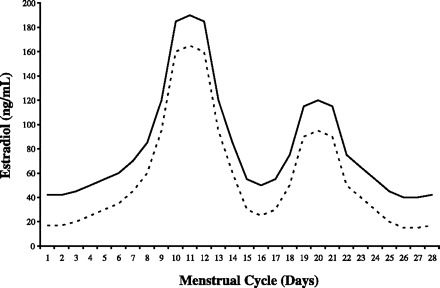
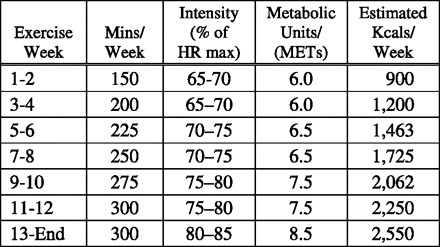
Experimental and clinical data support a role for estrogens in the development and growth of breast cancer, and lowered estrogen exposure reduces breast cancer recurrence and new diagnoses in high-risk women. There is varied evidence that increased physical activity is associated with breast cancer risk reduction in both pre- and postmenopausal women, perhaps via lowered estrogen levels. The purpose of this study was to assess whether exercise intervention in premenopausal women at increased breast cancer risk reduces estrogen or progesterone levels. Seven healthy premenopausal women at high risk for breast cancer completed a seven-menstrual-cycle study. The study began with two preintervention cycles of baseline measurement of hormone levels via daily first-morning urine collection, allowing calculation of average area under the curve (AUC) hormone exposure across the menstrual cycle. Participants then began five cycles of exercise training to a maintenance level of 300 min per week at 80-85% of maximal aerobic capacity. During the last two exercise cycles, urinary estradiol and progesterone levels were again measured daily. Total estrogen exposure declined by 18.9% and total progesterone exposure by 23.7%. The declines were mostly due to decreased luteal phase levels, although menstrual cycle and luteal phase lengths were unchanged. The study demonstrated the feasibility of daily urine samples and AUC measurement to assess hormone exposure in experimental studies of the impact of interventions on ovarian hormones. The results suggest value in exercise interventions to reduce hormone levels in high-risk women with few side effects and the potential for incremental benefits to surgical or pharmacologic interventions.
Figures

References
-
- Aiello EJ, Tworoger SS, Yasui Y, Stanczyk FZ, Potter J, Ulrich CM, Irwin M, McTiernan A. Associations among circulating sex hormones, insulin-like growth factor, lipids, and mammographic density in postmenopausal women. Cancer Epidemiol Biomarkers Prev 14: 1411–1417, 2005 - PubMed
-
- Beitins IZ, McArthur JW, Turnbull BA, Skrinar GS, Bullen BA. Exercise induces two types of human luteal dysfunction: confirmation by urinary free progesterone. J Clin Endocrinol Metab 72: 1350–1358, 1991 - PubMed
-
- Boyd NF, Guo H, Martin LJ, Sun L, Stone J, Fishell E, Jong RA, Hislop G, Chiarelli A, Minkin S, Yaffe MJ. Mammographic density and the risk and detection of breast cancer. N Engl J Med 356: 227–236, 2007 - PubMed
-
- Bruce RA, Kusumi F, Hosmer D. Maximal oxygen intake and nomographic assessment of functional aerobic impairment in cardiovascular disease. Am Heart J 85: 546–562, 1973 - PubMed
-
- Bullen BA, Skrinar GS, Beitins IZ, von Mering G, Turnbull BA, McArthur JW. Induction of menstrual disorders by strenuous exercise in untrained women. N Engl J Med 312: 1349–1353, 1985 - PubMed
Publication types
MeSH terms
Substances
Grants and funding
LinkOut - more resources
Full Text Sources
Medical
