


Isoflavone soy protein supplementation and atherosclerosis progression in healthy postmenopausal women: a randomized controlled trial
- PMID: 21903957
- PMCID: PMC3202054
- DOI: 10.1161/STROKEAHA.111.620831
Isoflavone soy protein supplementation and atherosclerosis progression in healthy postmenopausal women: a randomized controlled trial
Abstract
Background and purpose: Although epidemiological and experimental studies suggest that dietary intake of soy may be cardioprotective, use of isoflavone soy protein (ISP) supplementation as a primary preventive therapy remains unexplored. We determined whether ISP reduces subclinical atherosclerosis assessed as carotid artery intima-media thickness progression.
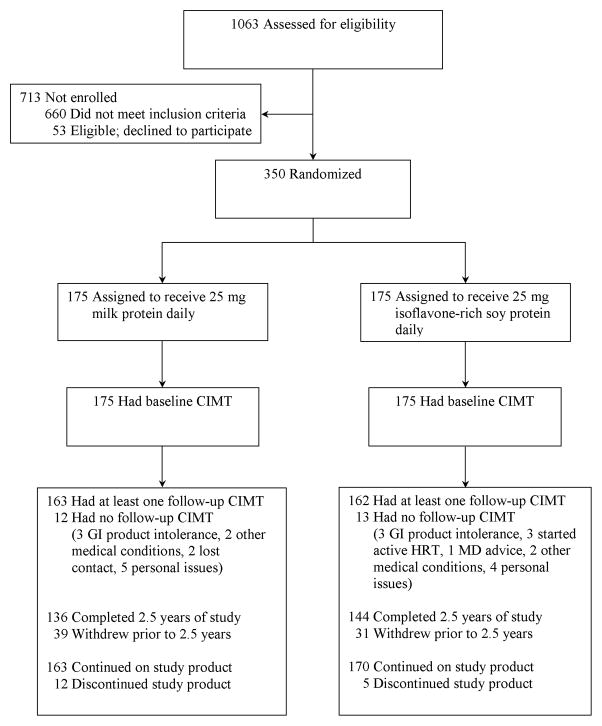
Methods: In a double-blind, placebo-controlled trial, 350 postmenopausal women 45 to 92 years of age without diabetes and cardiovascular disease were randomized to 2 evenly divided daily doses of 25 g soy protein containing 91 mg aglycon isoflavone equivalents or placebo for 2.7 years.
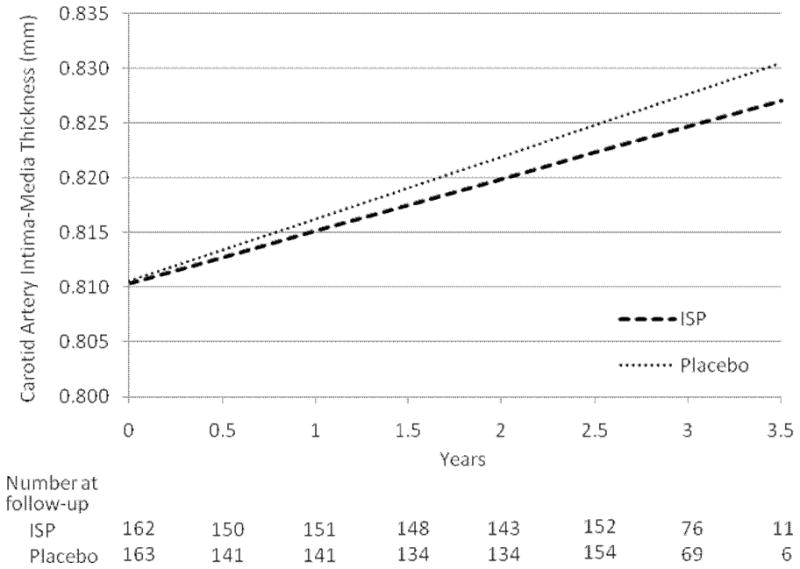
Results: Overall, mean (95% CI) carotid artery intima-media thickness progression rate was 4.77 (3.39-6.16) μm/year in the ISP group and 5.68 (4.30-7.06) μm/year in the placebo group. Although carotid artery intima-media thickness progression was reduced on average by 16% in the ISP group relative to the placebo group, this treatment effect was not statistically significant (P=0.36). Among the subgroup of women who were randomized within 5 years of menopause, ISP participants had on average a 68% lower carotid artery intima-media thickness progression rate than placebo participants 2.16 (-1.10 to 5.43) versus 6.79 (3.56-10.01) μm/year (P=0.05). ISP supplementation had a null effect on women who were >5 years beyond menopause when randomized. There were no major adverse events from ISP supplementation.
Conclusions: ISP supplementation did not significantly reduce subclinical atherosclerosis progression in postmenopausal women. Subgroup analysis suggests that ISP supplementation may reduce subclinical atherosclerosis in healthy young (median age, 53 years) women at low-risk for cardiovascular disease who were <5 years postmenopausal. These first trial results of their kind warrant further investigation.
Trial registration: ClinicalTrials.gov NCT00118846.
Figures
References
-
- Spencer Gregory., editor. U.S. Bureau of the Census Population Reports. Series P-25, No. 1018, Projections of the Population of the United States, by Age, Sex, and Race: 1988 to 2080. U.S. Government Printing Office; Washington, D.C.: 1989.
-
- Eisenberg DM, Kessler RC, Foster C, Norlock FE, Calkins DR, Delbanco TL. Unconventional medicine in the United States: prevalence, costs and patterns of use. N Engl J Med. 1993;328:246–252. - PubMed
-
- Stadberg E, Mattsson LA, Milsom I. The prevalence and severity of climacteric symptoms and the use of different treatment regimens in a Swedish population. Acta Obstet Gynecol Scand. 1997;76:442–448. - PubMed
-
- Kuiper GGJM, Carlson B, Grandien K, Enmark E, Haggblad J, Nilsson S, et al. Comparison of the ligand binding specificity and transcript tissue distribution of estrogen receptors α and β. Endocrinology. 1997;138:863–870. - PubMed
-
- Kuiper GGJM, Lemmen JG, Carlsson B, Corton JC, Safe SH, van der Saag PT, et al. Interaction of estrogenic chemicals and phytoestrogens with estrogen receptor β. Endocrinology. 1998;139:4252–4263. - PubMed
Publication types
MeSH terms
Substances
Associated data
Grants and funding
LinkOut - more resources
Full Text Sources
Medical
