. 2011 Sep 1;67(Pt 9):998-1005.
doi: 10.1107/S1744309111017374. Epub 2011 Aug 13.

Immobilized metal-affinity chromatography protein-recovery screening is predictive of crystallographic structure success

Affiliations

Immobilized metal-affinity chromatography protein-recovery screening is predictive of crystallographic structure success

Ryan Choi et al. Acta Crystallogr Sect F Struct Biol Cryst Commun. .

Abstract

The recombinant expression of soluble proteins in Escherichia coli continues to be a major bottleneck in structural genomics. The establishment of reliable protocols for the performance of small-scale expression and solubility testing is an essential component of structural genomic pipelines. The SSGCID Protein Production Group at the University of Washington (UW-PPG) has developed a high-throughput screening (HTS) protocol for the measurement of protein recovery from immobilized metal-affinity chromatography (IMAC) which predicts successful purification of hexahistidine-tagged proteins. The protocol is based on manual transfer of samples using multichannel pipettors and 96-well plates and does not depend on the use of robotic platforms. This protocol has been applied to evaluate the expression and solubility of more than 4000 proteins expressed in E. coli. The UW-PPG also screens large-scale preparations for recovery from IMAC prior to purification. Analysis of these results show that our low-cost non-automated approach is a reliable method for the HTS demands typical of large structural genomic projects. This paper provides a detailed description of these protocols and statistical analysis of the SSGCID screening results. The results demonstrate that screening for proteins that yield high recovery after IMAC, both after small-scale and large-scale expression, improves the selection of proteins that can be successfully purified and will yield a crystal structure.


Figures
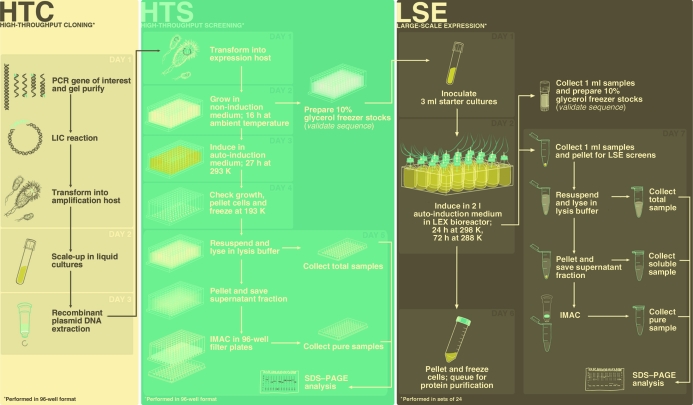
Figure 1
Figure 1
Standard workflow based on UW-PPG’s current cloning, HTS and LSE protocols. Cloning and HTS procedures are carried out manually in 96-well plates and can be completed in two weeks. LSE and screens are performed in sets of 24 using the LEX bioreactor and can be carried out in one week, with the induction step proceeding over the weekend. See Bryan et al. (2011 ▶) for a detailed protein-purification workflow.
Figure 2
Figure 2
(a) AVA0421 vector map. (b) Ligation-independent cloning (LIC) site of AVA0421 and LIC-ready reaction of inserts.
Figure 3
Figure 3
An example of an SDS–PAGE gel displaying the HTS results for 11 M. smegmatis target proteins. Reading from left to right, the first lane shows the protein ladder (in kDa). The next two lanes show the total (T) and IMAC elution (P) fractions of a positive control that is known to have high IMAC recovery. The following lanes represent a total of 11 target proteins of two lanes each, alternating between their T and P fractions. IMAC-recovery scores are determined by evaluating the size of each band (as described in §2.2.5), e.g. target s38 A03’s recovery would be scored as low, s38 A06’s recovery would be scored as medium and s38 A05’s recovery would be scored as high. Targets s38 A09 and s38 A10 are insoluble and would not be queued for scale up in LSE.
Figure 4
Figure 4
The LEX-48 bioreactor growing 24 individual 2 l cultures. Its overall design features an enclosure with a multi-stage replaceable carbon + HEPA filter forced-air hood, two water circulators, customizable controls for aeration, efficient water-bath regulation of temperature conditions and fully sterilizable components.
Figure 5
Figure 5
An example of an SDS–PAGE gel of LSE screens of eight expressed M. smegmatis target proteins. The two outermost lanes hold the protein ladders (labeled in kDa). Each target protein-expression preparation occupies three lanes: total expressed (T), soluble expressed (S) and IMAC elution pure (P) fractions. The variations in expression levels as seen in this gel are typical. The solubility-scoring system is identical to that of the HTS (as described in §2.2.5). Target protein recoverability after IMAC would be scored as low for 2, 3 and 7, medium for 5 and 6, and high for 4 and 8. Target 1 is primarily insoluble and would not be queued for purification.
Figure 6
Figure 6
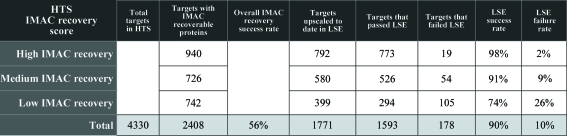
HTS IMAC recovery results (high, medium or low) and LSE screening success rates.
Figure 7
Figure 7
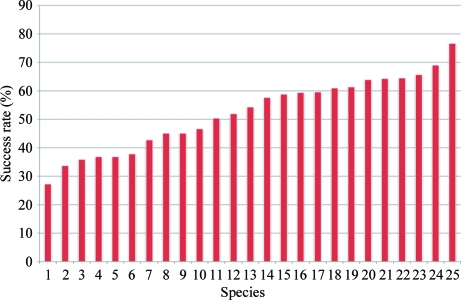
HTS IMAC recovery success rates (y axis) of 25 commonly screened species (x axis), where HTS success is defined by the number of preparations that had either low, medium or high IMAC recovery divided by the total screened and multiplied by 100. 1, Plasmodium falciparum; 2, Coccidioides immitis; 3, Mycobacterium bovis; 4, M. leprae; 5, Toxoplasma gondii; 6, M. ulcerans; 7, Borrelia burgdorferi; 8, Anaplasma phagocytophilum; 9, M. tuberculosis; 10, Entamoeba histolytica; 11, Rickettsia prowazekii; 12, Babesia bovis; 13, Encephalitozoon cuniculi; 14, M. thermoresistible; 15, M. avium; 16, Cryptosporidium parvum; 17, M. abscessus; 18, Burkholderia pseudomallei; 19, Bartonella henselae; 20, M. marinum; 21, Ehrlichia chaffeensis; 22, M. paratuberculosis; 23, Giardia lamblia; 24, Brucella abortus; 25, M. smegmatis.
Figure 8
Figure 8
(a) Relationship between HTS IMAC-recovery scores (x axis) and LSE success (y axis, left) and failure rates (y axis, right). (b) A comparison of HTS IMAC-recovery scores (x axis) and LSE IMAC-recovery results (y axis).
Figure 9
Figure 9
LSE screening IMAC-recovery results, protein-purification and structure-determination success rates.

References

    1. Alexandrov, A., Vignali, M., LaCount, D. J., Quartley, E., de Vries, C., De Rosa, D., Babulski, J., Mitchell, S. F., Schoenfeld, L. W., Fields, S., Hol, W. G., Dumont, M. E., Phizicky, E. M. & Grayhack, E. J. (2004). Mol. Cell. Proteomics, 3, 934–938. - PubMed
    1. Alzari, P. M. et al. (2006). Acta Cryst. D62, 1103–1113.
    1. Aslanidis, C. & de Jong, P. J. (1990). Nucleic Acids Res. 18, 6069–6074. - PMC - PubMed
    1. Benita, Y., Wise, M. J., Lok, M. C., Humphery-Smith, I. & Oosting, R. S. (2006). Mol. Cell. Proteomics, 5, 1567–1580. - PubMed
    1. Berrow, N. S. et al. (2006). Acta Cryst. D62, 1218–1226. - PubMed

Publication types