. 2011 Sep 1;67(Pt 9):1006-9.
doi: 10.1107/S1744309111022159. Epub 2011 Aug 13.

Expression of proteins in Escherichia coli as fusions with maltose-binding protein to rescue non-expressed targets in a high-throughput protein-expression and purification pipeline

Affiliations

Expression of proteins in Escherichia coli as fusions with maltose-binding protein to rescue non-expressed targets in a high-throughput protein-expression and purification pipeline

Stephen N Hewitt et al. Acta Crystallogr Sect F Struct Biol Cryst Commun. .

Abstract

Despite recent advances, the expression of heterologous proteins in Escherichia coli for crystallization remains a nontrivial challenge. The present study investigates the efficacy of maltose-binding protein (MBP) fusion as a general strategy for rescuing the expression of target proteins. From a group of sequence-verified clones with undetectable levels of protein expression in an E. coli T7 expression system, 95 clones representing 16 phylogenetically diverse organisms were selected for recloning into a chimeric expression vector with an N-terminal histidine-tagged MBP. PCR-amplified inserts were annealed into an identical ligation-independent cloning region in an MBP-fusion vector and were analyzed for expression and solubility by high-throughput nickel-affinity binding. This approach yielded detectable expression of 72% of the clones; soluble expression was visible in 62%. However, the solubility of most proteins was marginal to poor upon cleavage of the MBP tag. This study offers large-scale evidence that MBP can improve the soluble expression of previously non-expressing proteins from a variety of eukaryotic and prokaryotic organisms. While the behavior of the cleaved proteins was disappointing, further refinements in MBP tagging may permit the more widespread use of MBP-fusion proteins in crystallographic studies.


Figures
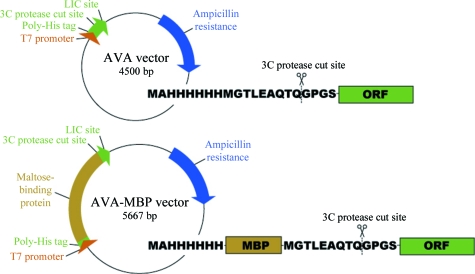
Figure 1
Figure 1
Comparison of AVA vector and AVA-MBP vector.
Figure 2
Figure 2
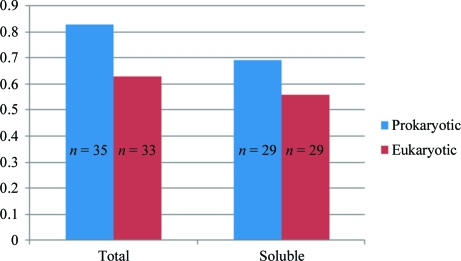
Distribution of protein solubility by species, grouped by prokaryotic and eukaryotic kingdoms.
Figure 3
Figure 3
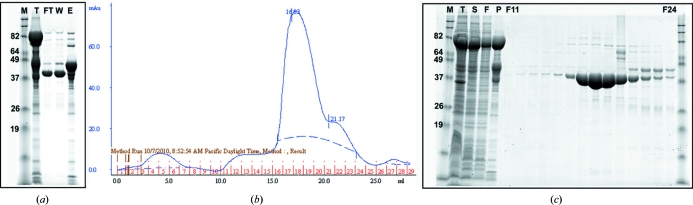
SDS–PAGE and SEC chromatogram of an exemplary rescued target which was easily purified. Even after cleavage and removal of the His-MBP tag, the target protein remained soluble and expressed at the expected size. (a) SDS–PAGE of samples from initial IMAC purification and subsequent 3C cleavage of the His-MBP tag. P represents pure sample after the first IMAC step; the observed molecular weight corresponds to the expected size of the recombinant protein expressed with fused MBP. After cleavage with 3C protease, His-MBP is retained on subsequent IMAC (E), while flowthrough (FT) and wash (W) samples contained protein that passes over the nickel column unbound. Unbound recombinant protein was pooled and subjected to SEC. (b) Chromatogram of SEC indicating fractions and sieving properties of smaller molecular-weight protein (without MBP tag). (c) SDS–PAGE of SEC fractions showing the purity of the final preparation. M, molecular-weight marker; T, sample from total lysate; S, sample from soluble fraction after centrifugation. The protein expressed and purified was an uncharacterized protein from Coccidioides immitis.
Figure 4
Figure 4
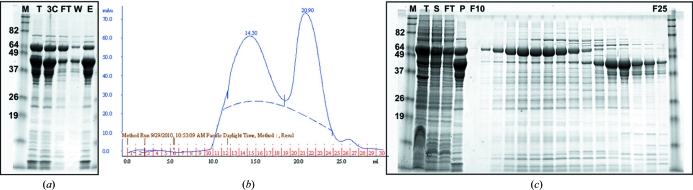
Example of more typical protein-purification products. Large quantities of fused protein running at the molecular weight of target protein and MBP combined are visible in the total (T) and soluble (S) fractions. (a) After cleavage, two forms of the protein remain visible: a band corresponding to the size of MBP and a band corresponding to the size of MBP plus the target protein; very little to no target protein remains in solution. A chromatogram (b) and SDS–PAGE (c) of SEC fractions from uncleaved sample indicate a heterogenous solution of either the recombinant protein expressed with MBP (higher molecular-weight band) or MBP alone (lower molecular-weight band). M, molecular-weight marker; T, total lysate; S, soluble fraction; FT, flowthrough from IMAC after 3C cleavage; W, wash after 3C cleavage; E, eluate with 250 mM imidazole from IMAC after 3C cleavage. The protein expressed and purified was Brucella abortus blue (type 1) copper protein.

References

    1. Arnold, F. H. (1991). Biotechnology, 9, 151–156. - PubMed
    1. Aslanidis, C. & de Jong, P. J. (1990). Nucleic Acids Res. 18, 6069–6074. - PMC - PubMed
    1. Choi, R., Kelley, A., Leibly, D., Nakazawa Hewitt, S., Napuli, A. & Van Voorhis, W. (2011). Acta Cryst. F67, 998–1005. - PMC - PubMed
    1. di Guan, C., Li, P., Riggs, P. D. & Inouye, H. (1988). Gene, 67, 21–30. - PubMed
    1. Edwards, A. M., Arrowsmith, C. H., Chrstendat, D., Dharamasi, A., Friesen, J. D., Greenblatt, J. F. & Vedadi, M. (2000). Nature Struct. Biol. 7, 970–972. - PubMed

Publication types

MeSH terms

Substances