High-throughput protein production and purification at the Seattle Structural Genomics Center for Infectious Disease
- PMID: 21904042
- PMCID: PMC3169394
- DOI: 10.1107/S1744309111018367
High-throughput protein production and purification at the Seattle Structural Genomics Center for Infectious Disease
Abstract
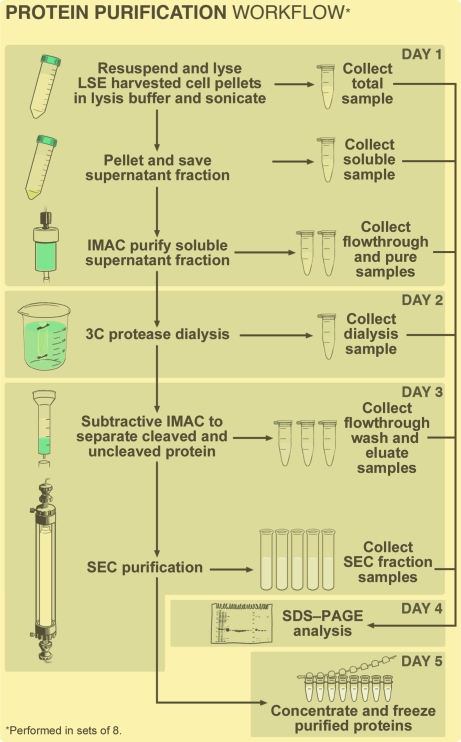
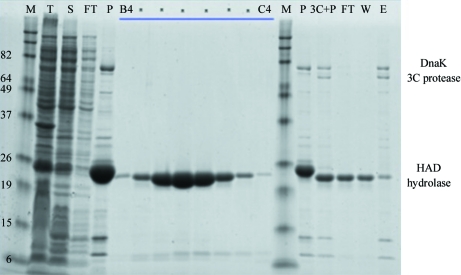
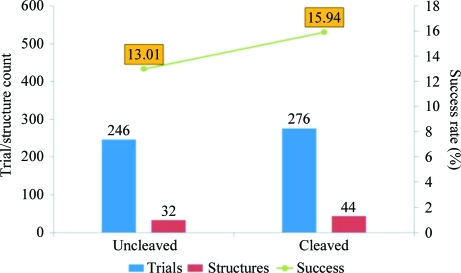
The establishment of an efficient and reliable protein-purification pipeline is essential for the success of structural genomic projects. The SSGCID Protein Purification Group at the University of Washington (UW-PPG) has established a robust protein-purification pipeline designed to purify 400 proteins per year at a rate of eight purifications per week. The pipeline was implemented using two ÄKTAexplorer 100 s and four ÄKTAprimes to perform immobilized metal-affinity chromatography (IMAC) and size-exclusion chromatography. Purifications were completed in a period of 5 d and yielded an average of 53 mg highly purified protein. This paper provides a detailed description of the methods used to purify, characterize and store SSGCID proteins. Some of the purified proteins were treated with 3C protease, which was expressed and purified by UW-PPG using a similar protocol, to cleave non-native six-histidine tags. The cleavage was successful in 94% of 214 attempts. Cleaved proteins yielded 2.9% more structures than uncleaved six-histidine-tagged proteins. This 2.9% improvement may seem small, but over the course of the project the structure output from UW-PPG is thus predicted to increase from 260 structures to 318 structures. Therefore, the outlined protocol with 3C cleavage and subtractive IMAC has been shown to be a highly efficient method for the standardized purification of recombinant proteins for structure determination via X-ray crystallography.
Figures
References
-
- Alexandrov, A., Vignali, M., LaCount, D. J., Quartley, E., de Vries, C., De Rosa, D., Babulski, J., Mitchell, S. F., Schoenfeld, L. W., Fields, S., Hol, W. G., Dumont, M. E., Phizicky, E. M. & Grayhack, E. J. (2004). Mol. Cell. Proteomics, 3, 934–938. - PubMed
-
- Baneyx, F. & Nannenga, B. L. (2010). Nature Chem. Biol. 6, 880–881. - PubMed
-
- Bolanos-Garcia, V. M. & Davies, O. R. (2006). Biochim. Biophys. Acta, 1760, 1304–1313. - PubMed
Publication types
MeSH terms
Substances
Grants and funding
LinkOut - more resources
Full Text Sources
Other Literature Sources