


Attention-deficit/hyperactivity disorder: is it time to reappraise the role of sugar consumption?
- PMID: 21904085
- PMCID: PMC3598008
- DOI: 10.3810/pgm.2011.09.2458
Attention-deficit/hyperactivity disorder: is it time to reappraise the role of sugar consumption?
Abstract
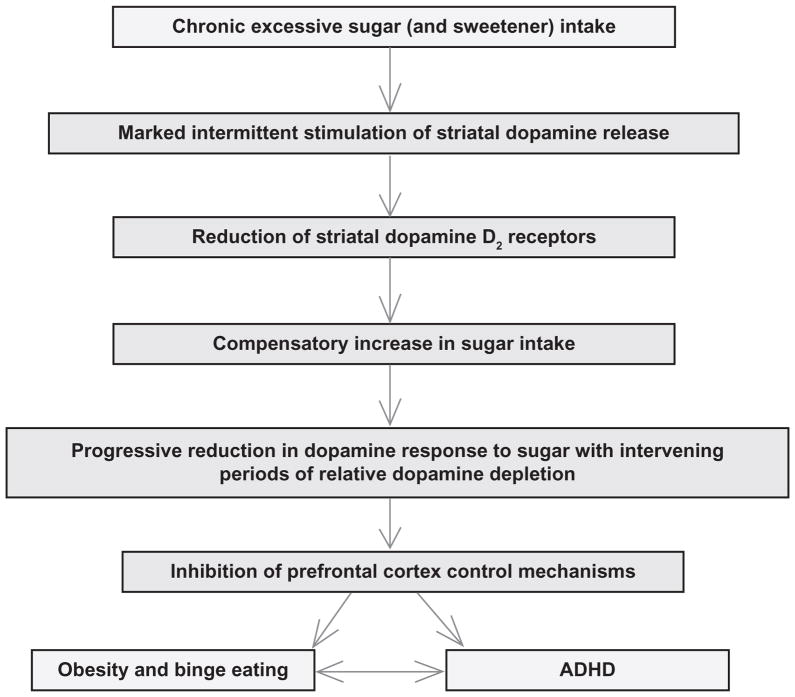
Attention-deficit/hyperactivity disorder (ADHD) affects nearly 10% of children in the United States, and the prevalence of this disorder has increased steadily over the past decades. The cause of ADHD is unknown, although recent studies suggest that it may be associated with a disruption in dopamine signaling whereby dopamine D2 receptors are reduced in reward-related brain regions. This same pattern of reduced dopamine-mediated signaling is observed in various reward-deficiency syndromes associated with food or drug addiction, as well as in obesity. While genetic mechanisms are likely contributory to cases of ADHD, the marked frequency of the disorder suggests that other factors are involved in the etiology. In this article, we revisit the hypothesis that excessive sugar intake may have an underlying role in ADHD. We review preclinical and clinical data suggesting overlaps among ADHD, sugar and drug addiction, and obesity. Further, we present the hypothesis that the chronic effects of excessive sugar intake may lead to alterations in mesolimbic dopamine signaling, which could contribute to the symptoms associated with ADHD. We recommend further studies to investigate the possible relationship between chronic sugar intake and ADHD.
Conflict of interest statement
Richard J. Johnson, MD and Takuji Ishimoto, MD have a patent application on inhibition of fructokinase as a mechanism to treat sugar craving. Richard J. Johnson is the author of
Figures
References
-
- Centers for Disease Control and Prevention (CDC) Increasing prevalence of parent-reported attention-deficit/hyperactivity disorder among children—United States, 2003 and 2007. MMWR Morb Mortal Wkly Rep. 2010;59(44):1439–1443. - PubMed
-
- American Psychiatric Association. Diagnostic and Statistical Manual of Mental Disorders. 4. Washington, DC: American Psychiatric Association; 2000. Text Revision.
-
- Wolraich ML. Attention-deficit hyperactivity disorder. Semin Pediatr Neurol. 2006;13(4):279–285. - PubMed
-
- Goldman LS, Genel M, Bezman RJ, Slanetz PJ. Diagnosis and treatment of attention-deficit/hyperactivity disorder in children and adolescents. Council on Scientific Affairs, American Medical Association. JAMA. 1998;279(14):1100–1107. - PubMed
Publication types
MeSH terms
Substances
Grants and funding
LinkOut - more resources
Full Text Sources
Other Literature Sources
Medical
Miscellaneous
