. 2011 Aug 26:4:17.
doi: 10.3389/fnmol.2011.00017. eCollection 2011.

GSK3 and Alzheimer's Disease: Facts and Fiction…

Affiliations

GSK3 and Alzheimer's Disease: Facts and Fiction…

Anna Kremer et al. Front Mol Neurosci. .

Abstract

The physiological functions and pathological roles of the Glycogen synthase kinase-type 3 (GSK3) kinases in peripheral and central systems are diverse and complex, and therefore hard to unravel in molecular detail in vivo. Our assignment to review and discuss available data to clarify the actual position of these kinases in the pathology of Alzheimer's dementia (AD) was both ambitious and easy. On the one hand, numerous studies are available in isolated, recombinant, or cell-based systems, which have resulted in very diverse data-sets that are hardly informative for the brain in vivo. At the other extreme, reliable, and relevant models for the role of GSK3 in CNS are rare, if not lacking. Moreover, (too) many in vivo studies used Li(+) as "specific" inhibitor of GSK3, which is factually not valid because lithium ions are neither specific nor potent inhibitors of GSK3 in vivo. More specific pharmacological inhibitors of GSK3 have met with considerable problems, and are reviewed by others in this issue or elsewhere. We concentrate here on AD-related aspects of GSK3 in brain in vivo, mainly studied in transgenic mice and highlight some of the more important issues, among many remaining: activation of GSK3 by amyloid, phosphorylation of protein tau, effects on or interference with synaptic activity, differentiation between both GSK3 isoforms. These relate directly to brain function, and brain dysfunction in AD, and are to be resolved if we want to understand the molecular pathology of this dreadful disease.

Keywords: Alzheimer; GSK3; tau.


Figures
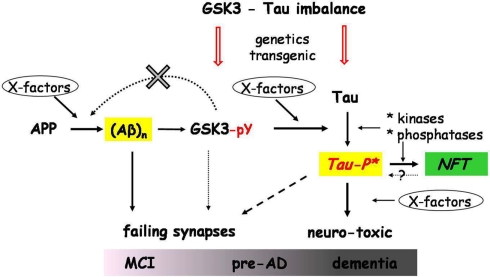
Figure 1
Figure 1
Schematic relations between amyloid, GSK3, protein Tau, and other factors. The scheme depicts the activation by amyloid peptides of GSK3α/β by increasing tyrosine phosphorylation, and leading to increased phosphorylation of protein Tau as the central event in AD pathogenesis. Condensed from in vivo observations in transgenic models, both proven (solid arrows) and proposed effects (broken arrows) are represented. The unknown molecular factors (X-factors) and mechanisms behind the relations and connections in this scheme are not yet fully understood as discussed in the text. Our most recent results did not confirm the proposed feedback effect of GSK3 on APP processing (data not shown). The amyloid and pTau species that cause synaptic defects, and eventually neurodegeneration, are not aggregates, but soluble oligomers (marked in yellow boxes). The phosphorylation of Tau by GSK3 and other kinases, produces a neurotoxic species, represented here as Tau-P*. This hypothetical intermediate is a soluble single, dimer, or small aggregate, in a transitional conformational state that can be directed either into aggregation (NFT; green box) or toward synaptic and neuronal toxicity. Tau-P* causes synaptic dysfunction, which in various combinations with amyloid peptides and aberrant activated GSK3 results in various synaptic defects, initiated in the earliest phases MCI or pre-AD, and evolving to dementia, as highlighted in the scheme. The genetic imbalance between GSK3 and Tau genes depicted in the scheme refers to the proposed interaction between the Tau (MAPT) and GSK3β genes in humans, discussed in the text. This interaction might impact on both GSK3 activation or availability and the Tau3R/4R ratio, thereby also contributing to the propensity of Tau phosphorylation. The imbalance is also generated in the various single and bigenic models, discussed in the text. The combination of all actors and factors and their interactions lead to a variety of clinical and pathological symptoms, observed in sporadic AD patients.
Figure 2
Figure 2
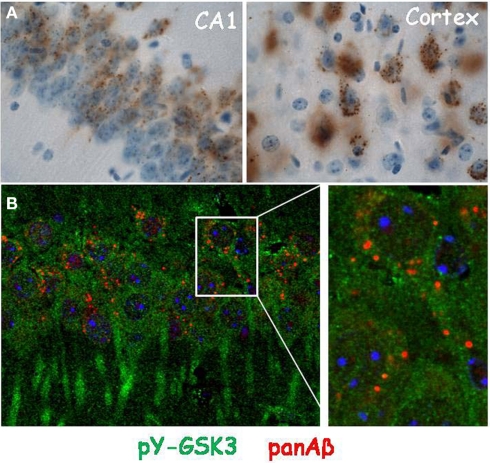
Localization of amyloid peptides and pY-GSK3 in transgenic mouse brain. (A) Intracellular amyloid (panAβ) in granules in pyramidal neurons of CA1 (left) and cortical layers III/IV (right) in brain of APP.V717I mice (age 6 months); (B) localization of activated pY-GSK3 (green) and panAβ (red) in the cytoplasm of CA1 neurons in the brain of APP.V717I mice (age 6 months), at right higher magnification of boxed area.

References

    1. Agam G., Bersudsky Y., Berry G. T., Moechars D., Lavi-Avnon Y., Belmaker R. H. (2009). Knockout mice in understanding the mechanism of action of lithium. Biochem. Soc. Trans. 37(Pt 5), 1121–112510.1042/BST0371121 - DOI - PubMed
    1. Aplin A. E., Gibb G. M., Jacobsen J. S., Gallo J. M., Anderton B. H. (1996). In vitro phosphorylation of the cytoplasmic domain of the amyloid precursor protein by glycogen synthase kinase-3beta. J. Neurochem. 67, 699–70710.1046/j.1471-4159.1996.67020699.x - DOI - PubMed
    1. Azoulay-Alfaguter I., Yaffe Y., Licht-Murava A., Urbanska M., Jaworski J., Pietrokovski S., Hirschberg K., Eldar-Finkelman H. (2011). Distinct molecular regulation of glycogen synthase kinase-3alpha isozyme controlled by its N-terminal region: functional role in calcium/calpain signaling. J. Biol. Chem. 286, 13470–1348010.1074/jbc.M110.127969 - DOI - PMC - PubMed
    1. Braak H., Braak E. (1991). Neuropathological stageing of Alzheimer-related changes. Acta Neuropathol. 82, 239–25910.1007/BF00308809 - DOI - PubMed
    1. Braak H., Del Tredici K. (2011a). The pathological process underlying Alzheimer’s disease in individuals under thirty. Acta Neuropathol. 121, 171–18110.1007/s00401-011-0825-z - DOI - PubMed