


Association of organophosphate pesticide exposure and paraoxonase with birth outcome in Mexican-American women
- PMID: 21904599
- PMCID: PMC3164135
- DOI: 10.1371/journal.pone.0023923
Association of organophosphate pesticide exposure and paraoxonase with birth outcome in Mexican-American women
Abstract
Background: Epidemiologic studies suggest that maternal organophosphorus (OP) pesticide exposure is associated with poorer fetal growth, but findings are inconsistent. We explored whether paraoxonase (PON1), a key enzyme involved in detoxification of OPs, could be an effect modifier in this association.
Methods: The study population included 470 pregnant women enrolled in the CHAMACOS Study, a longitudinal cohort study of mothers and children living in an agricultural region of California. We analyzed urine samples collected from mothers twice during pregnancy for dialkyl phosphate (DAP) metabolites of OP pesticides. We analyzed maternal and fetal (cord) blood samples for PON1 genotype (PON1(192) and PON1(-108)) and enzyme activity (paraoxonase and arylesterase). Infant birth weight, head circumference, and gestational age were obtained from medical records.
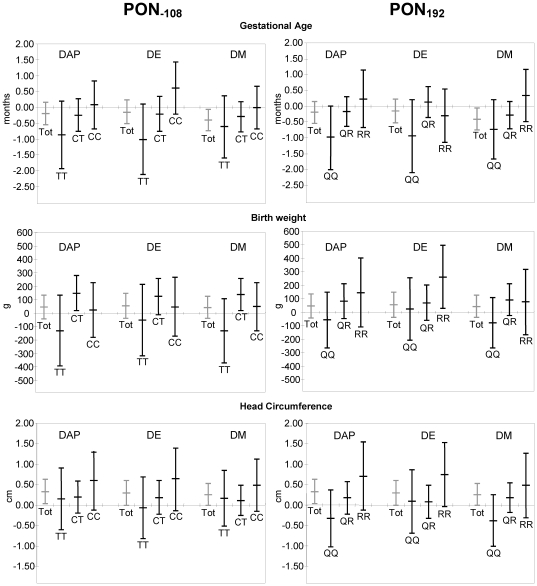
Results: Infants' PON1 genotype and activity were associated with birth outcome, but mothers' were not. Infants with the susceptible PON1(-108TT) genotype had shorter gestational age (β = -0.5 weeks, 95% Confidence Interval (CI): -0.9, 0.0) and smaller head circumference (β = -0.4 cm, 95% CI: -0.7, 0.0) than those with the PON1(-108CC) genotype. Infants' arylesterase and paraoxonase activity were positively associated with gestational age. There was some evidence of effect modification with DAPs: maternal DAP concentrations were associated with shorter gestational age only among infants of the susceptible PON1(-108TT) genotype (p-value(interaction) = 0.09). However, maternal DAP concentrations were associated with larger birth weight (p-value(interaction) = 0.06) and head circumference (p-value(interaction)<0.01) in infants with non-susceptible genotypes.
Conclusions: Infants whose PON1 genotype and enzyme activity levels suggested that they might be more susceptible to the effects of OP pesticide exposure had decreased fetal growth and length of gestation. PON1 may be another factor contributing to preterm or low birth weight birth.
Conflict of interest statement
Figures
References
-
- Keily T, Donaldson D, Grube A. Pesticides Industry Sales and Usage: 2000 and 2001 Market Estimates. Washington, DC: US Environmental Protection Agency; 2004.
-
- Muto MA, Lobelle F, Jr, Bidanset JH, Wurpel JN. Embryotoxicity and neurotoxicity in rats associated with prenatal exposure to DURSBAN. Vet Hum Toxicol. 1992;34:498–501. - PubMed
-
- Breslin W, Liberacki A, Dittenber D, Quast J. Evaluation of the developmental and reproductive toxicity of chlorpyrifos in the rat. Fundamental and Applied Toxicology. 1996;29:119–130. - PubMed
-
- Chanda SM, Harp P, Liu J, Pope CN. Comparative developmental and maternal neurotoxicity following acute gestational exposure to chlorpyrifos in rats. J Toxicol Environ Health. 1995;44:189–202. - PubMed
-
- Maurissen JP, Hoberman AM, Garman RH, Hanley TR., Jr Lack of selective developmental neurotoxicity in rat pups from dams treated by gavage with chlorpyrifos. Toxicol Sci. 2000;57:250–263. - PubMed
Publication types
MeSH terms
Substances
Grants and funding
LinkOut - more resources
Full Text Sources
Medical
Miscellaneous
