


Clinical implication of coronary tortuosity in patients with coronary artery disease
- PMID: 21904618
- PMCID: PMC3164184
- DOI: 10.1371/journal.pone.0024232
Clinical implication of coronary tortuosity in patients with coronary artery disease
Abstract
Background: Coronary tortuosity (CT) is a common coronary angiography finding. The exact pathogenesis, clinical implication and long-term prognosis of CT are not fully understood. The purpose of this study is to investigate the clinical characteristics of CT in patients with suspected coronary artery disease (CAD) in a Chinese population.
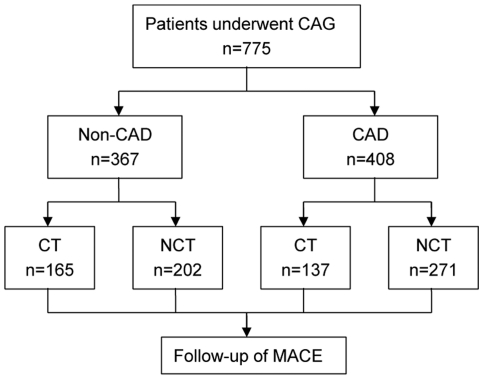
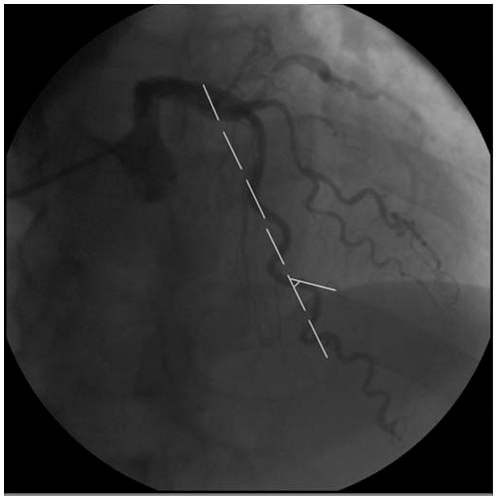
Methods: A total of 1010 consecutive patients underwent coronary angiography with complaints of chest pain or related symptoms were included in the present study (544 male, mean age: 64±11 years). CT was defined by the finding of ≥3 bends (defined as ≥45° change in vessel direction) along main trunk of at least one artery in systole and in diastole. Patients with or without CAD were further divided into CT-positive and CT-negative groups, all patients were followed up for the incidence of major adverse cardiovascular events (MACE) for 2 to 4 years.
Results: The prevalence of CT was 39.1% in this patient cohort and incidence of CT was significantly higher in female patients than that in male patients (OR = 2.603, 95%CI 1.897, 3.607, P<0.001). CT was positively correlated with essential hypertension (OR = 1.533, 95%CI 1.131, 2.076, P = 0.006) and negatively correlated with CAD (OR = 0.755, 95%CI 0.574, 0.994, P = 0.045). MACE during follow up was similar between CAD patients with or without CT.
Conclusions: CT is more often seen in females and positively correlated with hypertension and negatively correlated with coronary atherosclerosis.
Conflict of interest statement
Figures
References
-
- Lloyd-Jones D, Adams RJ, Brown TM, Carnethon M, Dai S, et al. Heart disease and stroke statistics–2010 update: a report from the American Heart Association. Circulation. 2010;121:e46–e215. - PubMed
-
- Zhang XH, Lu ZL, Liu L. Coronary heart disease in China. Heart. 2008;94:1126–1131. - PubMed
-
- Turgut O, Yilmaz A, Yalta K, Yilmaz BM, Ozyol A, et al. Tortuosity of coronary arteries: an indicator for impaired left ventricular relaxation? Int J Cardiovasc Imaging. 2007;23:671–677. - PubMed
-
- Jakob M, Spasojevic D, Krogmann ON, Wiher H, Hug R, et al. Tortuosity of coronary arteries in chronic pressure and volume overload. Cathet Cardiovasc Diagn. 1996;38:25–31. - PubMed
Publication types
MeSH terms
LinkOut - more resources
Full Text Sources
Medical
Miscellaneous
