


Cell therapy for multiple sclerosis
- PMID: 21904787
- PMCID: PMC3250283
- DOI: 10.1007/s13311-011-0073-x
Cell therapy for multiple sclerosis
Abstract
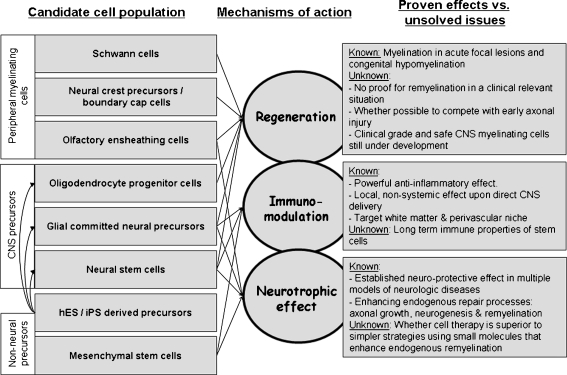
The spontaneous recovery observed in the early stages of multiple sclerosis (MS) is substituted with a later progressive course and failure of endogenous processes of repair and remyelination. Although this is the basic rationale for cell therapy, it is not clear yet to what degree the MS brain is amenable for repair and whether cell therapy has an advantage in comparison to other strategies to enhance endogenous remyelination. Central to the promise of stem cell therapy is the therapeutic plasticity, by which neural precursors can replace damaged oligodendrocytes and myelin, and also effectively attenuate the autoimmune process in a local, nonsystemic manner to protect brain cells from further injury, as well as facilitate the intrinsic capacity of the brain for recovery. These fundamental immunomodulatory and neurotrophic properties are shared by stem cells of different sources. By using different routes of delivery, cells may target both affected white matter tracts and the perivascular niche where the trafficking of immune cells occur. It is unclear yet whether the therapeutic properties of transplanted cells are maintained with the duration of time. The application of neural stem cell therapy (derived from fetal brain or from human embryonic stem cells) will be realized once their purification, mass generation, and safety are guaranteed. However, previous clinical experience with bone marrow stromal (mesenchymal) stem cells and the relative easy expansion of autologous cells have opened the way to their experimental application in MS. An initial clinical trial has established the probable safety of their intravenous and intrathecal delivery. Short-term follow-up observed immunomodulatory effects and clinical benefit justifying further clinical trials.
Figures
References
-
- Altman J, Das GD. Postnatal neurogenesis in the guinea-pig. Nature. 1967;214:1098–1101. - PubMed
-
- Nottebohm F. Neuronal replacement in adulthood. Ann N Y Acad Sci. 1985;457:143–161. - PubMed
-
- Kirschenbaum B, Nedergaard M, Preuss A, Barami K, Fraser RA, Goldman SA. In vitro neuronal production and differentiation by precursor cells derived from the adult human forebrain. Cereb Cortex. 1994;4:576–589. - PubMed
-
- Pincus DW, Keyoung HM, Harrison-Restelli C, et al. Fibroblast growth factor-2/brain-derived neurotrophic factor-associated maturation of new neurons generated from adult human subependymal cells. Ann Neurol. 1998;43:576–585. - PubMed
Publication types
MeSH terms
Substances
LinkOut - more resources
Full Text Sources
Medical
