


High altitude adaptation in Daghestani populations from the Caucasus
- PMID: 21904933
- PMCID: PMC3312735
- DOI: 10.1007/s00439-011-1084-8
High altitude adaptation in Daghestani populations from the Caucasus
Abstract
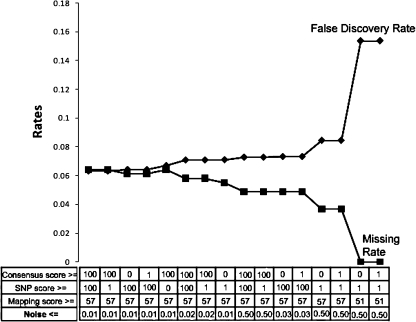
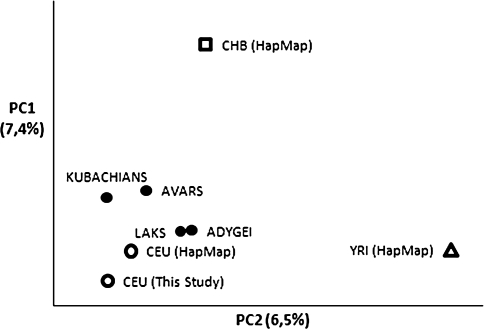
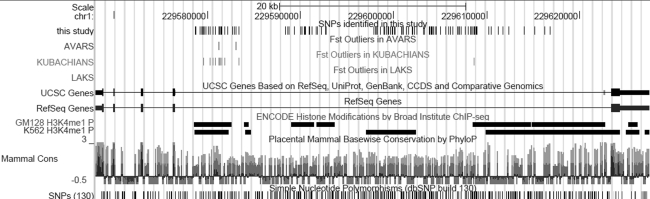
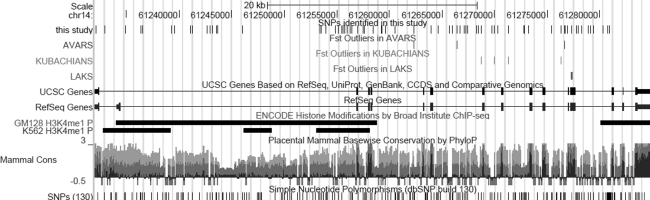
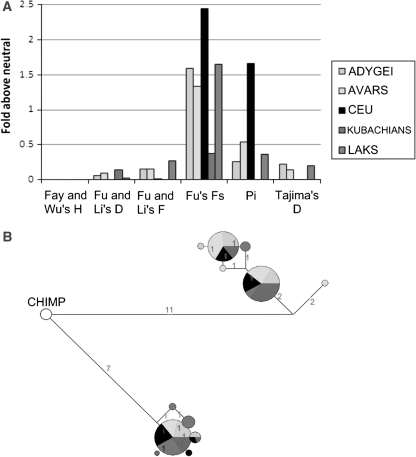
We have surveyed 15 high-altitude adaptation candidate genes for signals of positive selection in North Caucasian highlanders using targeted re-sequencing. A total of 49 unrelated Daghestani from three ethnic groups (Avars, Kubachians, and Laks) living in ancient villages located at around 2,000 m above sea level were chosen as the study population. Caucasian (Adygei living at sea level, N = 20) and CEU (CEPH Utah residents with ancestry from northern and western Europe; N = 20) were used as controls. Candidate genes were compared with 20 putatively neutral control regions resequenced in the same individuals. The regions of interest were amplified by long-PCR, pooled according to individual, indexed by adding an eight-nucleotide tag, and sequenced using the Illumina GAII platform. 1,066 SNPs were called using false discovery and false negative thresholds of ~6%. The neutral regions provided an empirical null distribution to compare with the candidate genes for signals of selection. Two genes stood out. In Laks, a non-synonymous variant within HIF1A already known to be associated with improvement in oxygen metabolism was rediscovered, and in Kubachians a cluster of 13 SNPs located in a conserved intronic region within EGLN1 showing high population differentiation was found. These variants illustrate both the common pathways of adaptation to high altitude in different populations and features specific to the Daghestani populations, showing how even a mildly hypoxic environment can lead to genetic adaptation.
Figures
References
-
- Aggarwal S, Negi S, Jha P, Singh PK, Stobdan T, Pasha MA, Ghosh S, Agrawal A, Prasher B, Mukerji M. EGLN1 involvement in high-altitude adaptation revealed through genetic analysis of extreme constitution types defined in Ayurveda. Proc Natl Acad Sci USA. 2010;107(44):18961–18966. doi: 10.1073/pnas.1006108107. - DOI - PMC - PubMed
-
- Bandelt HJ, Forster P, Rohl A. Median-joining networks for inferring intraspecific phylogenies. Mol Biol Evol. 1999;16(1):37–48. - PubMed
Publication types
MeSH terms
Substances
Grants and funding
LinkOut - more resources
Full Text Sources
