


Salivary secretory immunoglobulin A secretion increases after 4-weeks ingestion of chlorella-derived multicomponent supplement in humans: a randomized cross over study
- PMID: 21906314
- PMCID: PMC3182968
- DOI: 10.1186/1475-2891-10-91
Salivary secretory immunoglobulin A secretion increases after 4-weeks ingestion of chlorella-derived multicomponent supplement in humans: a randomized cross over study
Abstract
Background: Chlorella, a unicellular green alga that grows in fresh water, contains high levels of proteins, vitamins, minerals, and dietary fibers. Some studies have reported favorable immune function-related effects on biological secretions such as blood and breast milk in humans who have ingested a chlorella-derived multicomponent supplement. However, the effects of chlorella-derived supplement on mucosal immune functions remain unclear. The purpose of this study was to investigate whether chlorella ingestion increases the salivary secretory immunoglobulin A (SIgA) secretion in humans using a blind, randomized, crossover study design.
Methods: Fifteen men took 30 placebo and 30 chlorella tablets per day for 4 weeks separated by a 12-week washout period. Before and after each trial, saliva samples were collected from a sterile cotton ball that was chewed after overnight fasting. Salivary SIgA concentrations were measured using ELISA.
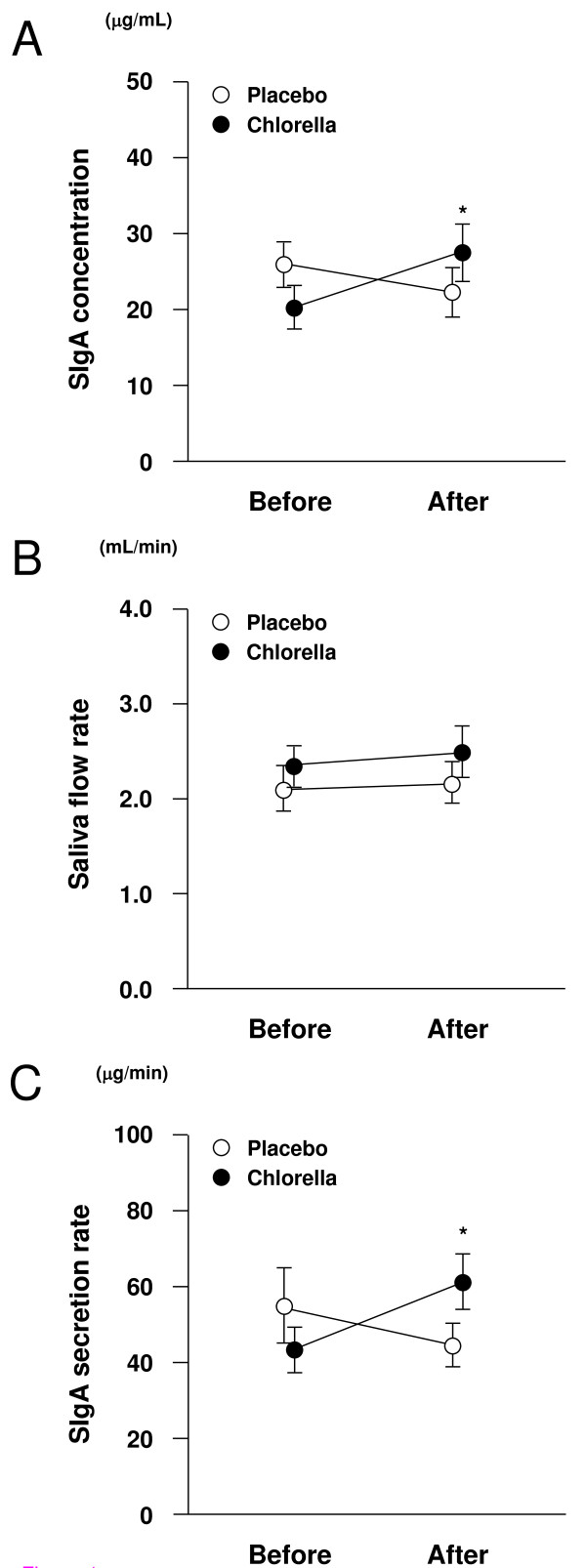
Results: Compliance rates for placebo and chlorella ingestions were 97.0 ± 1.0% and 95.3 ± 1.6%, respectively. No difference was observed in salivary SIgA concentrations before and after placebo ingestion (P = 0.38). However, salivary SIgA concentrations were significantly elevated after chlorella ingestion compared to baseline (P < 0.01). No trial × period interaction was identified for the saliva flow rates. Although the SIgA secretion rate was not affected by placebo ingestion (P = 0.36), it significantly increased after 4-week chlorella ingestion than before intake (P < 0.01).
Conclusions: These results suggest 4-week ingestion of a chlorella-derived multicomponent supplement increases salivary SIgA secretion and possibly improves mucosal immune function in humans.
Figures
References
-
- McMurray DN, Rey H, Casazza LJ, Watson RR. Effect of moderate malnutrition on concentrations of immunoglobulins and enzymes in tears and saliva of young Colombian children. Am J Clin Nutr. 1977;30:1944–1948. - PubMed
-
- Watson RR, McMurray DN, Martin P, Reyes MA. Effect of age, malnutrition and renutrition on free secretory component and IgA in secretions. Am J Clin Nutr. 1985;42:281–288. - PubMed
-
- Sirisinha S, Suskind R, Edelman R, Asvapaka C, Olson RE. Secretory and serum IgA in children with protein-calorie malnutrition. Pediatrics. 1975;55:166–170. - PubMed
-
- Gangopadhyay NN, Moldoveanu Z, Stephensen CB. Vitamin A deficiency has different effects on immunoglobulin A production and transport during influenza A infection in BALB/c mice. J Nutr. 1996;126:2960–2967. - PubMed
Publication types
MeSH terms
Substances
LinkOut - more resources
Full Text Sources
Other Literature Sources
Medical
