


Auditing complex concepts of SNOMED using a refined hierarchical abstraction network
- PMID: 21907827
- PMCID: PMC3313651
- DOI: 10.1016/j.jbi.2011.08.016
Auditing complex concepts of SNOMED using a refined hierarchical abstraction network
Abstract
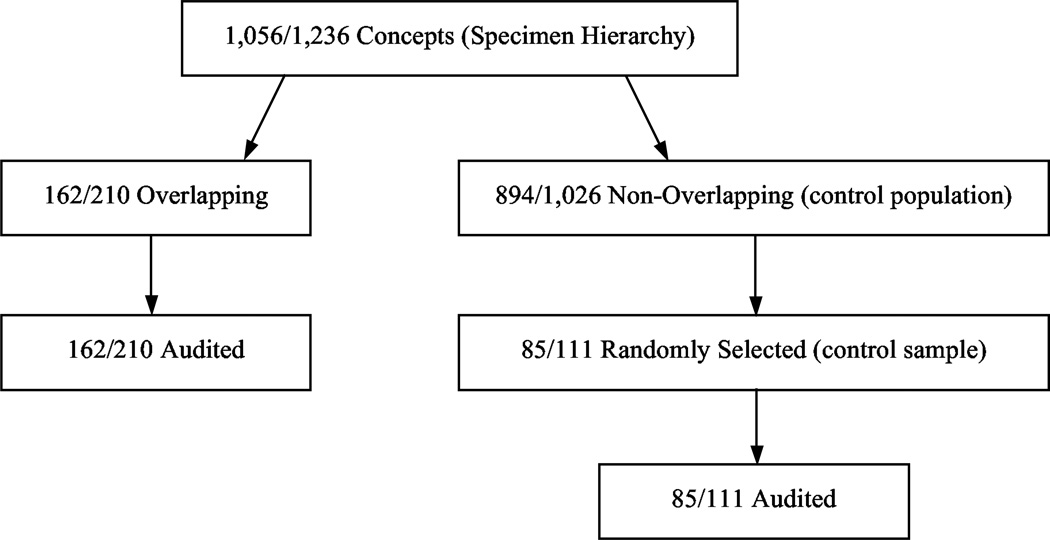
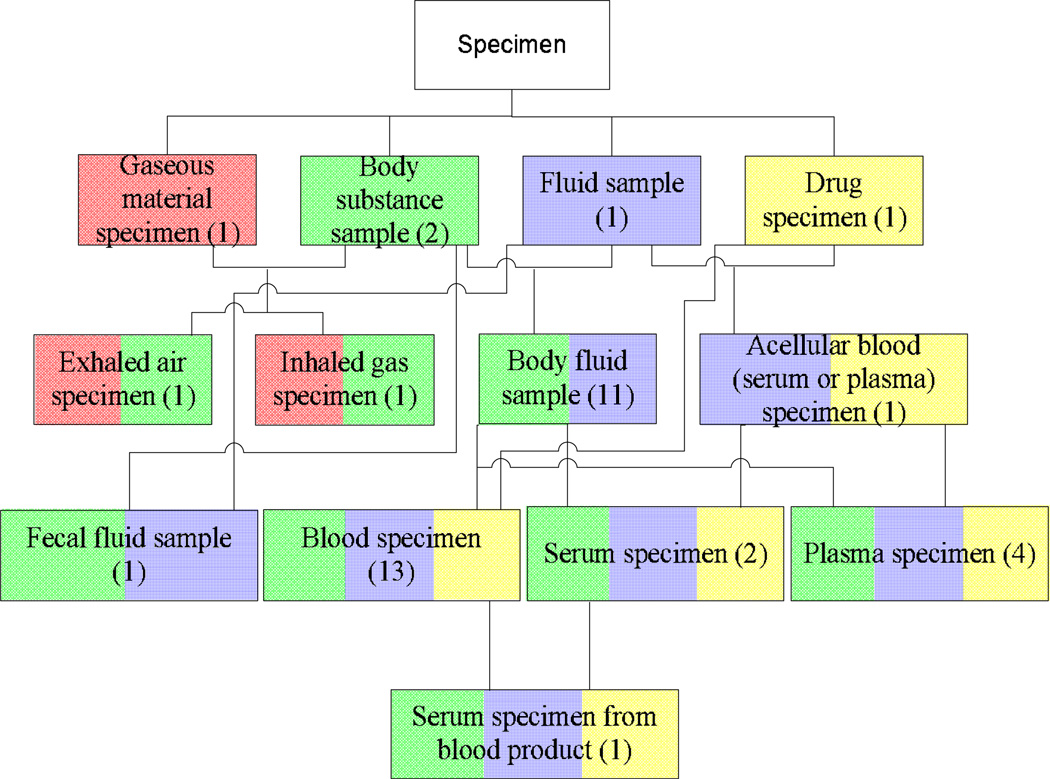
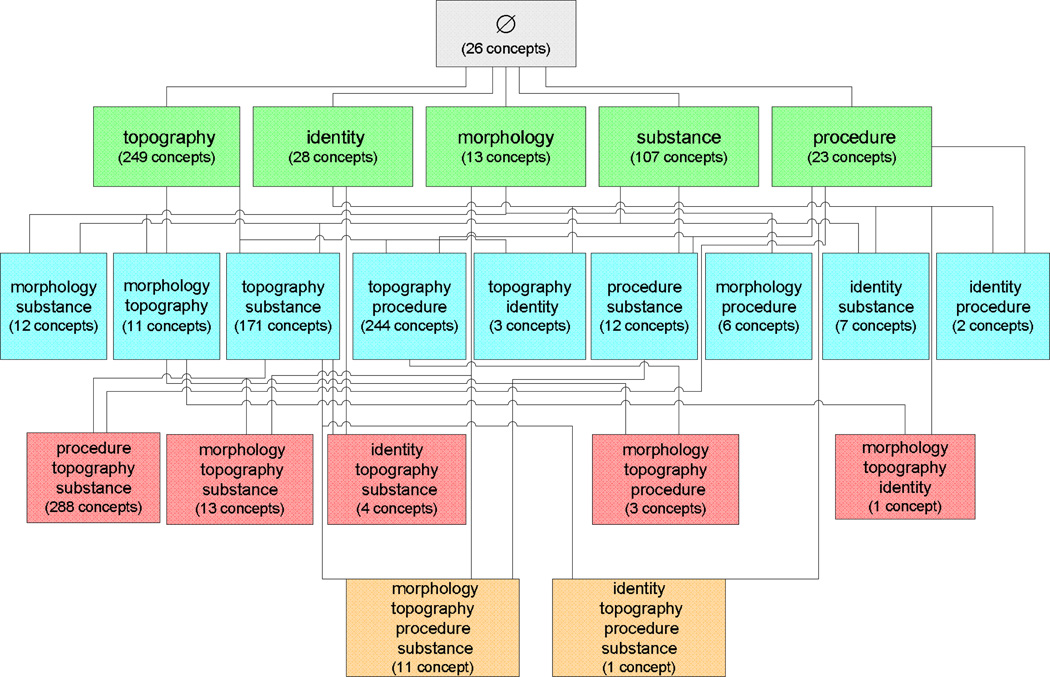
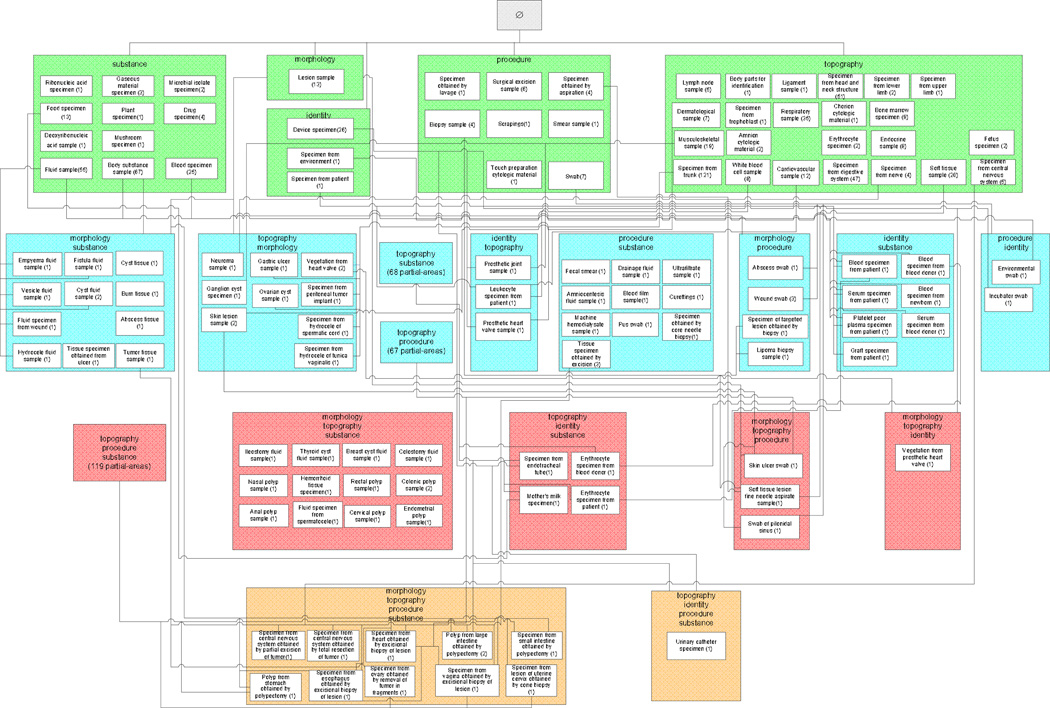
Auditors of a large terminology, such as SNOMED CT, face a daunting challenge. To aid them in their efforts, it is essential to devise techniques that can automatically identify concepts warranting special attention. "Complex" concepts, which by their very nature are more difficult to model, fall neatly into this category. A special kind of grouping, called a partial-area, is utilized in the characterization of complex concepts. In particular, the complex concepts that are the focus of this work are those appearing in intersections of multiple partial-areas and are thus referred to as overlapping concepts. In a companion paper, an automatic methodology for identifying and partitioning the entire collection of overlapping concepts into disjoint, singly-rooted groups, that are more manageable to work with and comprehend, has been presented. The partitioning methodology formed the foundation for the development of an abstraction network for the overlapping concepts called a disjoint partial-area taxonomy. This new disjoint partial-area taxonomy offers a collection of semantically uniform partial-areas and is exploited herein as the basis for a novel auditing methodology. The review of the overlapping concepts is done in a top-down order within semantically uniform groups. These groups are themselves reviewed in a top-down order, which proceeds from the less complex to the more complex overlapping concepts. The results of applying the methodology to SNOMED's Specimen hierarchy are presented. Hypotheses regarding error ratios for overlapping concepts and between different kinds of overlapping concepts are formulated. Two phases of auditing the Specimen hierarchy for two releases of SNOMED are reported on. With the use of the double bootstrap and Fisher's exact test (two-tailed), the auditing of concepts and especially roots of overlapping partial-areas is shown to yield a statistically significant higher proportion of errors.
Copyright © 2011 Elsevier Inc. All rights reserved.
Figures
References
-
- IHTSDO: SNOMED CT. [Accessed March 30, 2011]; available at http://www.ihtsdo.org/snomed-ct.
-
- Department of Health and Human Services, Health Information Technology. Initial Set of Standards, Implementation Specifications, and Certification Criteria for Electronic Health Record Technology; Final Rule, 45 CFR Part 170. 2010 July 28; - PubMed
-
- Nardi D, Brachman RJ. An introduction to description logics. In: Baader F, Calvanese D, McGuinness DL, Nardi D, Patel-Schneider PF, editors. The Description Logic Handbook: Theory, Implementation, and Applications. Cambridge, UK: Cambridge University Press; 2003. pp. 1–40.
Publication types
MeSH terms
Grants and funding
LinkOut - more resources
Full Text Sources
Other Literature Sources
