. 2012 Jan;40(1):391-8.
doi: 10.1093/nar/gkr700. Epub 2011 Sep 8.

Loss of ribosomal RNA modification causes developmental defects in zebrafish

Affiliations

Loss of ribosomal RNA modification causes developmental defects in zebrafish

Sayomi Higa-Nakamine et al. Nucleic Acids Res. 2012 Jan.

Abstract

Non-coding RNAs (ncRNAs) play key roles in diverse cellular activities, and efficient ncRNA function requires extensive posttranscriptional nucleotide modifications. Small nucleolar RNAs (snoRNAs) are a group of ncRNAs that guide the modification of specific nucleotides in ribosomal RNAs (rRNAs) and small nuclear RNAs. To investigate the physiological relevance of rRNA modification in vertebrates, we suppressed the expression of three snoRNAs (U26, U44 and U78), either by disrupting the host gene splicing or by inhibiting the snoRNA precursor processing, and analyzed the consequences of snoRNA loss-of-function in zebrafish. Using a highly sensitive mass spectrometric analysis, we found that decreased snoRNA expression reduces the snoRNA-guided methylation of the target nucleotides. Impaired rRNA modification, even at a single site, led to severe morphological defects and embryonic lethality in zebrafish, which suggests that rRNA modifications play an essential role in vertebrate development. This study highlights the importance of posttranscriptional modifications and their role in ncRNA function in higher eukaryotes.


Figures
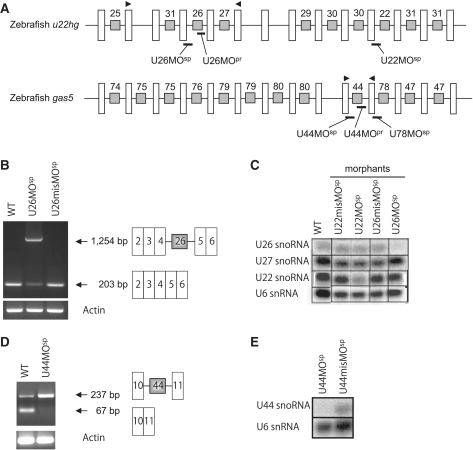
Figure 1.
Figure 1.
The snoRNA-deficient zebrafish have reduced mature snoRNA expression. (A) The genomic structure of u22hg and gas5 in zebrafish. The white bars represent the exons and the black lines connecting the white bars represent the introns. The gray boxes within the introns indicate the snoRNA genes, which are numbered according to their human orthologs. The morpholinos were designed to target either the splicing (MOsp) or maturation (MOpr) of the snoRNAs, and the morpholino binding sites are shown in thick black lines. The arrowheads indicate the primer binding sites for RT–PCR. The u22hg and gas5 genomic sequences were obtained from the database under the accession numbers NW003334572.1 and NW001879345.1, respectively. (B) sqRT–PCR indicating that the improperly spliced transcript (1254 bp including intron 4) in the U26 morphants (middle lane) is increased compared with the normal u22hg transcript (203 bp without intron 4) in wild-type and control embryos. (C) Northern blotting of total RNA from morphants (U26MOsp and U22MOsp) and control embryos (U26misMOsp and U22misMOsp) using radiolabeled snoRNA probes. The U26 morphants have decreased expression of mature U26 snoRNA, and the expression of other snoRNAs transcribed from the same host gene was not affected. (D and E) sqRT–PCR and northern blotting showing the accumulation of unspliced precursor transcript (237 bp including intron 10) and a decrease in mature U44 snoRNA in the U44MOsp morphants. The U6 snRNA probe was used as loading control for the northern blotting.
Figure 2.
Figure 2.
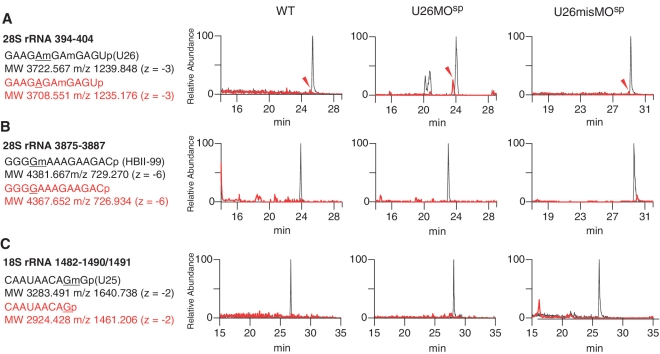
28S rRNA methylation is decreased in the U26 morphants. LC/MS analyses of RNase A-digested 28S rRNA fragments and RNase T1-digested 18S rRNA fragments from wild-type (WT, left panels), U26 morphants (U26MOsp, middle panels) and control embryos (U26misMOsp, right panels). (A–C) Mass chromatograms of RNase A-digested 28S rRNA fragments showing the accumulation of a mono-methylated fragment containing the U26 snoRNA-specific modification site (arrowhead in A) in U26 morphants. The other snoRNA-specific modification sites in the 28S rRNA (HBII-99 snoRNA-guided guanosine at position 3878; B) and the 18S rRNA (U25 snoRNA-guided guanosine at position 1490; C) show no detectable accumulation of unmethylated fragments in the U26 morphants. The spectra for the methylated and unmethylated (mono-methylated in A) fragments are shown in black and red, respectively. The sequence and molecular weight of these fragments and their corresponding m/z values are indicated. The snoRNA-specific target nucleotide in each rRNA fragment is underlined.
Figure 3.
Figure 3.
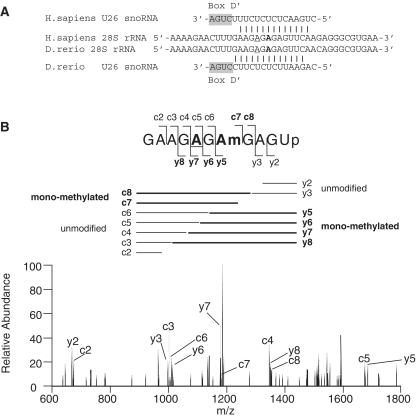
A398 methylation of the 28S rRNA is decreased in the U26 morphants. (A) The 28S rRNA region that contains the methylated adenosine (Am, guided by U26 snoRNA) at position 398 (underlined) is highly conserved between humans and zebrafish. The boxD signature motif of the U26 snoRNA and the base-pairing interactions with 28S rRNA are shown. Another proximal adenosine (indicated in bold), which is methylated by U81 snoRNA, is also highlighted. (B) The collision-induced dissociation (CID) spectrum of the mono-methylated fragment (precursor ion m/z 1235.0) obtained from the U26 morphants (as in Figure 2A). The A398 site is underlined in the fragment sequence (upper panel). The delineated fragment pattern (middle panel) corresponds to the dissociated fragments obtained after CID analysis of the mono-methylated fragment as in Figure 2A. The assignments of the product ions are indicated in the CID spectrum (lower panel), and the nomenclature for the product ions of the nucleic acids are as described by McLuckey et al. (49). The mono-methylated product ions are shown in bold. The observed and calculated m/z values of each product ion are listed in Supplementary Table S3.
Figure 4.
Figure 4.
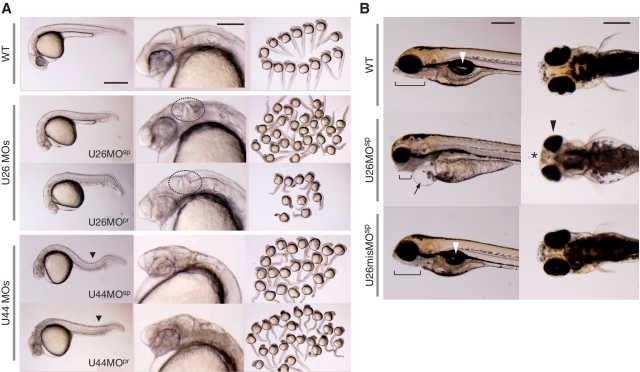
Developmental defects in the snoRNA-deficient zebrafish. (A) A lateral view of wild-type embryos and morphants (left column), close-up images of the head region (middle column), and an overview of embryos (right column) at 27 hpf. Both the U26 and U44 morphants display deformities in the brain region and reduced eye pigmentation (middle column). The mhb is not clearly delineated in the U26 morphants (dotted circle). The U44 morphants display ventrally or laterally bent trunks (solid black triangle) and an incomplete yolk sac extension (solid line). Scale bars: 500 µm (left column), 200 µm (middle column). (B) Lateral (left column) and ventral (right column) views of wild-type embryos and U26MOsp morphants at 5 dpf. The U26 morphants display an underdeveloped jaw structure (solid line) and pericardial edema (arrow), as well as malformed eyes (black arrowhead) and mouth (asterisk). The internal organs, including the swim bladder (white arrowhead), were only observed in the wild-type and U26misMO-injected embryos. Scale bars: 200 µm.

References

    1. Limbach PA, Crain PF, McCloskey JA. Summary: the modified nucleosides of RNA. Nucleic Acids Res. 1994;22:2183–2196. - PMC - PubMed
    1. Dunin-Horkawicz S, Czerwoniec A, Gajda MJ, Feder M, Grosjean H, Bujnicki JM. MODOMICS: a database of RNA modification pathways. Nucleic Acids Res. 2006;34:D145–D149. - PMC - PubMed
    1. Suzuki T. Biosynthesis and function of tRNA wobble modifications. In: Grosjean H, editor. Fine-Tuning of RNA Functions by Modification and Editing. Berlin Heidelberg: Springer-Verlag; 2005. pp. 23–69.
    1. Yu B, Yang Z, Li J, Minakhina S, Yang M, Padgett RW, Steward R, Chen X. Methylation as a crucial step in plant microRNA biogenesis. Science. 2005;307:932–935. - PMC - PubMed
    1. Li J, Yang Z, Yu B, Liu J, Chen X. Methylation protects miRNAs and siRNAs from a 3′ end uridylation activity in Arabidopsis. Curr. Biol. 2005;15:1501–1507. - PMC - PubMed

Publication types