. 2011 Nov;62(15):5727-34.
doi: 10.1093/jxb/err300. Epub 2011 Sep 9.

Low cadmium (LCD), a novel gene related to cadmium tolerance and accumulation in rice

Affiliations

Low cadmium (LCD), a novel gene related to cadmium tolerance and accumulation in rice

Hugo Shimo et al. J Exp Bot. 2011 Nov.

Abstract

The contamination of food crops by cadmium (Cd) is a major concern in food production because it can reduce crop yields and threaten human health. In this study, knockout rice plants (Oryza sativa) tagged with the gene trap vector pGA2707 were screened for Cd tolerance, and the tolerant line lcd was obtained. The lcd mutant showed tolerance to Cd on agar plates and in hydroponic culture during early plant development. Metal concentration measurements in hydroponically grown plants revealed significantly less Cd in the shoots of lcd plants compared with wild-type (WT) shoots. When cultured in the field in soil artificially contaminated with low levels of Cd, lcd showed no significant difference in the Cd content of its leaf blades; however, the Cd concentration in the grains was 55% lower in 2009 and 43% lower in 2010. There were no significant differences in plant dry weight or seed yield between lcd and wild-type plants. LCD, a novel gene, is not homologous to any other known gene. LCD localized to the cytoplasm and nucleus, and was expressed mainly in the vascular tissues in the roots and phloem companion cells in the leaves. These data indicate that lcd may be useful for understanding Cd transport mechanisms and is a promising candidate rice line for use in combating the threat of Cd to human health.


Figures
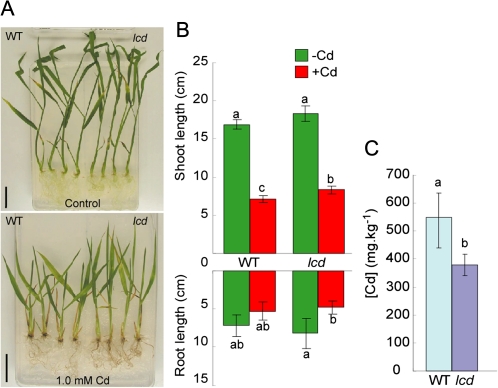
Fig. 1.
Fig. 1.
Selection of the Cd-tolerant mutant line lcd. (A) WT and lcd mutants were grown in MS medium with or without 1.0 mM Cd for 10 d. (B) Root and shoot length of the WT and lcd in both conditions. (C) Cd concentration in shoots of the WT and lcd from plants grown in MS medium in both conditions. Bars=2 cm. Values followed by different letters are statistically different according to Student–Newman–Keuls test (n=4).
Fig. 2.
Fig. 2.
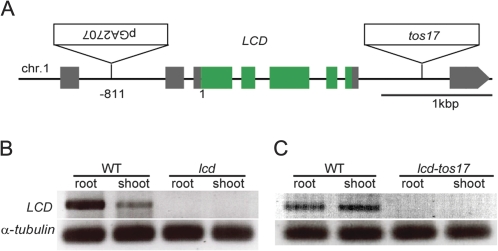
Insertion positions and LCD expression in the mutants. (A) Schematic representation of LCD and the insertion positions of the T-DNA and the tos17 fragment. (B and C) Total RNA was extracted from roots and shoots for lcd/lcd-tos17 and their respective WTs, and RT-PCR was performed.
Fig. 3.
Fig. 3.
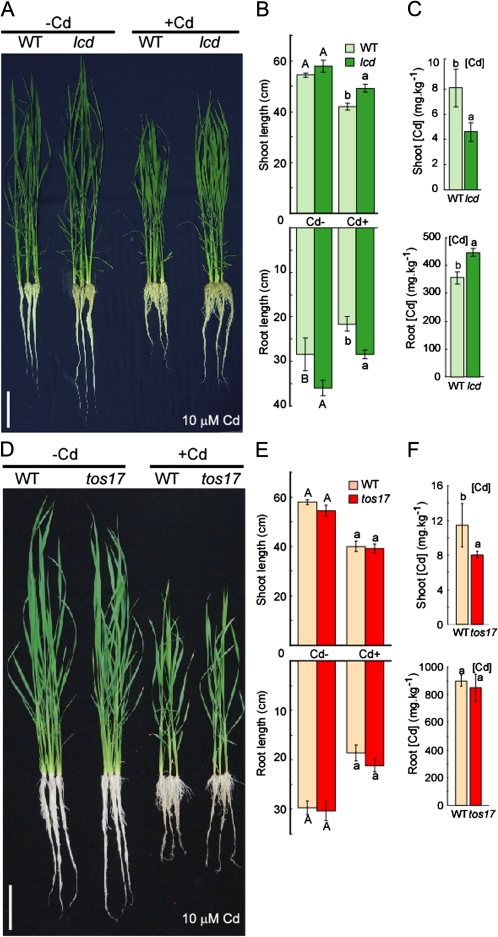
lcd and lcd-tos17 phenotype in response to Cd. (A and D) WT and lcd/lcd-tos17 were grown in nutrient solution for 1 week then grown in nutrient solution with or without 10 μM Cd for another week. (B and E) Root and shoot lengths of WT and lcd/lcd-tos17 in both conditions (n=3). (C and F) Cd concentration of roots and shoots (n=3). Bars=10 cm. Values followed by different letters are statistically different according to Student–Newman–Keuls.
Fig. 4.
Fig. 4.
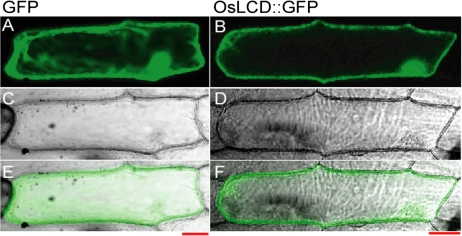
Subcellular localization of OsLCD. The OsLCD::GFP fusion protein was transiently expressed in onion (Allium cepa) epidermal cells and fluorescence was analysed. (A and B) GFP fluorescence. (C and D) Transient imaging. (E and F) Merged image. Bars=50 μm.
Fig. 5.
Fig. 5.
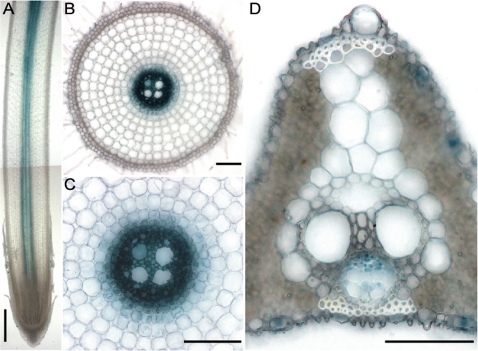
Tissue expression analysis of OsLCD. OsLCDp–GUS plants were germinated and cultured in nutrient solution for 2 weeks and analysed for GUS staining. (A) Longitudinal section of a root. (B) Cross-section. (C) Amplified view of the cross-section. (D) Leaf cross-section. Bars=500 μm in A, 100 μm in B and C, and 50 μm in D.
Fig. 6.
Fig. 6.
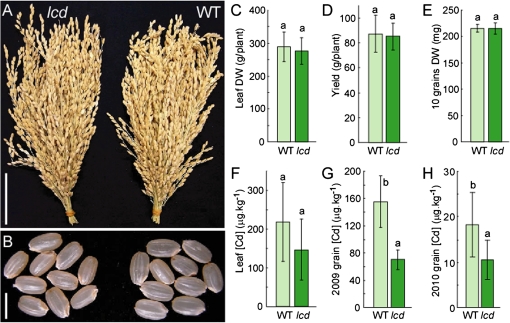
Field experiment. Photo of panicles (A) and grains (B). (C) Leaf dry weight (DW). (D) Grain yield per plant. (E) DW of 10 grains. (F) Leaf Cd concentration. (G) Grain Cd concentration in lcd and the WT from the field experiment in 2009 (n=6). (H) Grain Cd concentration in lcd and the WT from the field experiment in 2010 (n=25). Bars=5 cm in A and 5 mm in B. Values followed by different letters are statistically different according to Student–Newman–Keuls test.

References

    1. Azpiroz-Leehan R, Feldmann KA. T-DNA insertion mutagenesis in Arabidopsis: going back and forth. Trends in Genetcs. 1997;13:152–156. - PubMed
    1. Cobbett CS, May MJ, Howden R, Rolls B. The glutathione-deficient, cadmium-sensitive mutant, cad2-1, of Arabidopsis thaliana is deficient in γ-glutamylcysteine synthetase. The Plant Journal. 1998;16:73–78. - PubMed
    1. Das P, Samantaray S, Rout GR. Studies on cadmium toxicity in plants: a review. Environmental Pollution. 1997;98:29–36. - PubMed

    1. Eren E, Argüello JM. Arabidopsis HMA2, a divalent heavy metal-transporting PIB-type ATPase, is involved in cytoplasmic Zn2+ homeostasis. Plant Physiology. 2004;136:3712–3723. - PMC - PubMed
    1. Fujimaki S, Suzui N, Ishioka NS, Kawachi N, Ito S, Chino M, Nakamura S. Tracing cadmium from culture to spikelet: noninvasive imaging and quantitative characterization of absorption, transport, and accumulation of cadmium in an intact rice plant. Plant Physiology. 2010;152:1796–1806. - PMC - PubMed

Publication types

MeSH terms