


Activation of tumor cell proliferation by thyroid hormone in a mouse model of follicular thyroid carcinoma
- PMID: 21909131
- PMCID: PMC3728834
- DOI: 10.1038/onc.2011.390
Activation of tumor cell proliferation by thyroid hormone in a mouse model of follicular thyroid carcinoma
Abstract
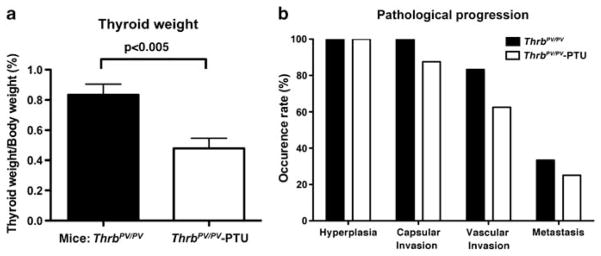
Thyroid cancers are the most common malignancy of the endocrine system in humans. To understand the molecular genetic events underlying thyroid carcinogenesis, we have generated a mouse model that spontaneously develops follicular thyroid carcinoma similar to human thyroid cancer (Thrb(PV/PV) mouse). This mutant mouse harbors a dominant-negative mutated thyroid hormone receptor β (denoted PV). The PV mutation was identified in a patient with resistance to thyroid hormone (TH). Thrb(PV/PV) mice exhibit highly elevated serum thyroid-stimulating hormone levels and increased TH. We have previously shown that thyroid-stimulating hormone is required, but not sufficient to induce metastatic follicular thyroid cancer in Thrb(PV/PV) mice. However, whether the elevated TH also contributes to the thyroid carcinogenesis of Thrb(PV/PV) mice was not elucidated. To understand the role of TH in thyroid carcinogenesis, we blocked the production of TH by treating Thrb(PV/PV) mice with propylthiouracil (Thrb(PV/PV)-PTU mice) and compared the development of thyroid cancer in Thrb(PV/PV)-PTU and untreated Thrb(PV/PV) mice. We found that thyroid tumor growth was reduced by ∼42% in Thrb(PV/PV)-PTU mice as compared with Thrb(PV/PV) mice. Analysis by bromodeoxyuridine-nuclear labeling showed decreased incorporation of bromodeoxyuridine in thyroid tumor cells of Thrb(PV/PV)-PTU mice, indicative of decreased tumor cell proliferation. However, cleaved-caspase 3 staining showed no apparent changes in apoptosis of tumor cells in Thrb(PV/PV)-PTU mice. Molecular studies identified a marked attenuation of the PI3K-AKT-β-catenin signaling pathway that led to decreased protein levels of cyclin D2, thereby decreasing tumor cell proliferation in Thrb(PV/PV)-PTU mice. Furthermore, matrix metalloproteinase-2, a downstream target of β-catenin and a key regulator during tumor invasion and metastasis, was also decreased. Thus, the present study uncovers a critical role of TH in promoting the thyroid carcinogenesis of Thrb(PV/PV) mice via membrane signaling events. Importantly, these findings suggest that anti-thyroid drugs could be considered as possible therapeutic agents of thyroid cancer.
Conflict of interest statement
The authors declare no conflict of interest.
Figures



References
-
- Abbosh PH, Nephew KP. Multiple signaling pathways converge on beta-catenin in thyroid cancer. Thyroid. 2005;15:551–561. - PubMed
-
- Bergh JJ, Lin HY, Lansing L, Mohamed SN, Davis FB, Mousa S, et al. Integrin alphaVbeta3 contains a cell surface receptor site for thyroid hormone that is linked to activation of mitogen-activated protein kinase and induction of angiogenesis. Endocrinology. 2005;146:2864–2871. - PubMed
-
- Boelaert K, McCabe CJ, Tannahill LA, Gittoes NJ, Holder RL, Watkinson JC, et al. Pituitary tumor transforming gene and fibroblast growth factor-2 expression: potential prognostic indicators in differentiated thyroid cancer. J Clin Endocrinol Metab. 2003;88:2341–2347. - PubMed
-
- Cao X, Kambe F, Moeller LC, Refetoff S, Seo H. Thyroid hormone induces rapid activation of Akt/protein kinase Bmammalian target of rapamycin-p70S6K cascade through phosphatidylinositol 3-kinase in human fibroblasts. Mol Endocrinol. 2005;19:102–112. - PubMed
Publication types
MeSH terms
Substances
Grants and funding
LinkOut - more resources
Full Text Sources
Medical
Molecular Biology Databases
Research Materials
