


Sign language and pantomime production differentially engage frontal and parietal cortices
- PMID: 21909174
- PMCID: PMC3167215
- DOI: 10.1080/01690965.2010.492643
Sign language and pantomime production differentially engage frontal and parietal cortices
Abstract
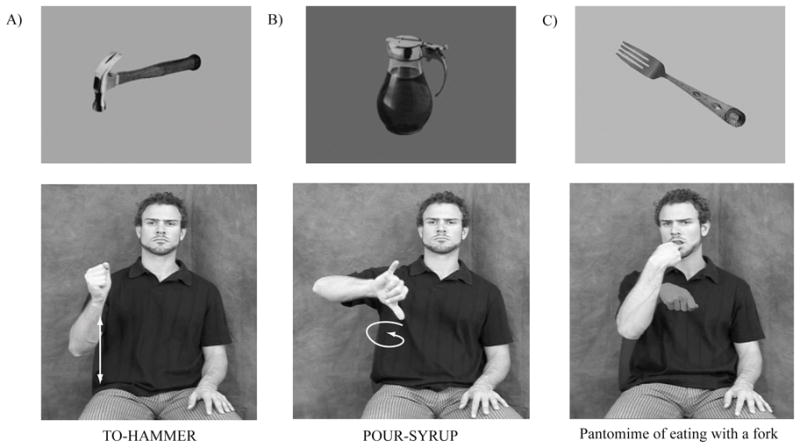
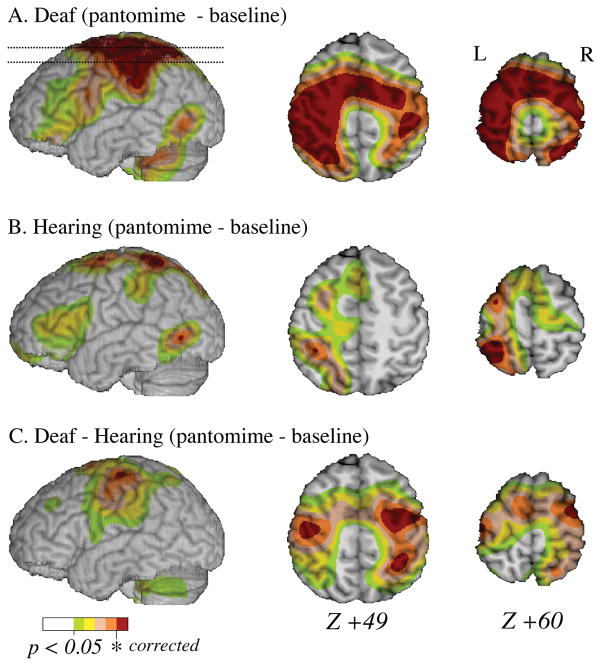
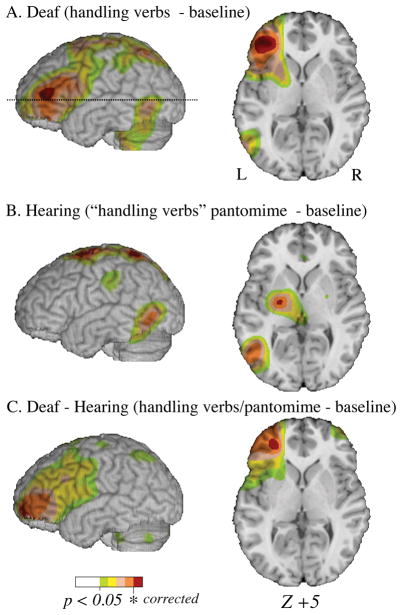
We investigated the functional organization of neural systems supporting language production when the primary language articulators are also used for meaningful, but non-linguistic, expression such as pantomime. Fourteen hearing non-signers and 10 deaf native users of American Sign Language (ASL) participated in an H(2) (15)O-PET study in which they generated action pantomimes or ASL verbs in response to pictures of tools and manipulable objects. For pantomime generation, participants were instructed to "show how you would use the object." For verb generation, signers were asked to "generate a verb related to the object." The objects for this condition were selected to elicit handling verbs that resemble pantomime (e.g., TO-HAMMER (hand configuration and movement mimic the act of hammering) and non-handling verbs that do not (e.g., POUR-SYRUP, produced with a "Y" handshape). For the baseline task, participants viewed pictures of manipulable objects and an occasional non-manipulable object and decided whether the objects could be handled, gesturing "yes" (thumbs up) or "no" (hand wave). Relative to baseline, generation of ASL verbs engaged left inferior frontal cortex, but when non-signers produced pantomimes for the same objects, no frontal activation was observed. Both groups recruited left parietal cortex during pantomime production. However, for deaf signers the activation was more extensive and bilateral, which may reflect a more complex and integrated neural representation of hand actions. We conclude that the production of pantomime versus ASL verbs (even those that resemble pantomime) engage partially segregated neural systems that support praxic versus linguistic functions.
Figures
References
-
- Benedicto E, Brentari D. Where did all the arguments go?: Argument-changing properties of classifiers in ASL. Natural Language and Linguistic Theory. 2004;22(4):743–810.
-
- Braun AR, Guillemin A, Hosey L, Varga M. The neural organization of discourse - An (H2O)-O-15-PET study of narrative production in English and American sign language. Brain. 2001;124:2028–2044. - PubMed
-
- Buckner RL, Raichle ME, Petersen SE. Dissociation of human prefrontal cortical areas across different speech production tasks and gender groups. J Neurophysiol. 1995;74(5):2163–2173. - PubMed
Grants and funding
LinkOut - more resources
Full Text Sources