


doi: 10.3390/ijerph8083399.
Epub 2011 Aug 18.
A framework for the specificity of addictions
Affiliations
- PMID: 21909314
- PMCID: PMC3166750
- DOI: 10.3390/ijerph8083399
Item in Clipboard
A framework for the specificity of addictions
Int J Environ Res Public Health.
2011 Aug.
Abstract
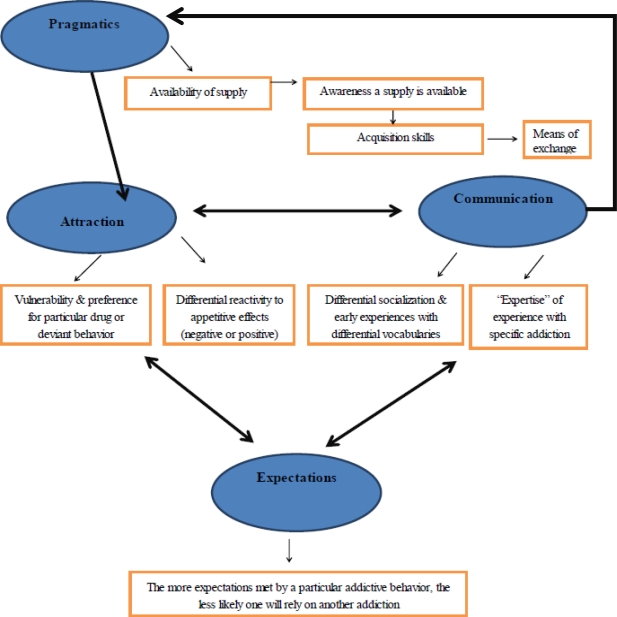
Research over the last two decades suggests that a wide range of substance and behavioral addictions may serve similar functions. Yet, co-occurrence of addictions has only been reported among a minority of addicts. "Addiction specificity" pertains to a phenomenon in which one pattern of addictive behaviors may be acquired whereas another is not. This paper presents the PACE model as a framework which might help explain addiction specificity. Pragmatics, attraction, communication, and expectation (PACE) variables are described, which may help give some direction to future research needs in this arena.
Keywords: PACE model; addiction specificity.
References
-
- Goodman A. Addiction: Definition and implications. Br. J. Addict. 1990;85:1403–1408. - PubMed
-
- Goodman A. Neurobiology of addiction: An integrative review. Biochem. Pharmacol. 2008;75:266–322. - PubMed
-
- Hatterer LJ. The addictive process. Psychiatr. Q. 1982;54:149–156. - PubMed
-
- Jacobs DF. A general theory of addictions: A new theoretical model. J. Gambl. Behav. 1986;2:15–31.
Publication types
MeSH terms
Grants and funding
LinkOut - more resources
Full Text Sources
Medical
