


On the Relationship Between the Practice of Mindfulness Meditation and Personality-an Exploratory Analysis of the Mediating Role of Mindfulness Skills
- PMID: 21909341
- PMCID: PMC3146707
- DOI: 10.1007/s12671-011-0060-7
On the Relationship Between the Practice of Mindfulness Meditation and Personality-an Exploratory Analysis of the Mediating Role of Mindfulness Skills
Abstract
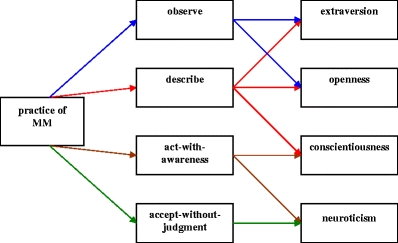
Mindfulness meditation (MM) has often been suggested to induce fundamental changes in the way events in life are experienced and dealt with, presumably leading to alterations in personality. However, the relationship between the practice of MM and personality has not been systematically studied. The aim of this study was to explore this relationship and to investigate the mediating role of mindfulness skills. Thirty-five experienced mindfulness meditators (age range, 31-75 years; meditation experience range, 0.25-35 years; mean, ∼13 years) and 35 age-, gender-, and ethnicity-matched controls (age range, 27-63 years) without any meditation experience completed a personality (NEO-FFI) and mindfulness (KIMS) questionnaire. The practice of MM was positively related to openness and extraversion and negatively related to neuroticism and conscientiousness. Thus, the results of the current study associate the practice of MM with higher levels of curiosity and receptivity to new experiences and experience of positive affect and with less proneness toward negative emotions and worrying and a reduced focus on achievements. Furthermore, the mediating role of specific mindfulness skills in the relationship between the practice of MM and personality traits was shown.
Figures
References
-
- Barrick MR, Mount MK, Judge TA. Personality and performance at the beginning of the new millennium: What do we know and where do we go next? International Journal of Selection and Assessment. 2001;9:9–30. doi: 10.1111/1468-2389.00160. - DOI
-
- Bishop SR, Lau M, Shapiro S, Carlson L, Anderson ND, Carmody J, et al. Mindfulness: A proposed operational definition. Clinical Psychology: Science and Practice. 2004;11:230–241. doi: 10.1093/clipsy.bph077. - DOI
LinkOut - more resources
Full Text Sources