


HIV incidence and risk factors for acquisition in HIV discordant couples in Masaka, Uganda: an HIV vaccine preparedness study
- PMID: 21909379
- PMCID: PMC3166075
- DOI: 10.1371/journal.pone.0024037
HIV incidence and risk factors for acquisition in HIV discordant couples in Masaka, Uganda: an HIV vaccine preparedness study
Abstract
Objectives: To determine the incidence of and risk factors for HIV acquisition in a cohort of HIV-uninfected partners from HIV discordant couples in Masaka, Uganda, and to establish its suitability for HIV vaccine trials.
Methods: HIV-uninfected adults living in HIV discordant couple relationships were enrolled and followed for 2 years. Interviews, medical investigations, HIV counseling and testing, syphilis and urine pregnancy (women) tests were performed at quarterly visits. Sexual risk behaviour data were collected every 6 months.
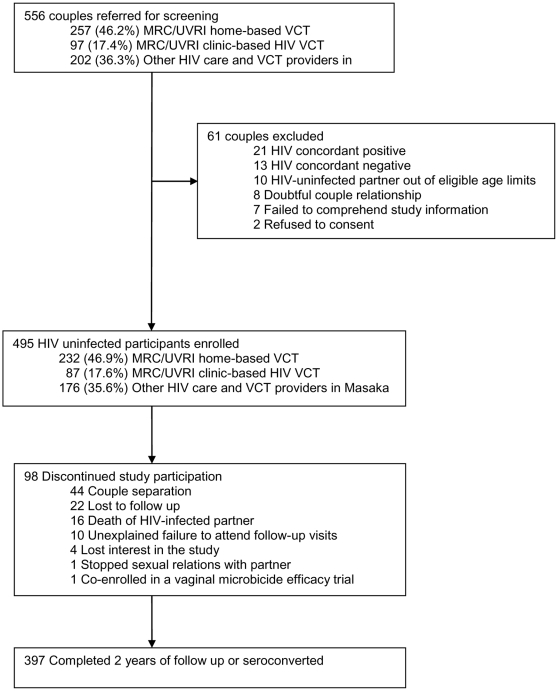
Results: 495 participants were enrolled, of whom 34 seroconverted during 786.6 person-years of observation (PYO). The overall HIV incidence rate [95% confidence interval (CI)] was 4.3 [3.1-6]; and 4.3 [2.8-6.4] and 4.4 [2.5-8] per 100 PYO in men and women respectively. Independent baseline predictors for HIV acquisition were young age [18-24 (aRR = 4.1, 95% CI 1.6-10.8) and 25-34 (aRR = 2.7, 95% CI 1.2-5.8) years]; alcohol use (aRR = 2.6, 95% CI 1.1-6); and reported genital discharge (aRR = 3.4, 95% CI 1.6-7.2) in the past year. Condom use frequency in the year preceding enrolment was predictive of a reduced risk of HIV acquisition [sometimes (aRR = 0.4, 95% CI 0.2-0.8); always (aRR = 0.1, 95% CI 0.02-0.9)]. In the follow-up risk analysis, young age [18-24 (aRR = 6.2, 95% CI 2.2-17.3) and 25-34 (aRR = 2.3, 95% CI 1.1-5.0) years], reported genital discharge (aRR = 2.5, 95% CI 1.1-5.5), serological syphilis (aRR 3.2, 95% CI 1.3-7.7) and the partner being ART naïve (aRR = 4.8, 95% CI 1.4-16.0) were independently associated with HIV acquisition. There were no seroconversions among participants who reported consistent condom use during the study.
Conclusions: The study has identified important risk factors for HIV acquisition among HIV discordant couples. HIV-uninfected partners in discordant couples may be a suitable population for HIV vaccine efficacy trials. However, recent confirmation that ART reduces heterosexual HIV transmission may make it unfeasible to conduct HIV prevention trials in this population.
Conflict of interest statement
References
-
- UNAIDS. Geneva: UNAIDS; 2009. AIDS epidemic update.
-
- Robinson JN, Mulder D, Auvert B, Whitworth J, Hayes R. Type of partnership and heterosexual spread of HIV infection in rural Uganda:results from simulation modelling. International Journal of STD & AIDS. 1999;10:718–725. - PubMed
-
- Carpenter LM, Kamali A, Ruberantwari A, Malamba S, Whitworth J. Rates of HIV transmission within marriage in rural Uganda in relation to the HIV sero-status of the partners. AIDS. 1999;13:1083–1089. - PubMed
-
- Hugonnet S, Mosha F, Todd J, Mugeye K, Klokke A, et al. Incidence of HIV infection in stable sexual partnerships: A retrospective cohort study of 1802 couples in Mwanza Region, Tanzania. J Acquir Immune Defic Syndr. 2002;30:73–80. - PubMed
-
- Allen S, Meinzen-Derr J, Kautzman M, Zulu I, Trask S, et al. Sexual behavior of HIV discordant couples after HIV counselling and testing . AIDS. 2003;17:733–740. - PubMed
Publication types
MeSH terms
Substances
Grants and funding
LinkOut - more resources
Full Text Sources
Medical
Miscellaneous
