


Effect of hydrophobic mutations in the H2-H3 subdomain of prion protein on stability and conversion in vitro and in vivo
- PMID: 21909425
- PMCID: PMC3164720
- DOI: 10.1371/journal.pone.0024238
Effect of hydrophobic mutations in the H2-H3 subdomain of prion protein on stability and conversion in vitro and in vivo
Abstract
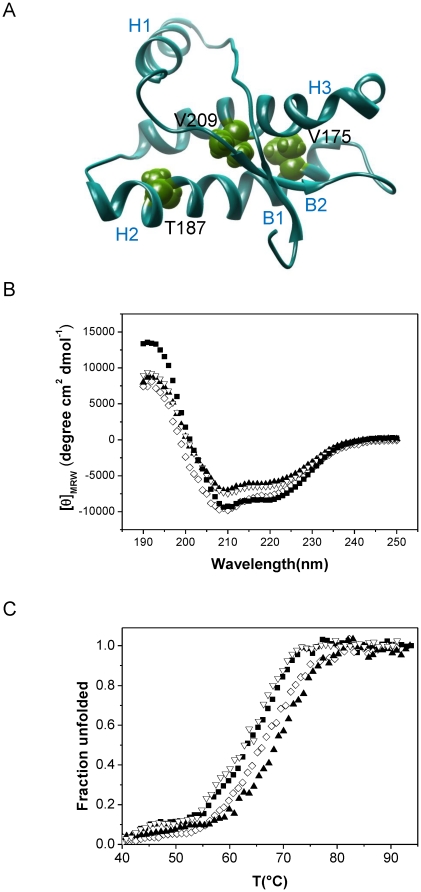
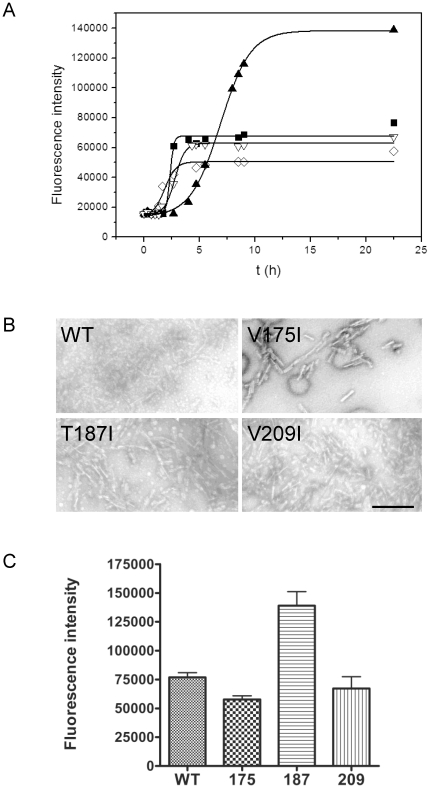
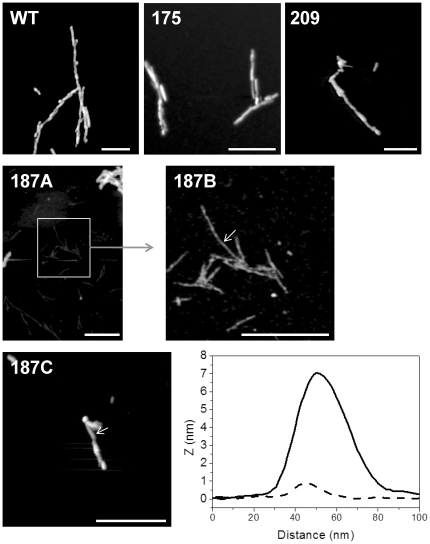
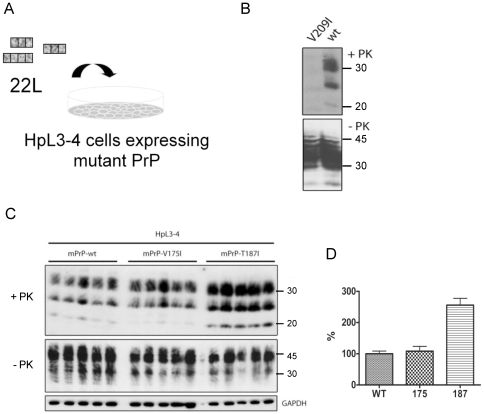
Prion diseases are fatal neurodegenerative diseases, which can be acquired, sporadic or genetic, the latter being linked to mutations in the gene encoding prion protein. We have recently described the importance of subdomain separation in the conversion of prion protein (PrP). The goal of the present study was to investigate the effect of increasing the hydrophobic interactions within the H2-H3 subdomain on PrP conversion. Three hydrophobic mutations were introduced into PrP. The mutation V209I associated with human prion disease did not alter protein stability or in vitro fibrillization propensity of PrP. The designed mutations V175I and T187I on the other hand increased protein thermal stability. V175I mutant fibrillized faster than wild-type PrP. Conversion delay of T187I was slightly longer, but fluorescence intensity of amyloid specific dye thioflavin T was significantly higher. Surprisingly, cells expressing V209I variant exhibited inefficient proteinase K resistant PrP formation upon infection with 22L strain, which is in contrast to cell lines expressing wild-type, V175I and T187I mPrPs. In agreement with increased ThT fluorescence at the plateau T187I expressing cell lines accumulated an increased amount of the proteinase K-resistant prion protein. We showed that T187I induces formation of thin fibrils, which are absent from other samples. We propose that larger solvent accessibility of I187 in comparison to wild-type and other mutants may interfere with lateral annealing of filaments and may be the underlying reason for increased conversion efficiency.
Conflict of interest statement
Figures
References
-
- Wuthrich K, Riek R. Three-dimensional structures of prion proteins. Adv Protein Chem. 2001;57:55–82. - PubMed
-
- Beck JA, Poulter M, Campbell TA, Adamson G, Uphill JB, et al. PRNP allelic series from 19 years of prion protein gene sequencing at the MRC Prion Unit. Hum Mutat. 2010;31:E1551–1563. - PubMed
-
- Swietnicki W, Petersen RB, Gambetti P, Surewicz WK. Familial mutations and the thermodynamic stability of the recombinant human prion protein. J Biol Chem. 1998;273:31048–31052. - PubMed
-
- Liemann S, Glockshuber R. Influence of amino acid substitutions related to inherited human prion diseases on the thermodynamic stability of the cellular prion protein. Biochemistry. 1999;38:3258–3267. - PubMed
-
- Apetri AC, Surewicz K, Surewicz WK. The effect of disease-associated mutations on the folding pathway of human prion protein. J Biol Chem. 2004;279:18008–18014. - PubMed
Publication types
MeSH terms
Substances
LinkOut - more resources
Full Text Sources
Research Materials
