


Seroprevalence and severity of 2009 pandemic influenza A H1N1 in Taiwan
- PMID: 21909433
- PMCID: PMC3164718
- DOI: 10.1371/journal.pone.0024440
Seroprevalence and severity of 2009 pandemic influenza A H1N1 in Taiwan
Abstract
Background: This study is to determine the seroprevalence of the pandemic influenza A H1N1 virus (pH1N1) in Taiwan before and after the 2009 pandemic, and to estimate the relative severity of pH1N1 infections among different age groups.
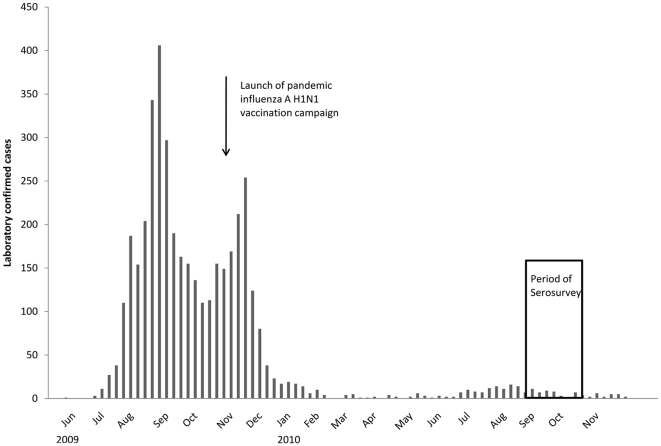
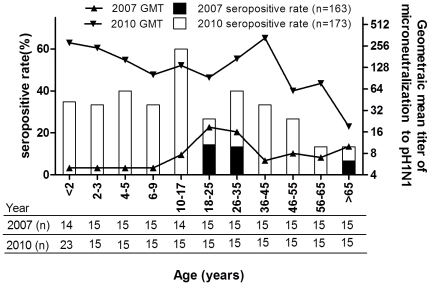
Methodology/principal findings: A total of 1544 and 1558 random serum samples were collected from the general population in Taiwan in 2007 and 2010, respectively. Seropositivity was defined by a hemagglutination inhibition titer to pH1N1 (A/Taiwan/126/09) ≥1:40. The seropositivity rate of pH1N1 among the unvaccinated subjects and national surveillance data were used to compare the proportion of infections that led to severe diseases and fatalities among different age groups. The overall seroprevalence of pH1N1 was 0.91% (95% confidence interval [CI] 0.43-1.38) in 2007 and significantly increased to 29.9% (95% CI 27.6-32.2) in 2010 (p<0.0001), with the peak attack rate (55.4%) in 10-17 year-old adolescents, the lowest in elderly ≥65 years (14.1%). The overall attack rates were 20.6% (188/912) in unvaccinated subjects. Among the unvaccinated but infected populations, the estimated attack rates of severe cases per 100,000 infections were significantly higher in children aged 0-5 years (54.9 cases, odds ratio [OR] 4.23, 95% CI 3.04-5.90) and elderly ≥ 65 years (22.4 cases, OR 2.76, 95% CI 1.99-3.83) compared to adolescents aged 10-17 years (13.0 cases). The overall case-fatality rate was 0.98 per 100,000 infections without a significant difference in different age groups.
Conclusions/significance: Pre-existing immunity against pH1N1 was rarely identified in Taiwanese at any age in 2007. Young children and elderly--the two most lower seroprotection groups showed the greatest vulnerability to clinical severity after the pH1N1 infections. These results imply that both age groups should have higher priority for immunization in the coming flu season.
Conflict of interest statement
Figures
References
-
- Center for Disease Control and Prevention. Swine influenza A (H1N1) infection in two–children Southern California, March-April 2009. Morb Mortal Wkly Rep. 2009;58:400–402. - PubMed
-
- Center for Disease Control and Prevention. Outbreak of swine-origin influenza A (H1N1) virus infection - Mexico, March-April 2009. Morb Mortal Wkly Rep. 2009;58:467–470. - PubMed
-
- European Centre for Disease Prevention and Control Technical Emergency Team. Initial epidemiological findings in the European Union following the declaration of pandemic alert level 5 due to influenza A (H1N1). Euro Surveill 14. 2009;8 Available: http://www.eurosurveillance.org/ViewArticle.aspx?ArticleId=19204 Accessed 2011 Feb. - PubMed
-
- European Centre for Disease Prevention and Control Technical Emergency Team. Pandemic phase level 4: human cases of the novel influenza A/H1N1 strain confirmed in Scotland and Spain. Euro Surveill 14. 2009;8 Available: http://www.eurosurveillance.org/ViewArticle.aspx?ArticleId=19185 Accessed 2011 Feb. - PubMed
-
- Center for Disease Control and Prevention. Swine-origin influenza A (H1N1) virus infections in a school - New York City, April 2009. Morb Mortal Wkly Rep. 2009;58:470–472. - PubMed
Publication types
MeSH terms
LinkOut - more resources
Full Text Sources
Medical
