Adiponectin is Associated with Impaired Fasting Glucose in the Non-Diabetic Population
- PMID: 21909476
- PMCID: PMC3163270
- DOI: 10.4178/epih/e2011007
Adiponectin is Associated with Impaired Fasting Glucose in the Non-Diabetic Population
Abstract
Objectives: Adiponectin is strongly associated with diabetes in the Western population. However, whether adiponectin is independently associated with impaired fasting glucose (IFG) in the non-obese population is unknown.
Methods: The serum adiponectin, insulin resistance (IR), and waist circumference (WC) of 27,549 healthy Koreans were measured. Individuals were then classified into tertile groups by gender. IFG was defined as a fasting serum glucose of 100-125 mg/dL without diabetes. IR was calculated using the homeostasis model assessment of insulin resistance (HOMA-IR). The association of adiponectin and IFG was determined using logistic regression analysis.
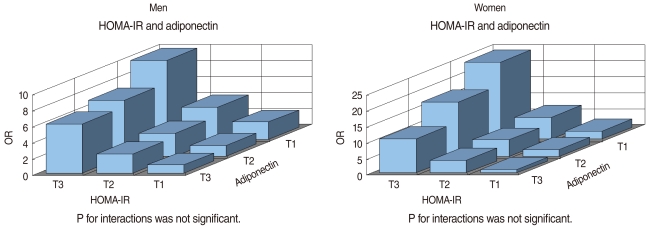
Results: WC and adiponectin were associated with IFG in both men and women. However, the association of WC with IFG was attenuated in both men and women after adjustment for the HOMA-IR. Adiponectin was still associated with IFG after adjustment for and stratification by HOMA-IR in men and women. Strong combined associations of IR and adiponectin with IFG were observed in men and women. Multivariate adjusted odds ratios (ORs) (95% confidence interval [CI]) among those in the highest tertile of IR and the lowest tertile of adiponectin were 9.8 (7.96 to 12.07) for men and 24.1 (13.86 to 41.94) for women.
Conclusion: These results suggest that adiponectin is strongly associated with IFG, and point to adiponectin as an additional diagnostic biomarker of IFG in the non-diabetic population.
Keywords: Adiponectin; Diabetes; Impaired fasting glucose; Insulin resistance.
Conflict of interest statement
The authors have no conflicts of interest to declare for this study.
Figures
References
-
- Diabetes programme. World Health Organization. [cited 2010 Nov 12]. Available from: http://www.who.int/diabetes/facts/en/index.html.
-
- Bassett J International Diabetes Institute; World Health Organization, Regional Office for the Western Pacific; International Association for the Study of Obesity; International Obesity Task Force. The Asia-Pacific perspective: redefining obesity and its treatment. Australia: Health Communications Australia; 2000.
-
- Korea Centers for Disease Control and Prevention. The Fourth Korea National Health and Nutrition Examination Survey (KNHANES IV), 2008. Seoul: Ministry for Health, Welfare and Family Affairs; 2009. (Korean)
-
- Wong MS, Gu K, Heng D, Chew SK, Chew LS, Tai ES. The Singapore impaired glucose tolerance follow-up study: does the ticking clock go backward as well as forward? Diabetes Care. 2003;26:3024–3030. - PubMed
-
- Um HD, Lee DC, Lee SY, Kim YS. A prospective cohort study of exercise and the incidence of type 2 diabetes in impaired fasting glucose group. J Prev Med Public Health. 2008;41:45–50. (Korean) - PubMed
LinkOut - more resources
Full Text Sources