


The complex world of post-transcriptional mechanisms: is their deregulation a common link for diseases? Focus on ELAV-like RNA-binding proteins
- PMID: 21909784
- PMCID: PMC11114966
- DOI: 10.1007/s00018-011-0810-7
The complex world of post-transcriptional mechanisms: is their deregulation a common link for diseases? Focus on ELAV-like RNA-binding proteins
Abstract
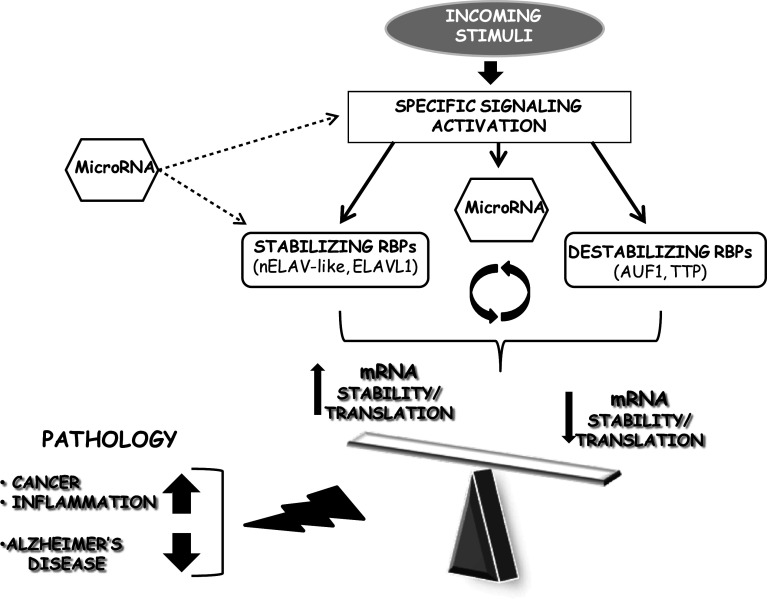
Post-transcriptional mechanisms are key determinants in the modulation of the expression of final gene products. Within this context, fundamental players are RNA-binding proteins (RBPs), and among them ELAV-like proteins. RBPs are able to affect every aspect in the processing of transcripts, from alternative splicing, polyadenylation, and nuclear export to cytoplasmic localization, stability, and translation. Of interest, more than one RBP can bind simultaneously the same mRNA; therefore, since each RBP is endowed with different properties, the balance of these interactions dictates the ultimate fate of the transcript, especially in terms of both stability and rate of translation. Besides RBPs, microRNAs are also important contributors to the post-transcriptional control of gene expression. Within this general context, the present review focuses on ELAV-like proteins describing their roles in the nucleus and in the cytoplasm, also highlighting some examples of interactions with other RBPs and with microRNAs. We also examine the putative role and the observed changes of ELAV-like proteins and of their interactions with other regulatory elements in Alzheimer's disease, cancer, and inflammation. The changes in the expression of proteins involved in these diseases are examples of how a derangement in the mRNA stabilization process may be associated with disease development and contribute to pathology. Overall, we hope that the topics handled in the present manuscript provide a hint to look at ELAV-like-mediated mRNA stabilization as a mechanism relevant to disease as well as a novel putative drug target.
Figures

References
-
- Moore MJ. From birth to death: the complex lives of eukaryotic mRNAs. Science. 2005;309(5740):1514–1518. - PubMed
-
- Fabian MR, Sonenberg N, Filipowicz W. Regulation of mRNA translation and stability by microRNAs. Annu Rev Biochem. 2010;79:351–379. - PubMed
-
- Nguyen-Chi M, Morello D. Aberrant regulation of mRNA 3′ untranslated region in cancers and inflammation. Med Sci (Paris) 2008;24(3):290–296. - PubMed
-
- Guhaniyogi J, Brewer G. Regulation of mRNA stability in mammalian cells. Gene. 2001;265(1–2):11–23. - PubMed
Publication types
MeSH terms
Substances
LinkOut - more resources
Full Text Sources
Medical
