doi: 10.1007/978-1-61779-166-6_26.
Analysis of chemotaxis in Dictyostelium
Affiliations
- PMID: 21909927
- PMCID: PMC3381519
- DOI: 10.1007/978-1-61779-166-6_26
Item in Clipboard
Analysis of chemotaxis in Dictyostelium
Methods Mol Biol.
2012.
Abstract
Dictyostelium discoideum is an excellent model organism for the study of directed cell migration, since Dictyostelium cells show robust chemotactic responses to the chemoattractant cAMP. Many powerful experimental tools are applicable, including forward and reverse genetics, biochemistry, microscopy, and proteomics. Recent studies have demonstrated that many components involved in chemotaxis are functionally conserved between human neutrophils and Dictyostelium amoebae. In this chapter, we describe how to define the functions of proteins that mediate and regulate cell motility, cell polarity, and directional sensing during chemotaxis in Dictyostelium.
Figures
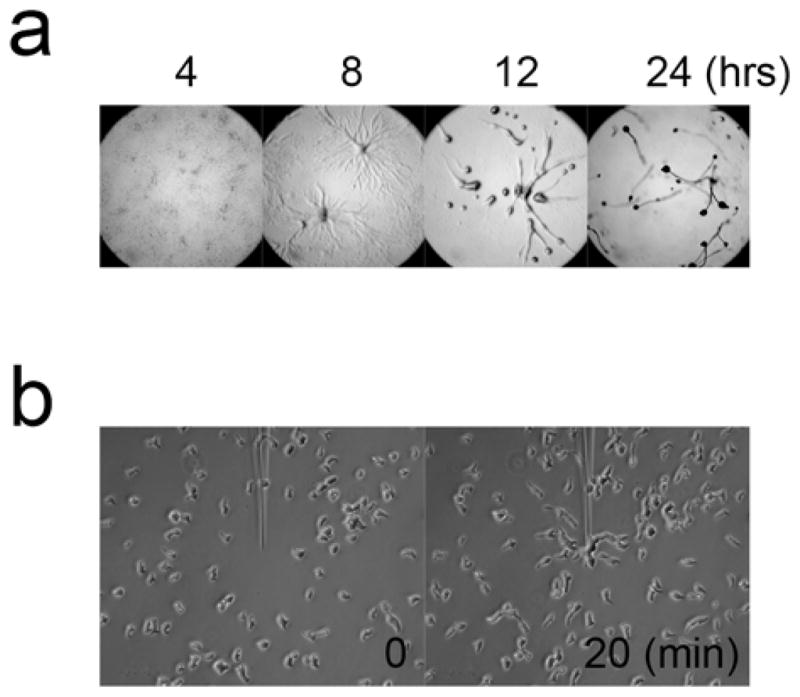
(a) Development of cells on non-nutrient agar plates. (b) Chemotaxis to a pipette filled with 1 μM cAMP
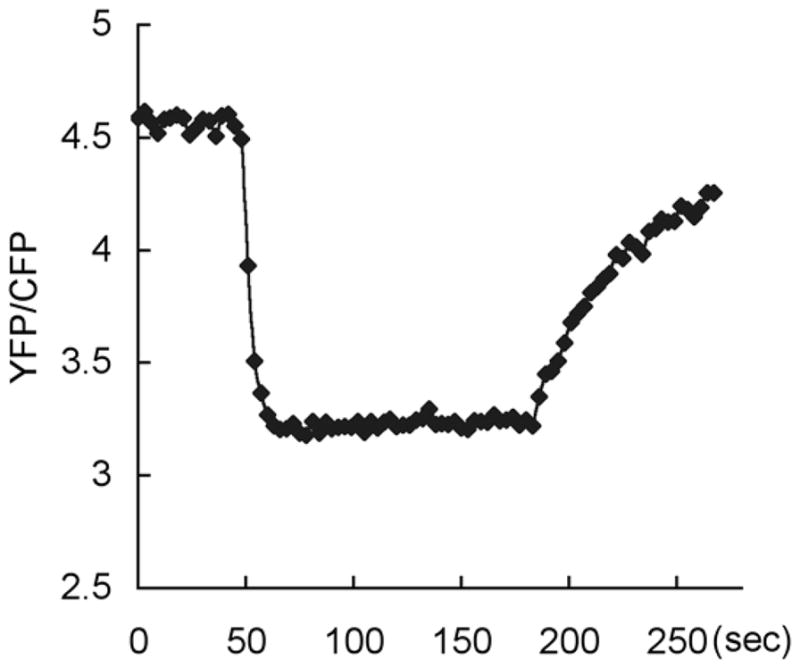
G protein activation upon cAMP stimulation monitored by FRET between Gα2-CFP and Gβ-YFP. Loss of FRET (decreased YFP:CFP ratio) was induced when a micropipette containing 10 μM cAMP was introduced at 45 sec and persisted until the micropipette was removed at 180 sec.
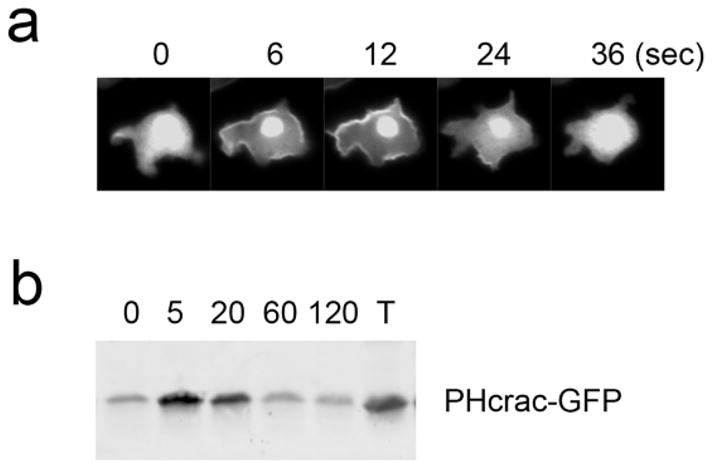
Visualization of transient PIP3 production upon uniform cAMP stimulation. Cells expressing PHcrac-GFP were examined by fluorescence microscopy (a) and immunoblotting using anti-GFP antibodies (b) after addition of 1 μM cAMP. T, 20% of input.
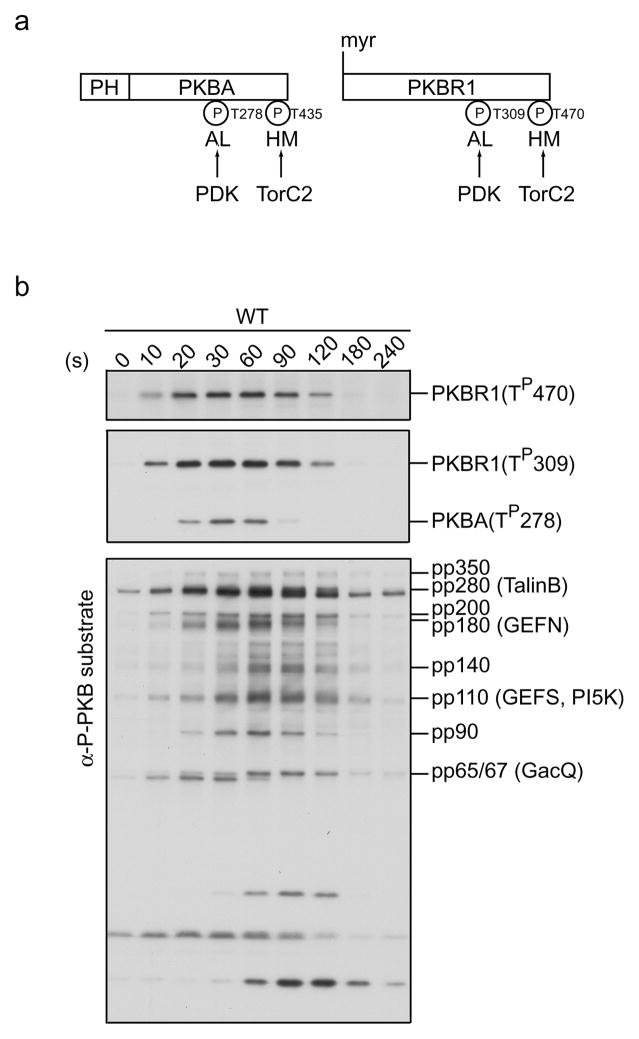
PKB activation in response to chemoattractant stimulation. (a) Schematic representation of the activation of PKBR1 and PKBA. The N-ternimus of PKBR1 is myristoylated while the N-terminus of PKBA has a PIP3-specific PH domain. Upon cAMP stimulation, the two PKBs are activated through phosphorylation of their HMs by TorC2 and ALs by PDK. The phosphorylation sites (P) can be detected by phospho-specific antibodies. (b) Wildtype cells were stimulated with cAMP, lysed at the indicated time points, and subjected immunoblotting using antibodies against phospho HM (top panel), phospho-AL (middle panel), and phospho-substrate (bottom panel).
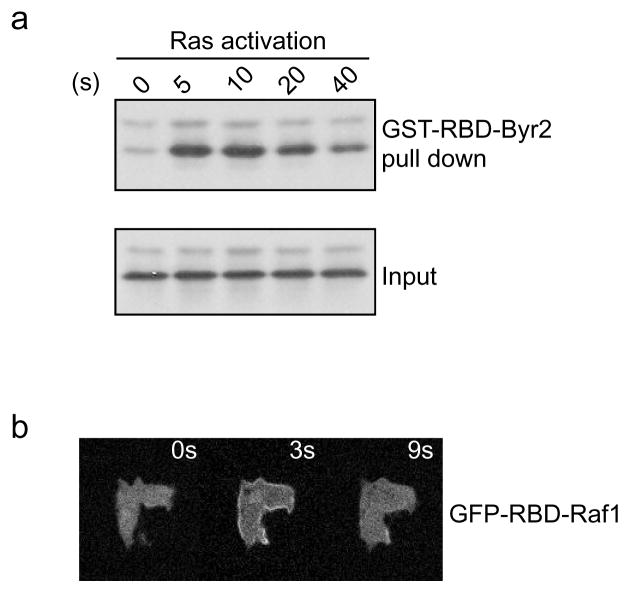
Ras activation in response to chemoattractant. (a) cAMP stimulation triggers rapid and transient activation of endogenous Ras proteins, which can be pulled down by GST-RBD-Byr2. (b) Fluorescent images of GFP-RBD-Raf1 in wildtype cells before and after cAMP stimulation.
Similar articles
-
Diverse chemotactic responses of Dictyostelium discoideum amoebae in the developing (temporal) and stationary (spatial) concentration gradients of folic acid, cAMP, Ca(2+) and Mg(2+).Cell Motil Cytoskeleton. 2002 Sep;53(1):1-25. doi: 10.1002/cm.10052. Cell Motil Cytoskeleton. 2002. PMID: 12211112
-
Chemotaxis with directional sensing during Dictyostelium aggregation.C R Biol. 2013 Nov-Dec;336(11-12):565-71. doi: 10.1016/j.crvi.2013.10.008. Epub 2013 Nov 7. C R Biol. 2013. PMID: 24296080
-
Imaging G-protein coupled receptor (GPCR)-mediated signaling events that control chemotaxis of Dictyostelium discoideum.J Vis Exp. 2011 Sep 20;(55):3128. doi: 10.3791/3128. J Vis Exp. 2011. PMID: 21969095 Free PMC article.
-
Signaling pathways mediating chemotaxis in the social amoeba, Dictyostelium discoideum.Eur J Cell Biol. 2006 Sep;85(9-10):897-904. doi: 10.1016/j.ejcb.2006.06.003. Eur J Cell Biol. 2006. PMID: 16962888 Review.
-
A contextual framework for characterizing motility and chemotaxis mutants in Dictyostelium discoideum.J Muscle Res Cell Motil. 2002;23(7-8):659-72. doi: 10.1023/a:1024459124427. J Muscle Res Cell Motil. 2002. PMID: 12952065 Review.
Cited by
-
Mechanism of human PTEN localization revealed by heterologous expression in Dictyostelium.Oncogene. 2014 Dec 11;33(50):5688-96. doi: 10.1038/onc.2013.507. Epub 2013 Dec 2. Oncogene. 2014. PMID: 24292679 Free PMC article.
-
Evolutionarily conserved coupling of adaptive and excitable networks mediates eukaryotic chemotaxis.Nat Commun. 2014 Oct 27;5:5175. doi: 10.1038/ncomms6175. Nat Commun. 2014. PMID: 25346418 Free PMC article.
-
Engineering ePTEN, an enhanced PTEN with increased tumor suppressor activities.Proc Natl Acad Sci U S A. 2014 Jul 1;111(26):E2684-93. doi: 10.1073/pnas.1409433111. Epub 2014 Jun 16. Proc Natl Acad Sci U S A. 2014. PMID: 24979808 Free PMC article.
-
Trade-offs in concentration sensing in dynamic environments.Biophys J. 2024 May 21;123(10):1184-1194. doi: 10.1016/j.bpj.2024.03.025. Epub 2024 Mar 25. Biophys J. 2024. PMID: 38532627 Free PMC article.
-
Proteomic and Transcriptomic Profiling Identifies Early Developmentally Regulated Proteins in Dictyostelium Discoideum.Cells. 2019 Oct 1;8(10):1187. doi: 10.3390/cells8101187. Cells. 2019. PMID: 31581556 Free PMC article.
References
-
- Parent CA, Devreotes PN. Molecular genetics of signal transduction in Dictyostelium. Annu Rev Biochem. 1996;65:411–440. - PubMed
-
- Janetopoulos C, Jin T, Devreotes P. Receptor-mediated activation of heterotrimeric G-proteins in living cells. Science. 2001;291:2408–2411. - PubMed
-
- Parent CA, Blacklock BJ, Froehlich WM, Murphy DB, Devreotes PN. G protein signaling events are activated at the leading edge of chemotactic cells. Cell. 1998;95:81–91. - PubMed
MeSH terms
Substances
Grants and funding
LinkOut - more resources
Full Text Sources