


Longitudinal evidence that fatherhood decreases testosterone in human males
- PMID: 21911391
- PMCID: PMC3182719
- DOI: 10.1073/pnas.1105403108
Longitudinal evidence that fatherhood decreases testosterone in human males
Abstract
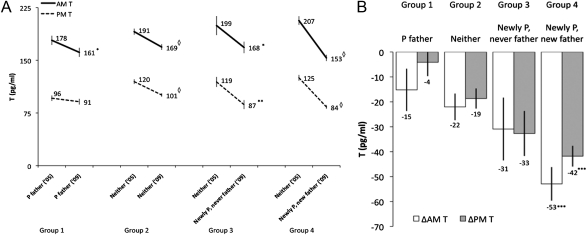
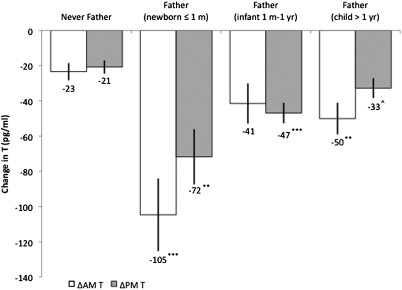
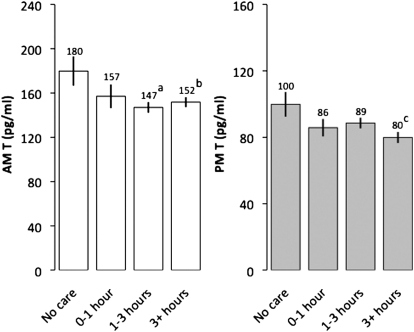
In species in which males care for young, testosterone (T) is often high during mating periods but then declines to allow for caregiving of resulting offspring. This model may apply to human males, but past human studies of T and fatherhood have been cross-sectional, making it unclear whether fatherhood suppresses T or if men with lower T are more likely to become fathers. Here, we use a large representative study in the Philippines (n = 624) to show that among single nonfathers at baseline (2005) (21.5 ± 0.3 y), men with high waking T were more likely to become partnered fathers by the time of follow-up 4.5 y later (P < 0.05). Men who became partnered fathers then experienced large declines in waking (median: -26%) and evening (median: -34%) T, which were significantly greater than declines in single nonfathers (P < 0.001). Consistent with the hypothesis that child interaction suppresses T, fathers reporting 3 h or more of daily childcare had lower T at follow-up compared with fathers not involved in care (P < 0.05). Using longitudinal data, these findings show that T and reproductive strategy have bidirectional relationships in human males, with high T predicting subsequent mating success but then declining rapidly after men become fathers. Our findings suggest that T mediates tradeoffs between mating and parenting in humans, as seen in other species in which fathers care for young. They also highlight one likely explanation for previously observed health disparities between partnered fathers and single men.
Conflict of interest statement
The authors declare no conflict of interest.
Figures
Comment in
-
The descent of a man's testosterone.Proc Natl Acad Sci U S A. 2011 Sep 27;108(39):16141-2. doi: 10.1073/pnas.1113323108. Epub 2011 Sep 13. Proc Natl Acad Sci U S A. 2011. PMID: 21914844 Free PMC article. No abstract available.
References
-
- Bribiescas RG. Reproductive ecology and life history of the human male. Am J Phys Anthropol. 2001;44(Suppl 33):148–176. - PubMed
-
- Archer J. Testosterone and human aggression: An evaluation of the challenge hypothesis. Neurosci Biobehav Rev. 2006;30:319–345. - PubMed
-
- Hart BL. Gonadal androgen and sociosexual behavior of male mammals: A comparative analysis. Psychol Bull. 1974;81:383–400. - PubMed
-
- Booth A, Dabbs JM. Testosterone and men's marriages. Soc Forces. 1993;72:463–477.
-
- Kleiman DG, Malcolm JR. The evolution of male parental investment in mammals. In: Gubernick DJ, Klopfer PH, editors. Parental Care in Mammals. New York: Plenum; 1981. pp. 347–387.
Publication types
MeSH terms
Substances
Grants and funding
LinkOut - more resources
Full Text Sources
Other Literature Sources
Miscellaneous
