


Factors associated with the career choices of hematology and medical oncology fellows trained at academic institutions in the United States
- PMID: 21911716
- PMCID: PMC3189092
- DOI: 10.1200/JCO.2011.35.8663
Factors associated with the career choices of hematology and medical oncology fellows trained at academic institutions in the United States
Abstract
Purpose: Factors that influence hematology-oncology fellows' choice of academic medicine as a career are not well defined. We undertook a survey of hematology-oncology fellows training at cancer centers designated by the National Cancer Institute (NCI) and the National Comprehensive Cancer Network (NCCN) to understand the factors fellows consider when making career decisions.
Methods: Program directors at all NCI and NCCN cancer centers were invited to participate in the study. For the purpose of analysis, fellows were grouped into three groups on the basis of interest in an academic career. Demographic data were tested with the Kruskal-Wallis test and χ² test, and nondemographic data were tested by using the multiscale bootstrap method.
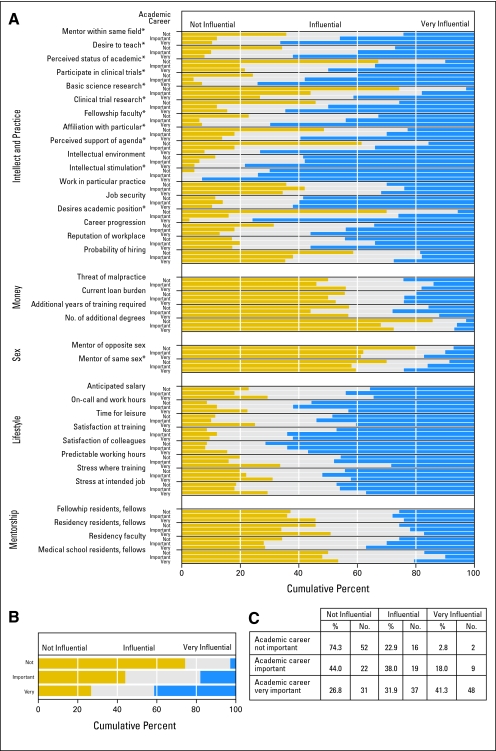
Results: Twenty-eight of 56 eligible fellowship programs participated, and 236 fellows at participating institutions responded (62% response rate). Approximately 60% of fellows graduating from academic programs in the last 5 years chose academic career paths. Forty-nine percent of current fellows ranked an academic career as extremely important. Fellows choosing an academic career were more likely to have presented and published their research. Additional factors associated with choosing an academic career included factors related to mentorship, intellect, and practice type. Fellows selecting nonacademic careers prioritized lifestyle in their career decision.
Conclusion: Recruitment into academic medicine is essential for continued progress in the field. Our data suggest that fewer than half the current fellows training at academic centers believe a career in academic medicine is important. Efforts to improve retention in academics should include focusing on mentorship, research, and career development during fellowship training and improving the image of academic physicians.
Conflict of interest statement
Authors' disclosures of potential conflicts of interest and author contributions are found at the end of this article.
Figures
References
-
- Hauer KE, Durning SJ, Kernan WN, et al. Factors associated with medical students' career choices regarding internal medicine. JAMA. 2008;300:1154–1164. - PubMed
-
- Babbott D, Levey GS, Weaver SO, et al. Medical student attitudes about internal medicine: A study of U.S. medical school seniors in 1988. Ann Intern Med. 1991;114:16–22. - PubMed
-
- Kassler WJ, Wartman SA, Silliman RA. Why medical students choose primary care careers. Acad Med. 1991;66:41–43. - PubMed
Publication types
MeSH terms
Grants and funding
LinkOut - more resources
Full Text Sources
