


From intestinal stem cells to inflammatory bowel diseases
- PMID: 21912468
- PMCID: PMC3158395
- DOI: 10.3748/wjg.v17.i27.3198
From intestinal stem cells to inflammatory bowel diseases
Abstract
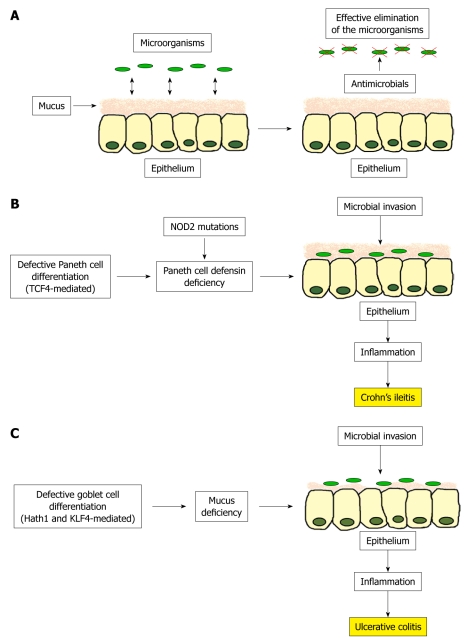
The pathogenesis of both entities of inflammatory bowel disease (IBD), namely Crohn's disease (CD) and ulcerative colitis (UC), is still complex and under investigation. The importance of the microbial flora in developing IBD is beyond debate. In the last few years, the focus has changed from adaptive towards innate immunity. Crohn's ileitis is associated with a deficiency of the antimicrobial shield, as shown by a reduced expression and secretion of the Paneth cell defensin HD5 and HD6, which is related to a Paneth cell differentiation defect mediated by a diminished expression of the Wnt transcription factor TCF4. In UC, the protective mucus layer, acting as a physical and chemical barrier between the gut epithelium and the luminal microbes, is thinner and in part denuded as compared to controls. This could be caused by a missing induction of the goblet cell differentiation factors Hath1 and KLF4 leading to immature goblet cells. This defective Paneth and goblet cell differentiation in Crohn's ileitis and UC may enable the luminal microbes to invade the mucosa and trigger the inflammation. The exact molecular mechanisms behind ileal CD and also UC must be further clarified, but these observations could give rise to new therapeutic strategies based on a stimulation of the protective innate immune system.
Keywords: Cell differentiation; Goblet cells; Hath1; Inflammatory bowel disease; KLF4; Paneth cells; TCF4.
Figures
References
-
- Ouellette AJ. Defensin-mediated innate immunity in the small intestine. Best Pract Res Clin Gastroenterol. 2004;18:405–419. - PubMed
-
- Barker N, van Es JH, Kuipers J, Kujala P, van den Born M, Cozijnsen M, Haegebarth A, Korving J, Begthel H, Peters PJ, et al. Identification of stem cells in small intestine and colon by marker gene Lgr5. Nature. 2007;449:1003–1007. - PubMed
Publication types
MeSH terms
Substances
LinkOut - more resources
Full Text Sources
Other Literature Sources
Medical
